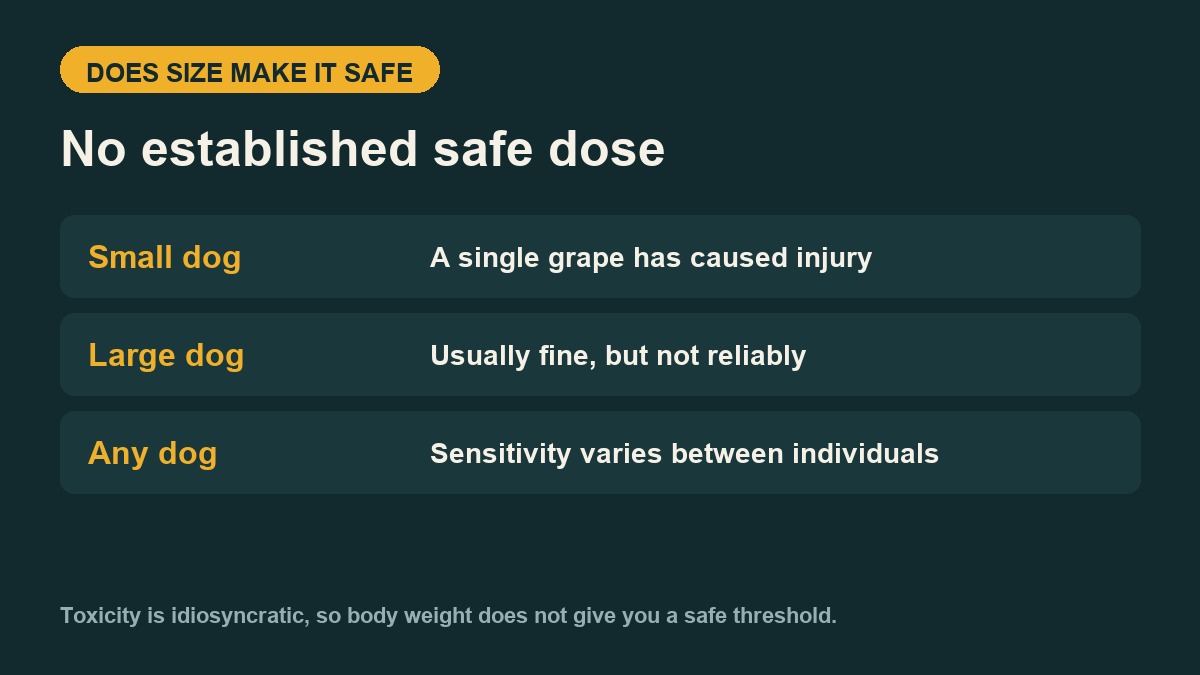
The short answer: phone your vet. One grape is unlikely to harm a large dog and has been enough to injure a small one, and there is no way to tell in advance which kind of dog yours is. Grape toxicity is idiosyncratic, which means it does not scale neatly with body weight the way most poisons do. If it happened in the last couple of hours, a vet can still empty the stomach, and that is the cheapest and most effective thing available. In the US, Pet Poison Helpline is on (855) 764-7661 and the ASPCA Animal Poison Control Center on (888) 426-4435. In the UK, Animal PoisonLine is on 01202 509000.
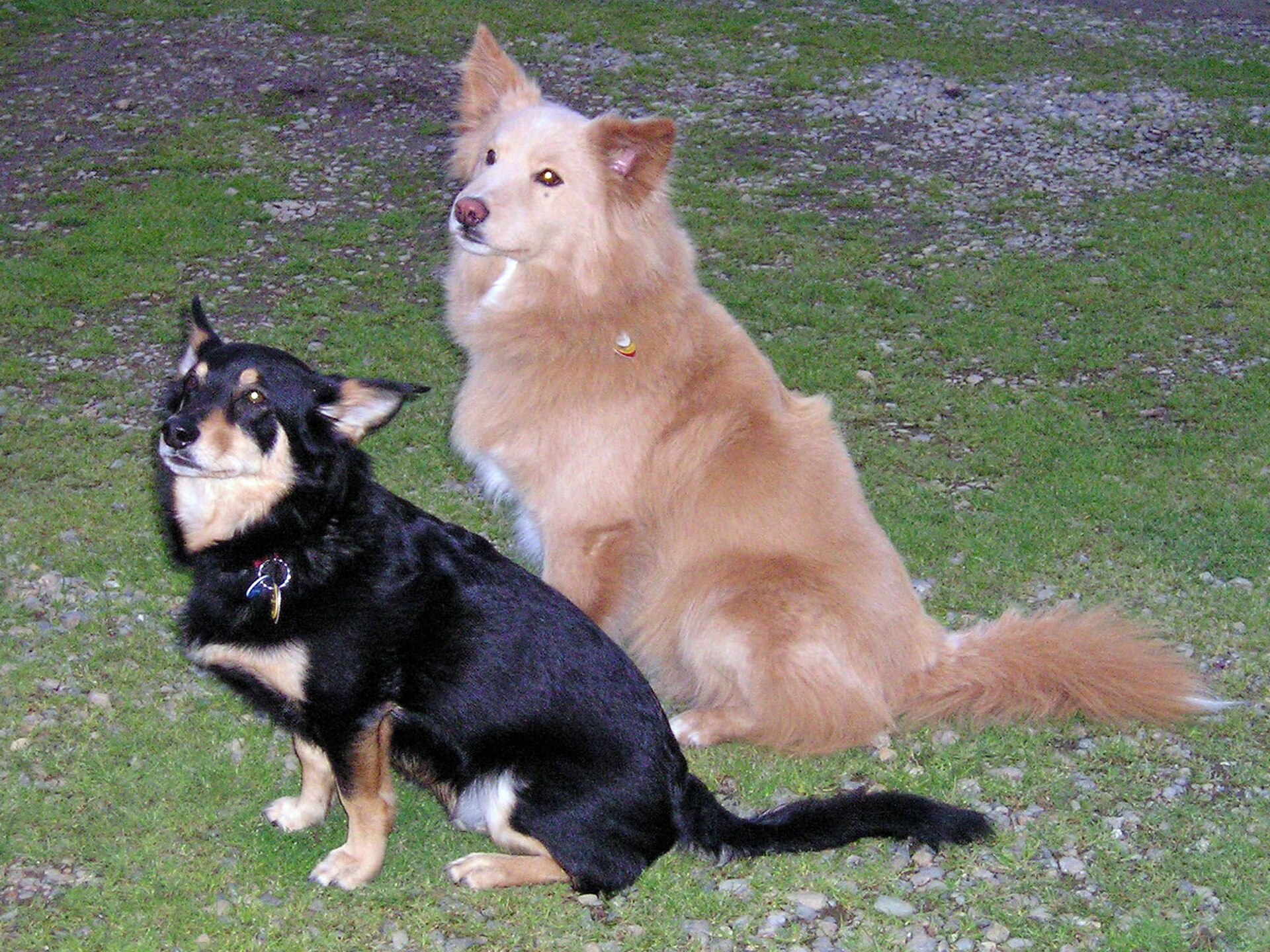
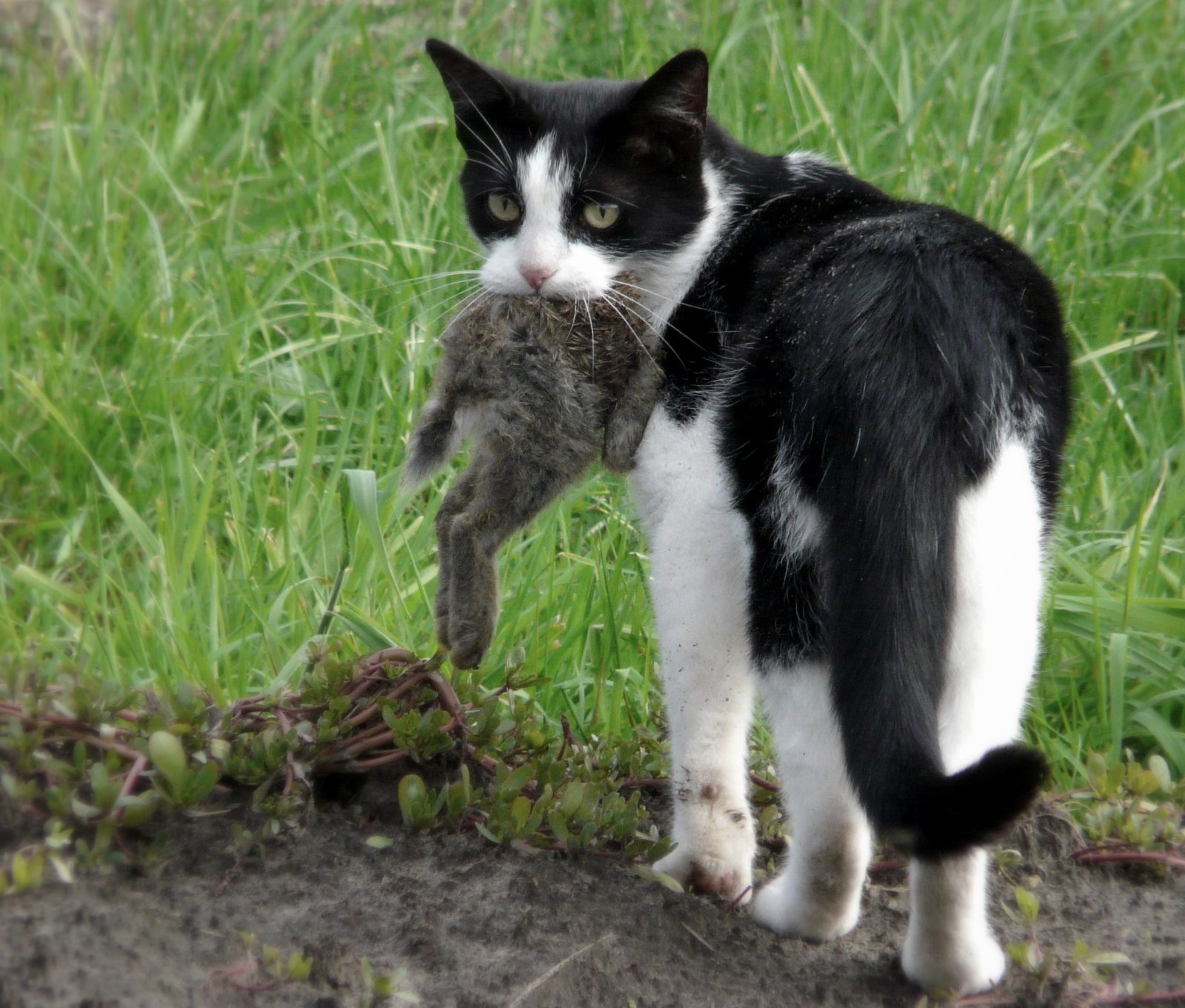
The question is almost never “is this poisonous”. It is “my dog already ate one, and now what”. (Photo: Unknown / Openverse, CC0)
Why nobody will give you a safe number
The honest reason this question has no clean answer is that the dose response is unreliable. Some dogs eat a handful of grapes and are completely fine. Others develop acute kidney injury after a single one. Published case reports include dogs poisoned at doses that other dogs tolerate without a problem.
The toxic principle is now generally thought to be tartaric acid and its salt potassium bitartrate, which grapes contain in amounts that vary by variety, ripeness and growing conditions. That variability is part of why two dogs eating “one grape” are not necessarily eating the same dose.
So the answer to “will one grape hurt a 50 pound dog” is: probably not, and nobody can promise it. That is not evasion. It is the actual state of the evidence.
Body weight is the first thing owners reach for, and it is the thing that helps least here. (Luve Ur Pet)
What to do, in order
Phone a vet or a poison line now. In the United States, Pet Poison Helpline is on (855) 764-7661 and the ASPCA Animal Poison Control Center is on (888) 426-4435, both 24 hours. Both charge a consultation fee.
Say how long ago. Inside roughly two hours, decontamination is realistic. After that the window narrows.
Do not make your dog vomit at home unless you are told to. Hydrogen peroxide dosing goes wrong easily and can cause its own damage.
Count what is missing. If the bag is open, estimate how many are gone. A guess beats nothing.
Keep the packaging if it was a product, because raisins, sultanas and currants are the dried form and gram for gram they carry far more.
What the first three days look like
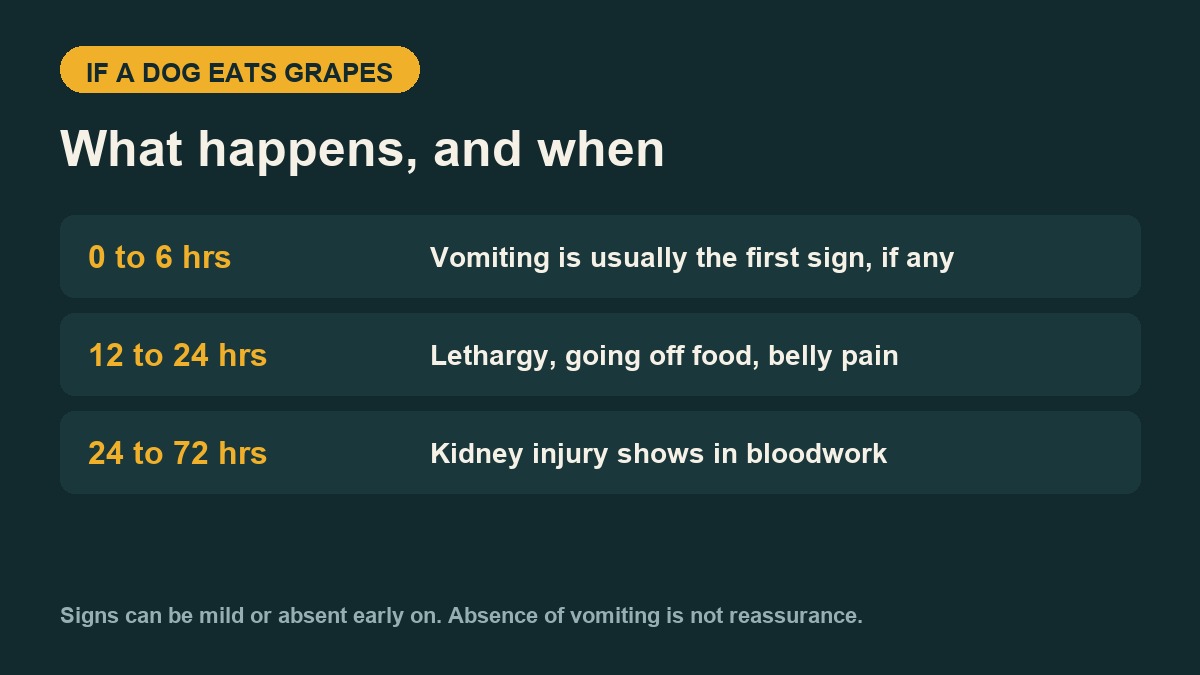
Vomiting, if it happens, usually comes first, in the first few hours. Then lethargy, going off food, and abdominal discomfort. Kidney injury shows up in bloodwork across roughly one to three days, and by the time an owner can see it in the dog’s behaviour, it is well established.
The useful window is early, and it closes before the obvious signs appear. (Luve Ur Pet)
This is why vets will often recommend bringing the dog in even when it seems completely well. Bloodwork at 24 and 48 hours, with fluids in between, is a far better position than waiting to see.
Raisins are not the same as grapes
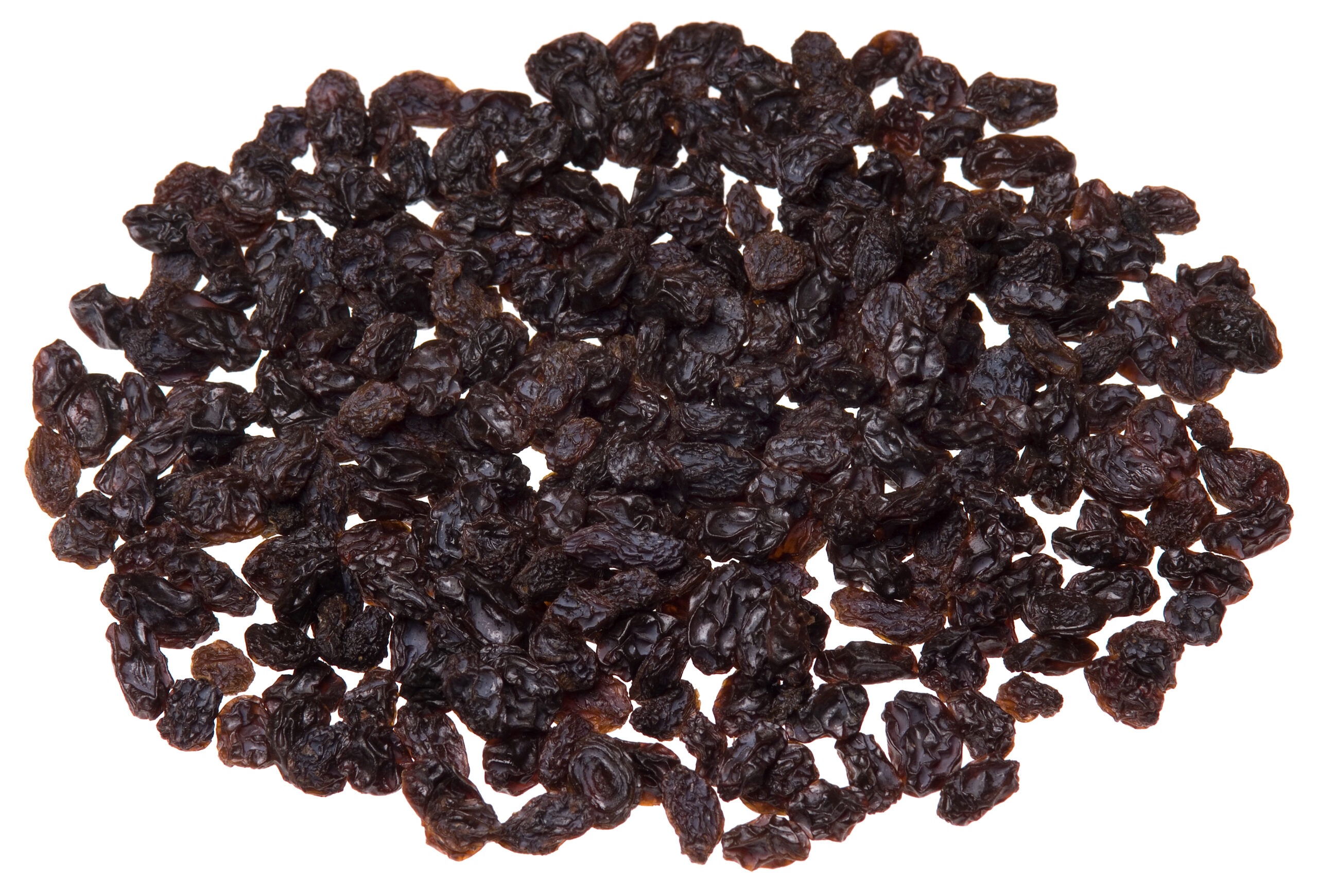
Raisins, sultanas and currants are dried, so the problem compound is concentrated. A small handful of raisins in a flapjack or a scone is a meaningfully larger exposure than the same visual quantity of fresh grapes.
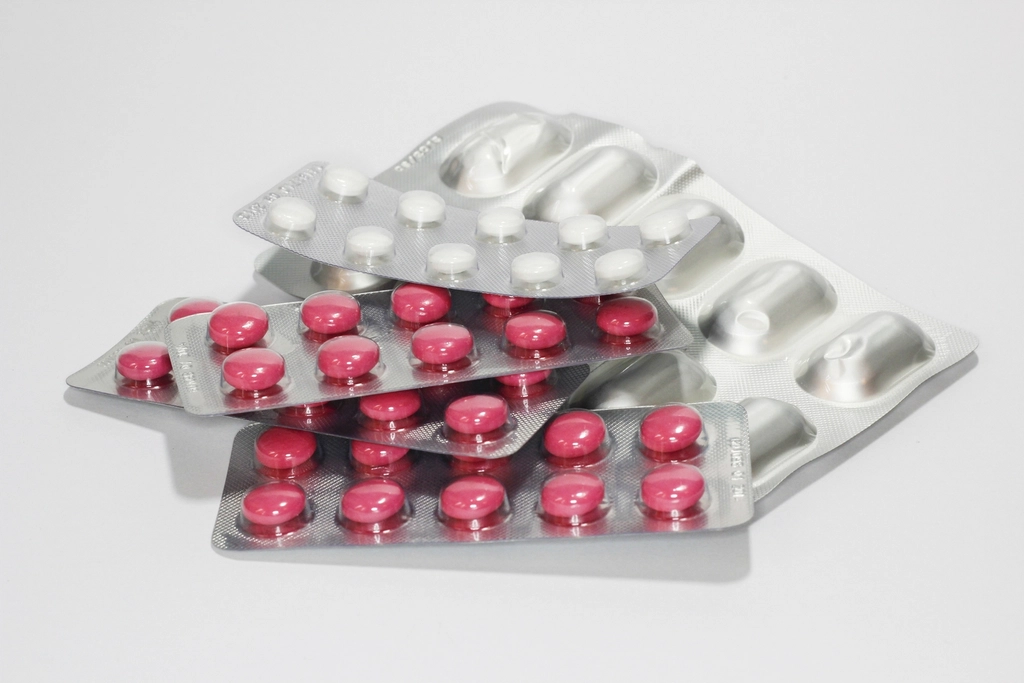
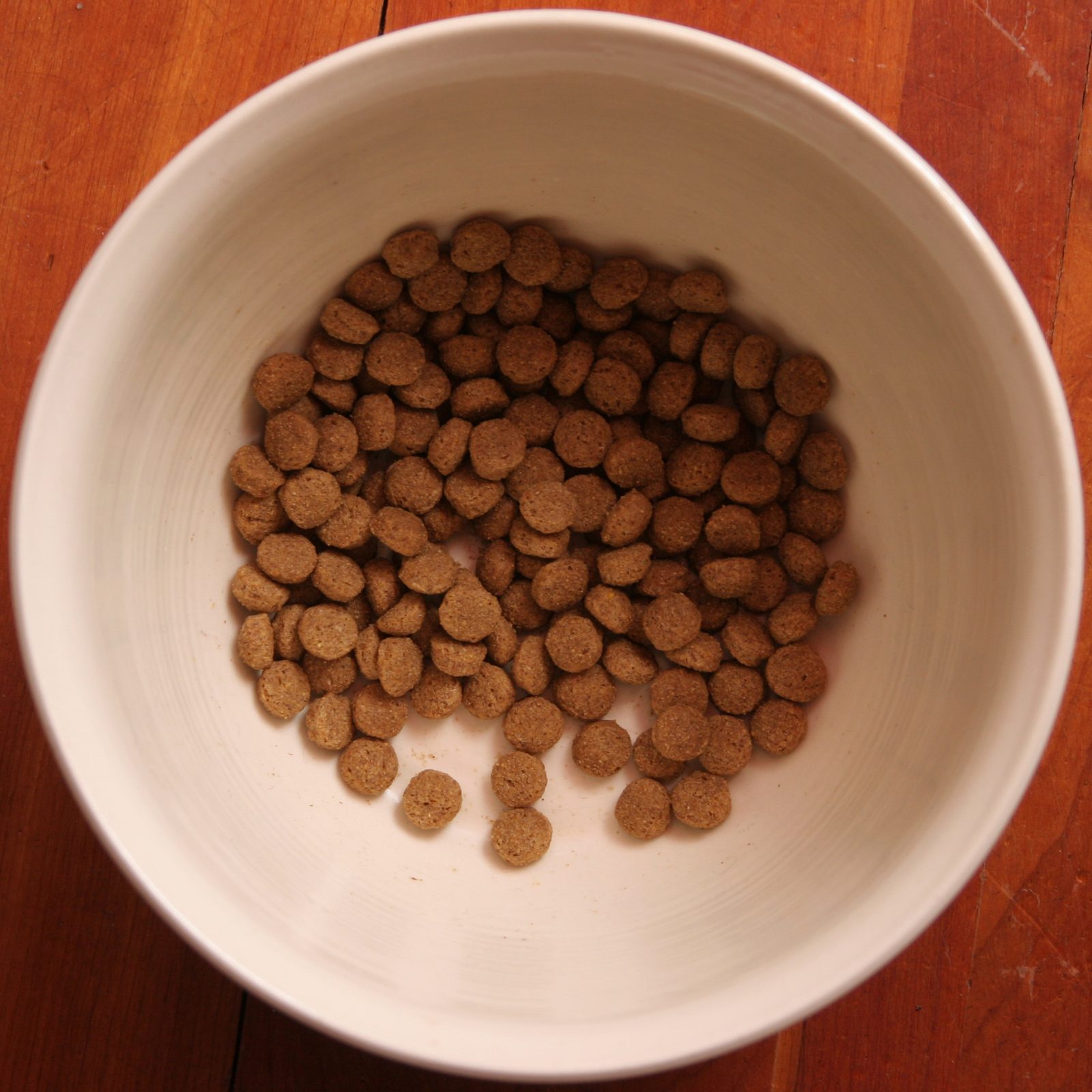
Dried means concentrated. The same number of raisins is a bigger exposure than the same number of grapes. (Photo: Evan-Amos / Openverse, CC0)
Worth remembering that raisins arrive in things people do not think of as fruit: cereal bars, fruit loaves, mince pies, trail mix, and chocolate coated snacks.
Where it usually happens
Not often from deliberate feeding. The common routes are duller:
A fruit bowl on a low table
A dropped grape in the kitchen that nobody noticed
A child sharing lunch under the table
A grazing dog at a picnic or a party
Food waste in an accessible bin
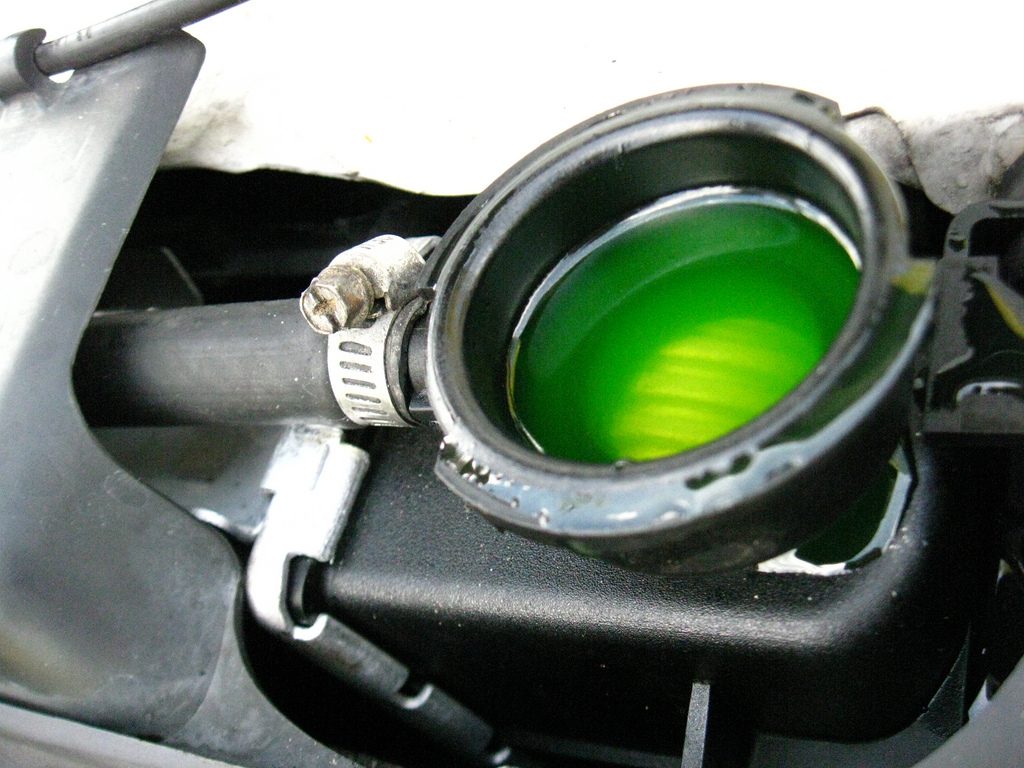
A fruit bowl at the wrong height is the single most common route. (Photo: Direct Media / Openverse, CC0)
Frequently asked questions
Will one grape hurt a large dog?
Usually not, but there is no established safe dose and sensitivity varies between individual dogs. Large body weight lowers the risk, it does not remove it. Phone a vet rather than deciding on weight alone.
My dog ate one grape and threw it up. Is that enough?
It helps, but it is not proof the stomach is empty. Tell the vet that it happened, when, and what came up, and follow their advice on whether to come in.
How long after eating a grape would a dog show symptoms?
Vomiting, if it occurs, is usually within the first few hours. Lethargy and loss of appetite follow in the first day. Kidney changes appear in bloodwork across roughly 24 to 72 hours.
My dog ate one grape two days ago and seems fine. Should I worry?
A dog that is genuinely well at 72 hours has most likely got away with it, but a vet can confirm that with a single blood test, which is worth it for peace of mind if the dog is small or if more than one grape is unaccounted for.
Is one raisin worse than one grape?
Yes. Raisins are dried grapes, so the toxic compound is concentrated. Treat any raisin exposure more seriously than the same number of fresh grapes.
Are grapes toxic to cats too?
Grape toxicity is best documented in dogs, with some reports in cats and ferrets. Do not feed grapes or raisins to any pet, and phone a vet if a cat has eaten one.
The one thing to take away
The question people ask is “how much is too much”. The question that actually helps is “how long ago”. Early decontamination is cheap, simple and effective, and it stops being an option quickly. Phone before you weigh up the odds.
This article is general information and is not a substitute for veterinary advice. If your dog has eaten grapes or raisins, contact a vet or a poison control line now.
The short answer: phone a vet or a poison line now, and take the packaging with you. There is no home treatment for rat poison, and the single most useful thing you can tell a vet is the active ingredient, because the four common types do completely different things and only one of them has a simple antidote. Do not wait to see whether your dog looks unwell. With the most common type, looking fine for three to five days is exactly what it does. In the US, Pet Poison Helpline is on (855) 764-7661 and the ASPCA Animal Poison Control Center on (888) 426-4435. In the UK, Animal PoisonLine is on 01202 509000.
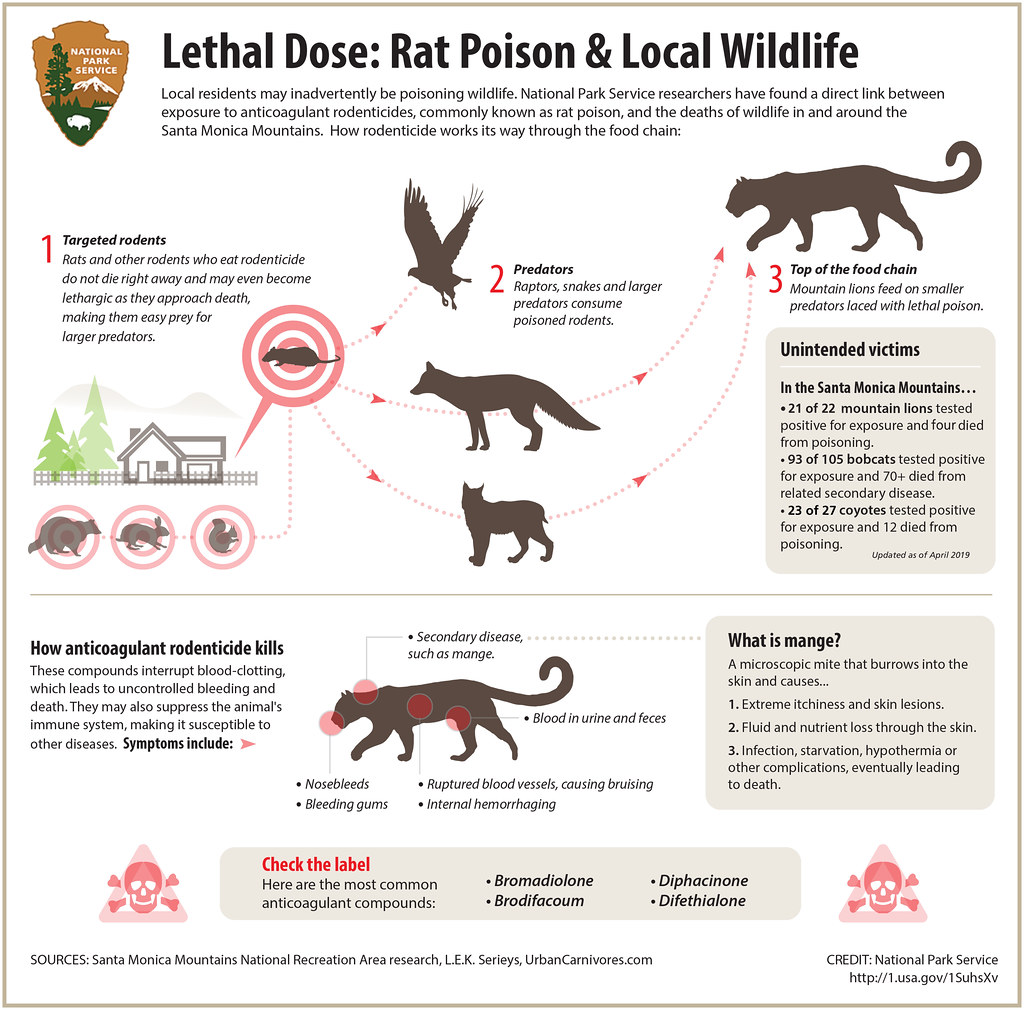
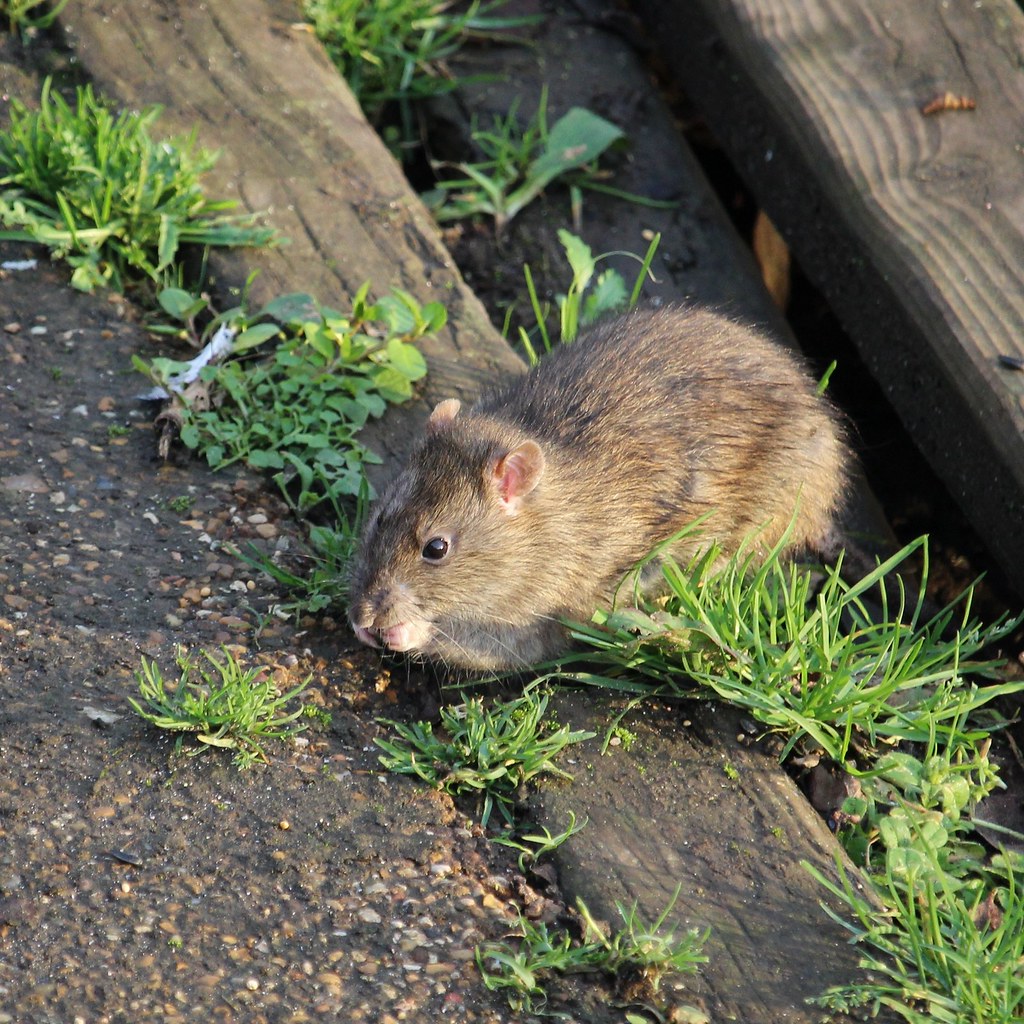
Anticoagulant rodenticide does not stop at the rat. It moves up the food chain into predators and pets. (Photo: Santa Monica Mountains National Recreation Area / Openverse, PDM)
Why “he seems fine” means nothing here
Most pet owners judge a poisoning by how the animal looks. With rodenticide that instinct is actively dangerous, because the most widely sold type is designed to work slowly.
Anticoagulant baits block the recycling of vitamin K, which the body needs to make clotting factors. The clotting factors already in circulation keep working for a few days. Only when they run out does the bleeding start, and the Merck Veterinary Manual puts that at roughly three to five days after eating it.
So a dog that ate bait this morning and is bouncing around this evening tells you nothing at all. By the time the signs appear, the treatment window has mostly closed.
The four types, and why the packet matters more than the symptoms
“Rat poison” is not one substance. These are the four you are likely to meet, and they are not interchangeable.
The most common. Causes internal bleeding after a delay of three to five days. Signs include pale gums, weakness, bruising, nosebleeds, blood in urine or faeces, coughing, and breathlessness as blood collects in the chest.
This is the one with an antidote. Vitamin K1, on prescription, often for four weeks with second generation products, and a clotting test afterwards to confirm it worked. Treated early, the outlook is good.
2. Bromethalin
A neurotoxin. It causes fluid to build up in the brain. Signs can appear within hours to a couple of days: wobbliness, tremors, seizures, paralysis.
There is no antidote. Vitamin K does nothing here, which is why guessing is dangerous. Treatment is supportive and the margin between a harmless amount and a fatal one is narrow.
3. Cholecalciferol (vitamin D3)
Raises calcium and phosphorus to the point that the kidneys fail and soft tissue starts to mineralise. Signs appear around twelve to thirty six hours in: increased drinking and urinating, vomiting, weakness.
No simple antidote, and treatment is intensive, prolonged and expensive. The toxic dose is very small.
4. Zinc or aluminium phosphide
Releases phosphine gas when it meets stomach acid. The gas is the danger, and it can affect people too: vomit and stomach contents can release it, which is why a poisoned animal should be kept in a well ventilated space and never shut in a car on the way to the surgery.
The bait is meant for this. Dogs find it because it is designed to be attractive and is usually placed at ground level. (Photo: Wildlife Terry / Openverse, CC0)
What to do, in order
Phone a vet or a poison line immediately. In the United States, Pet Poison Helpline is on (855) 764-7661 and the ASPCA Animal Poison Control Center is on (888) 426-4435, both 24 hours. Both charge a fee. Pay it.
Find the packaging. Photograph the active ingredient and the EPA registration number if there is one. If the box is gone, photograph the bait itself: colour and block shape narrow it down.
Say when. Time of exposure decides whether the vet can still empty the stomach. A rough guess is far better than nothing.
Do not induce vomiting unless you are told to. It is the wrong move with some products, and with phosphides it releases gas.
Do not give vitamin K from a health food shop. It is the wrong form, the wrong dose, and it will not treat anticoagulant poisoning. It may also mask the problem while the bleeding continues.
Where dogs actually find it
Rarely a chewed box on a kitchen counter. Much more often:
A bait station in a shed, garage or under decking, placed at exactly nose height for a dog
Bait put down by a neighbour, a landlord or a pest control visit nobody mentioned
A poisoned rodent eaten in the garden, which is called relay poisoning and carries a smaller dose but is still worth a phone call
Bait that a rat has carried off and cached somewhere else entirely, which is how bait ends up under a hedge fifty feet from where it was laid
Sheds, garages and under decking are where bait usually sits, and where a dog usually finds it. (Photo: karenblakeman / Openverse, CC0)
Cats, and why the picture is different
Cats are poisoned less often by eating bait directly, because they are fussier, and more often by relay poisoning from hunting. The same four types apply and the same rule holds: identify the product, phone, do not wait for signs.
How to cut the risk at home
If you use bait at all, use lockable tamper resistant stations, and record where every one is
Ask neighbours and any pest controller what they are using, and keep a photo of the label
Check under decking, in garages and behind sheds when you move into a property, because old bait stays lethal
Consider traps rather than bait where there are pets or children
Vitamin K1 on prescription is the antidote for one type only, and it is not the vitamin K sold in health shops. (Photo: Unknown / Openverse, CC0)
Frequently asked questions
How long after eating rat poison will a dog show symptoms?
It depends entirely on the type. Anticoagulants take three to five days. Bromethalin can show within hours to two days. Cholecalciferol takes roughly twelve to thirty six hours. Phosphides can act within hours. This is why the product matters more than watching the animal.
Is there a home treatment for rat poison in dogs?
No. There is no safe home treatment. Vitamin K bought over the counter is not the antidote, inducing vomiting can make things worse with some products, and milk, bread or activated charcoal from a cupboard are not treatment. The delay caused by trying is the real harm.
My dog ate rat poison but seems fine. Do I still need a vet?
Yes. With the most common type, seeming fine for several days is the expected course, not reassurance. The treatment window is widest before any signs appear.
Can a dog be poisoned by eating a poisoned rat?
Yes, that is called relay or secondary poisoning. The dose is usually lower than eating bait directly, but it is still worth a phone call, particularly for repeated hunting or for a small dog.
How much rat poison is dangerous to a dog?
There is no single figure, because it depends on the active ingredient, its concentration and the dog’s weight. Second generation anticoagulants and cholecalciferol are both dangerous in very small amounts. Treat any quantity as worth a phone call rather than trying to judge it yourself.
Do cats get rat poisoning too?
Yes, more often through eating poisoned rodents than through eating bait. The same rules apply.
If you even suspect it, phone. The cost of being wrong the other way is much higher. (Photo: T100Timlen / Openverse, CC0)
The one thing to take away
Treat suspicion as confirmation, and take the packet with you. The type of rodenticide decides whether there is an antidote, how long you have, and what the vet does first. It is the one piece of information that changes the outcome, and it is the one most owners leave at home.
This article is general information and is not a substitute for veterinary advice. If you suspect your pet has eaten rodenticide, contact a vet or a poison control line now.
Sources: Merck Veterinary Manual, rodenticide toxicosis; Pet Poison Helpline; ASPCA Animal Poison Control Center.
Search for the most aggressive dog breeds and you will find list after list, all confident, most of them naming the same half dozen dogs. Search for the best family breed and you get the same thing in reverse.
The largest study ever done on dog behaviour looked at this directly, and the answer it came back with is awkward for every one of those lists: breed tells you far less about an individual dog than people assume.
The Labrador has topped popularity lists for decades. That tells you what people buy, not how any particular Labrador will behave. (Photo: IDS.photos from Tiverton, UK / Wikimedia Commons, CC BY-SA 2.0)
What the biggest study actually found
In 2022 a team published a paper in Science called “Ancestry inclusive dog genomics challenges popular breed stereotypes”. They surveyed the owners of 18,385 dogs, purebred and mixed, and genotyped 2,155 of them.
The headline number: breed accounts for roughly 9% of the behavioural variation between individual dogs.
Nine percent. Which means that if you line up a hundred dogs and ask why one is bolder, calmer or more easily startled than another, breed explains about a tenth of the answer. Everything else is the individual animal, how it was raised, what happened to it, and chance.
Worth being precise, because a lot of the coverage of this paper overstated it. The study did not find that genetics is irrelevant. Most of the behavioural traits it measured were meaningfully heritable, with heritability above 25%. Genes matter. What the study undercuts is the breed label as a shortcut for predicting an individual dog.
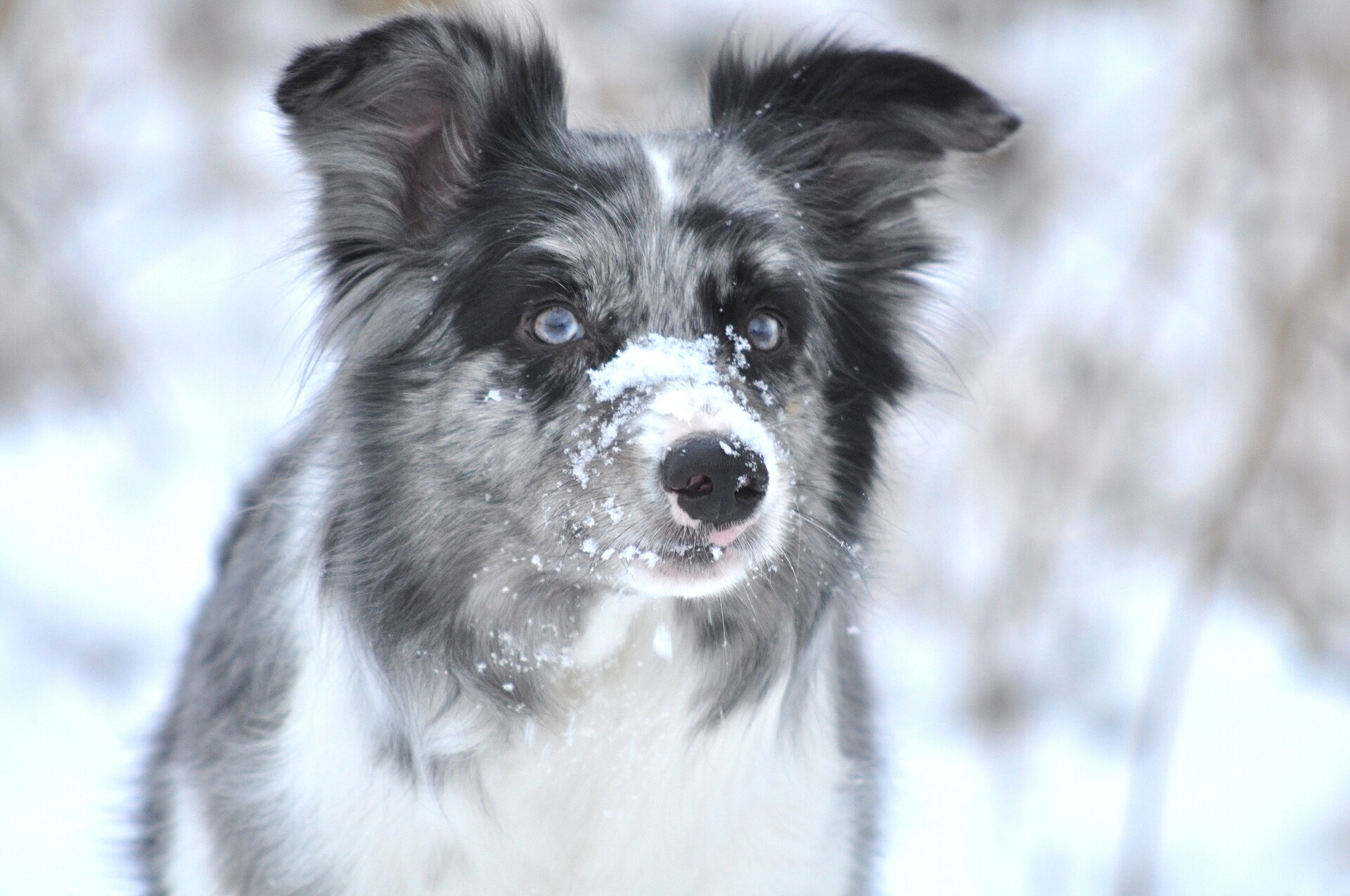
Mixed breed dogs are what made the finding possible. If a behaviour really tracked a breed, it should follow that breed’s ancestry into mixes. Mostly it did not. (Photo: Borteddd / Wikimedia Commons, CC BY-SA 4.0)
The part that matters for the aggression lists
The researchers broke behaviour into separate factors rather than treating it as one lump, and breed predicted some far better than others.
Biddability, meaning how readily a dog responds to human direction, was one of the better ones. Knowing a dog’s breed ancestry does make that somewhat more predictable, which will surprise nobody who has met a Border Collie.
And then there is agonistic threshold: how easily a dog is provoked, by a stranger, a noise, a sudden approach. This is the trait sitting underneath every aggressive breeds list ever written.
For that trait, breed was nearly uninformative.
That is the finding worth sitting with. The single behaviour those lists exist to predict is the one breed predicted worst.
Biddability is one of the traits breed does help predict. A working line Border Collie really is more likely to want a job. (Photo: Iceblueblue / Wikimedia Commons, CC BY-SA 4.0)
Why breeds look so different but behave so similarly
It seems contradictory. A Chihuahua and a Great Dane could not look less alike, so why would their behaviour not differ just as sharply?
The authors’ answer is about timing. The behaviours we think of as doglike, the herding, the retrieving, the guarding, came from thousands of years of selection that happened before modern breeds existed. Breeds as we know them are mostly a Victorian invention, a couple of hundred years old, and what they were selected for hardest was appearance.
So we spent two centuries breeding dogs to look distinctive and comparatively little time breeding them to behave distinctively. The visible differences are dramatic and recent. The behavioural ones are older, shared, and spread across all of them.
Two centuries of selecting hard for appearance produced this. Behaviour was never shaped anything like as sharply. (Photo: Mary Bloom, American Kennel Club / Wikimedia Commons, CC0)
What this does not mean
This is where it would be easy to overcorrect, so three things the study does not say.
It does not say all dogs are the same. Dogs differ enormously. It says breed is a weak guide to which dog is which.
It does not say size and strength do not matter. Breed predicts physical capability very well indeed, and that is not a behavioural question. A frightened Chihuahua and a frightened mastiff may be equally likely to bite. They are not equally capable of causing harm, and anyone choosing a dog should think honestly about that.
It does not say breed is useless. Coat type, exercise need, grooming, likely size, common health problems, these are all far more predictable from breed than temperament is. If you want to know whether a dog will need two hours of exercise a day or shed on everything you own, breed is genuinely informative.
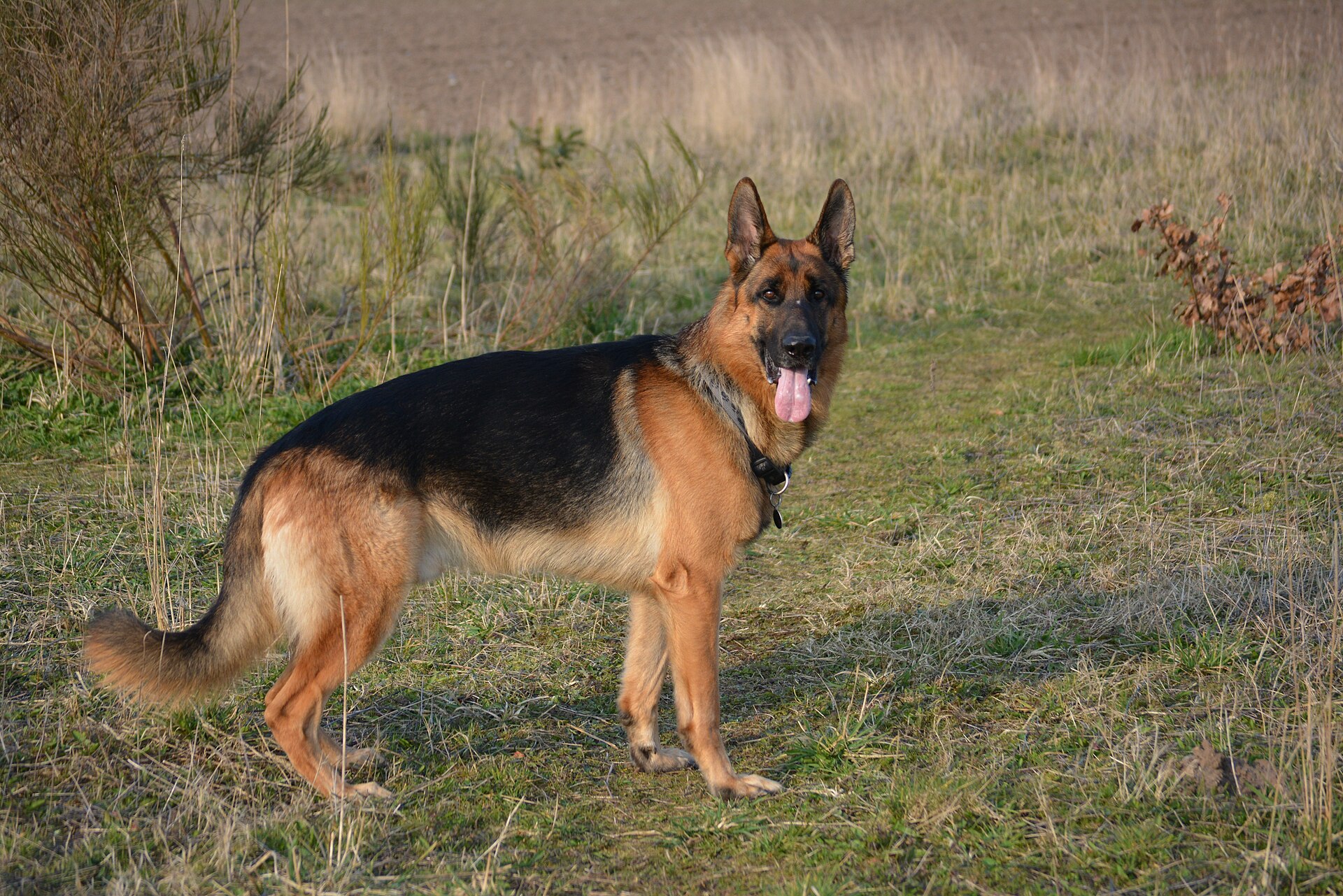
Breeds that appear on aggression lists are often simply big, common and strong, which is a different thing from being easily provoked. (Photo: Hans Kemperman / Wikimedia Commons, CC0)
So how should you actually choose a dog?
Use breed for the things it predicts well, and meet the individual for the things it does not.
Use breed to predict the practical stuff. Adult size, coat and grooming, exercise needs, and the health problems that run in that line. Ask a breeder directly what the line is screened for.
Meet the actual dog, more than once if you can. For temperament, ten minutes with the animal in front of you beats any amount of reading about its breed.
Ask about the parents and the early weeks. Early socialisation between roughly three and sixteen weeks shapes an enormous amount, and it is already happening before you collect a puppy.
Be honest about strength, not just temperament. Match the dog’s physical capability to who lives in your house and who will be holding the lead.
Do not rule out a mixed breed on predictability grounds. The study’s whole point is that purebred does not buy you nearly as much behavioural certainty as the price tag implies.
Littermates from the same mixed litter can differ as much from each other as from any purebred. Individual variation is the rule, not the exception. (Photo: Elf / Wikimedia Commons, CC BY-SA 4.0)
A note on the limits of this research
It would be inconsistent to use one study to knock down the breed lists and then treat that study as beyond question, so here are its weaknesses.
The behavioural data came from owner surveys, not from researchers observing dogs directly. Owners are not neutral about their own dogs, and someone who bought a breed because of its reputation may unconsciously report behaviour that fits. The genotyped sample, 2,155 dogs, is large for this kind of work but small against the world’s dog population. And 9% is an average across the whole dataset, which means some traits and some breeds sit above it.
None of that overturns the finding. It does mean the honest summary is “breed is a much weaker predictor than the lists claim”, not “breed means nothing”.
Even within one litter, by one father and one mother, individuals diverge. That is the variation breed averages cannot capture. (Photo: Sagaciousphil / Wikimedia Commons, CC BY-SA 3.0)
Frequently asked questions
Which dog breed is the most aggressive?
The research does not support naming one. In the largest study of dog behaviour to date, agonistic threshold, the trait that captures how easily a dog is provoked, was the behaviour breed predicted worst of all. Breeds that appear on these lists tend to be common, large and strong, which affects how much damage a bite does rather than how likely a bite is.
So does breed matter at all?
Yes, for different things than people expect. Breed predicts adult size, coat, grooming, exercise needs and inherited health problems well. It predicts temperament poorly. Use it for the first list and meet the individual dog for the second.
Are mixed breed dogs less predictable than purebreds?
Less than you would think. Since breed explains only around 9% of behavioural variation between individuals, the certainty a pedigree appears to offer about temperament is mostly illusory. Mixes are less predictable in appearance and adult size.
What is the best dog breed for a family?
There is no breed answer to that, which is why every list disagrees. The useful questions are practical: how much exercise can you genuinely commit to, how much grooming and shedding will you tolerate, how big a dog can everyone in the house physically manage, and what does this particular dog seem like when you meet it.
If breed is a weak predictor, why do Border Collies all seem to herd?
Because some traits do track breed better than others. Biddability, how readily a dog takes direction from a person, was one of the better predicted traits in the study. It is the easily provoked end of behaviour where breed stops being informative.
The honest summary
Breed is a good guide to what a dog will look like, how big it will get, how much it will shed and what it might need treating for. It is a poor guide to who that dog will be.
The most aggressive breeds lists are built on the one trait the evidence says breed predicts worst. Read them accordingly, and judge the dog in front of you instead.
This article is general information and is not a substitute for veterinary or professional behavioural advice. If your dog is showing aggression, speak to your vet, who can rule out pain and refer you to a qualified behaviourist.
Source: Morrill K. and colleagues, “Ancestry inclusive dog genomics challenges popular breed stereotypes”, Science, 2022, volume 376, article eabk0639.
You are stroking your cat and your hand stops on a lump. It is firm, about the size of a grape, and when you part the fur there is a small hole in the middle of it. Something moves.
Your first instinct will be to squeeze. Every botfly removal video on the internet ends with someone squeezing. Please do not, and this article is mostly about why, because that single decision is what separates a minor vet visit from a genuine emergency.
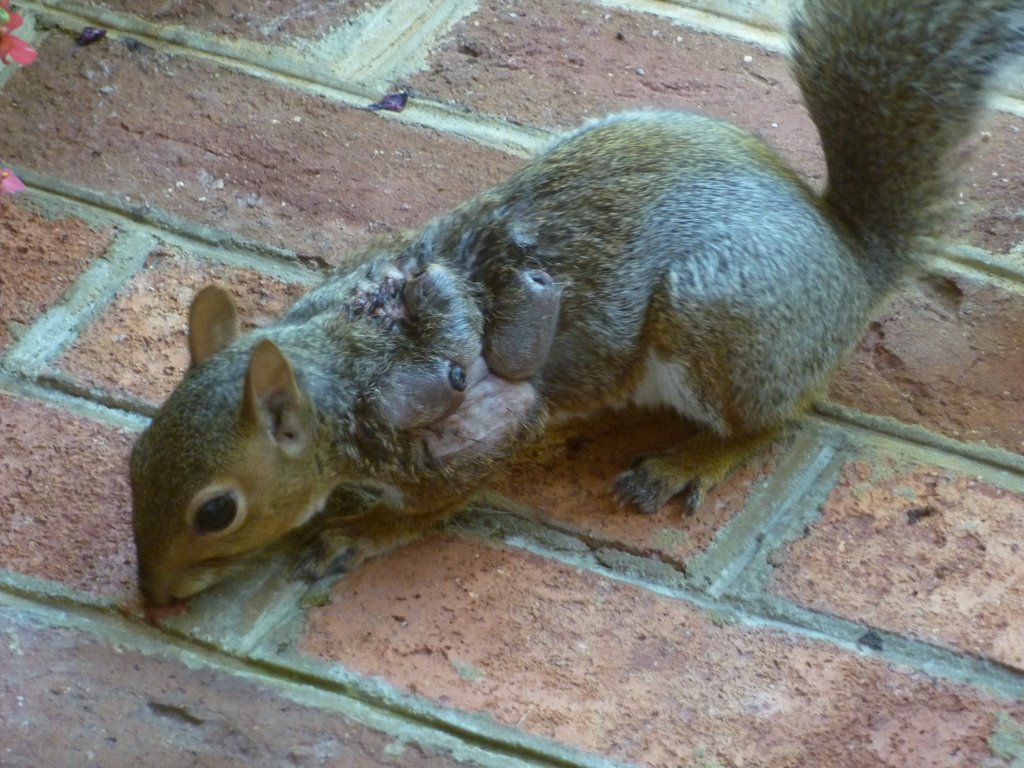
A grey squirrel carrying botfly warbles. Rodents and rabbits are what this parasite is built for, and they usually cope with it. Dogs and cats are not part of the plan. (Photo: Martin Bennett / Wikimedia Commons, Public domain)
What a botfly actually is
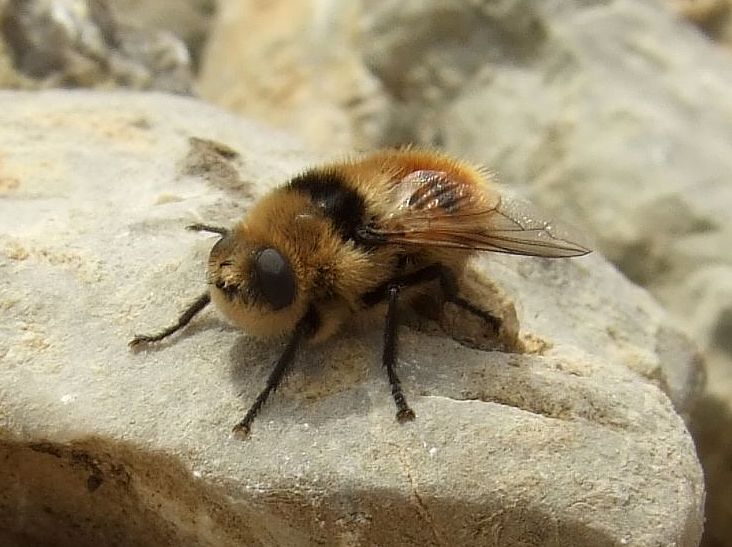
In North America the botfly that turns up on pets is Cuterebra. The adult is a thick, furry fly that looks more like a bumblebee than a housefly, and it does not bite, feed or sting. It has no mouthparts worth speaking of. The adult’s only job is to mate and lay eggs.
Those eggs go near the burrows and runways of rabbits and rodents, on stones, on stems, along the paths those animals use every day. The eggs then sit and wait. They hatch in response to the warmth of a body passing close by.
That is the whole mechanism, and it explains everything else. The fly is not hunting your pet. It is waiting for a cottontail.
An adult botfly, in this case a deer botfly from the same family. Note how little it resembles a housefly. Adults have no functional mouthparts and cannot bite. (Photo: Karsten Heinrich / Wikimedia Commons, CC BY 3.0)
The myth: it did not burrow through your pet’s skin
This is the detail almost every article gets wrong, and getting it right changes how you prevent it.
The larva does not land on your dog and drill inward. According to the Merck Veterinary Manual, larvae enter mainly through the mouth or the nostrils while the animal is grooming or sniffing, and less commonly through an existing open wound. Intact skin is not the doorway.
So the lump on your cat’s neck did not start on your cat’s neck. It started at the nose or the mouth, and the larva then travelled through the body before settling under the skin to finish growing.
Which tells you where the risk really is: a pet with their face down a burrow. Cats that hunt, and dogs that push their nose into holes in a hedge bank, are the ones that get this.
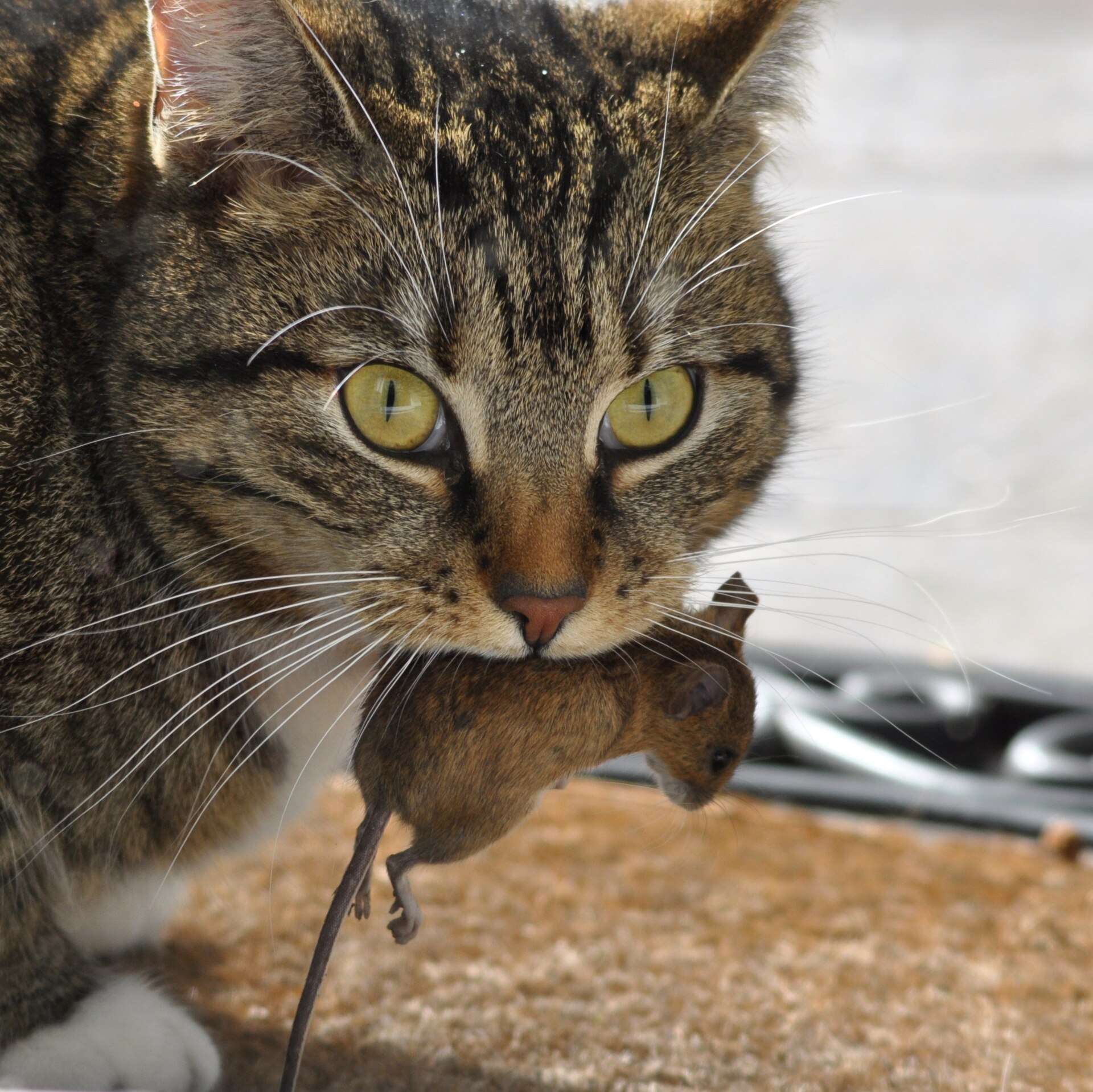
The behaviour that creates the risk. Merck notes that free roaming cats are far more likely than indoor cats to pick up a larva, and hunting is why. (Photo: Stiopa / Wikimedia Commons, CC BY-SA 4.0)
What it looks like on a dog or cat
The textbook lesion is a soft, well defined swelling under the skin, roughly one centimetre across, with a small breathing hole in the centre. That hole is not damage. The larva made it deliberately so it can breathe, and it sits with its rear end against the opening.
In practice, here is the order most owners notice things:
Matted, damp fur over one spot, because the animal has been grooming or licking it obsessively. On cats this is very often the first sign, before anyone finds a lump.
A lump that feels soft rather than solid.
A central hole, sometimes oozing, sometimes with something visibly moving in it.
Late summer and early autumn. This is a seasonal problem and it clusters there.
Lesions sit mostly around the head, neck and trunk. Pain varies, and when it hurts that is usually a secondary bacterial infection rather than the larva itself.
Worth knowing: the most common thing this gets mistaken for is an abscess or a foreign body, which is reasonable, because that is exactly what it looks like. If your vet finds a larva in it, the diagnosis is settled on the spot.
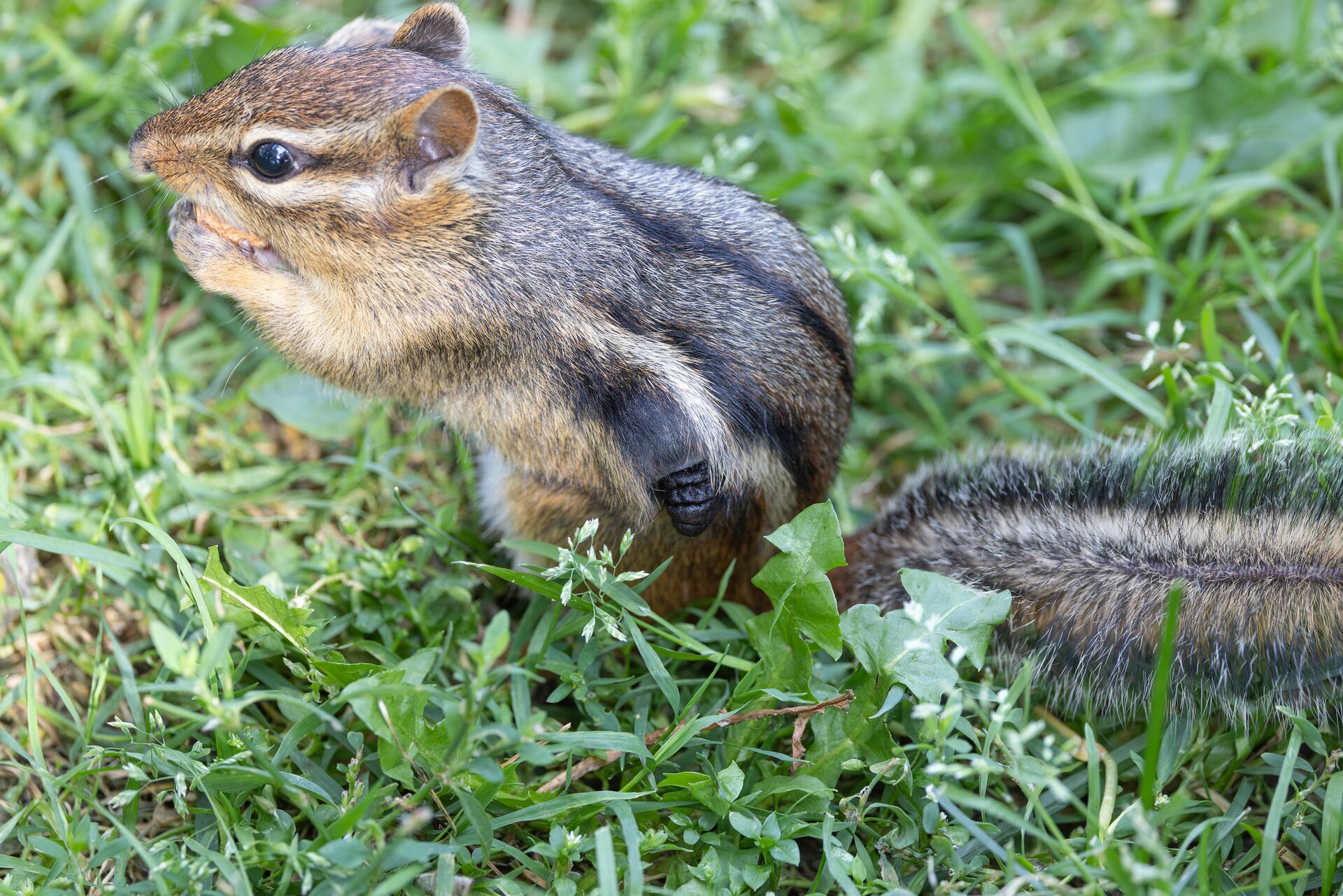
A mature larva backing out of an eastern chipmunk on its own schedule. The dark, segmented, spiny body is what a vet is trying to lift out whole. (Photo: Laura Erickson / Wikimedia Commons, CC BY 4.0)
Why you must not squeeze it
Here is the part that matters.
A mature Cuterebra larva is a fat, stiff, barrel shaped thing covered in rows of dark spines. It is not a maggot you can flick out. It is firmly anchored in a pocket under the skin, and it is wider than the hole it breathes through.
Squeeze it and one of two things happens. Either it holds, and you achieve nothing but pain. Or it ruptures.
Rupturing it is the problem:
Chronic foreign body reaction. Merck is explicit that squeezing can rupture the larva and cause a chronic foreign body reaction and secondary infection. Spines and fragments left in the tissue keep the wound angry for months.
Recurrent abscesses. If a lump keeps coming back at a spot that was treated before, that points at larval remnants still in there.
Anaphylaxis. There are reports of a ruptured larva triggering a severe allergic reaction. Merck describes these as anecdotal rather than common, so this is not a likely outcome, but it is a dangerous one and the risk is entirely avoidable.
Also, do not try to smother it. Vets do use petroleum jelly over the breathing pore, but only for ten to fifteen minutes immediately before grasping the larva with instruments, as a way to bring it within reach. Covering the hole and walking away kills the larva in place, which leaves you with exactly the decomposing foreign body you were trying to avoid.
And do not cut it out at home. The opening has to be enlarged carefully around a parasite you cannot see the shape of.
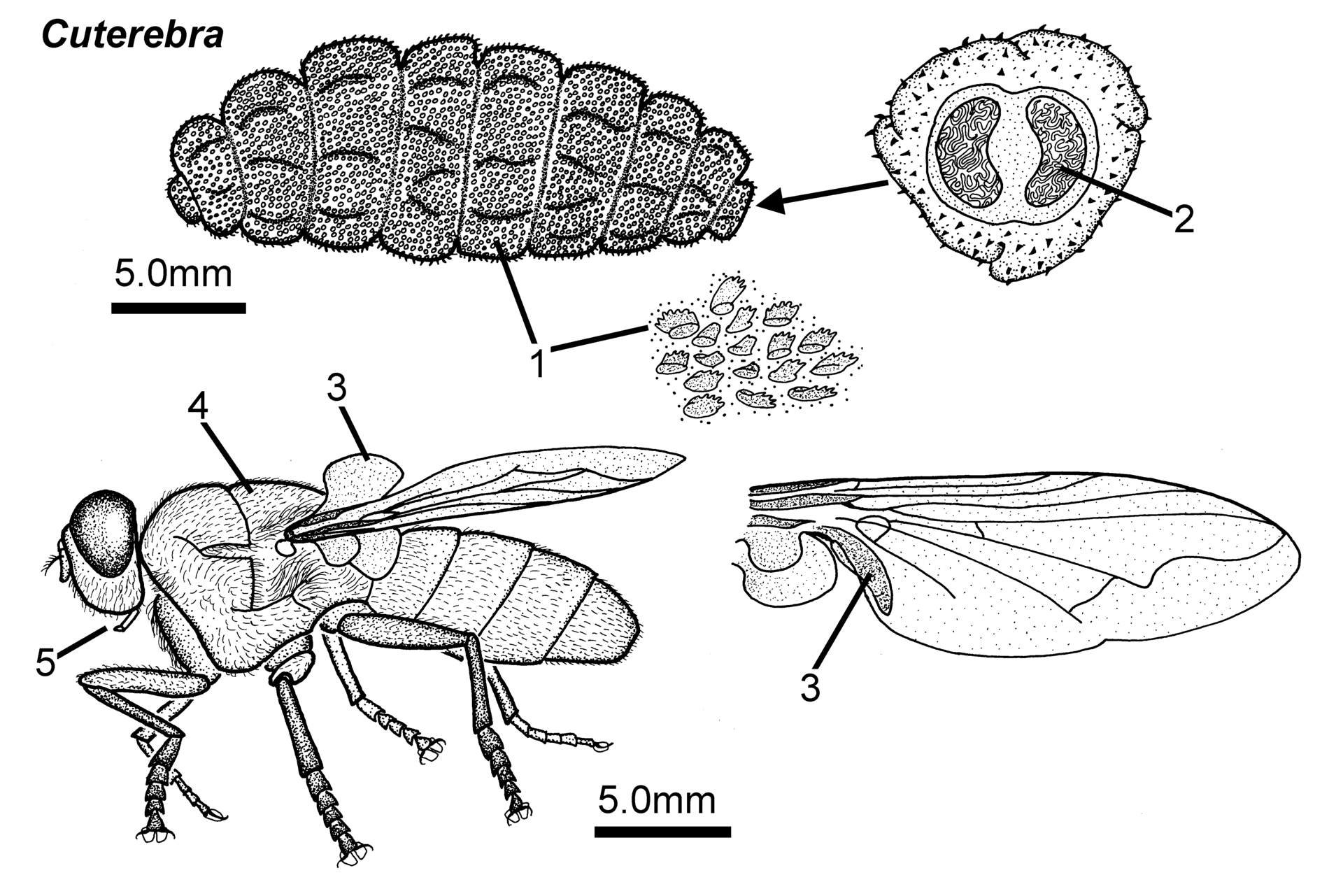
A Cuterebra larva, left, with the adult fly below. The scale bars are five millimetres each, which gives a sense of why a mature larva will not come out of a small hole intact. (Illustration: Acarologiste / Wikimedia Commons, CC BY-SA 4.0)
What the vet actually does
It is a quick procedure and it is not dramatic.
The breathing pore is carefully enlarged so the larva can come out without being compressed.
If the larva retreats deeper, which it does, petroleum jelly over the pore for ten to fifteen minutes brings it back up within reach.
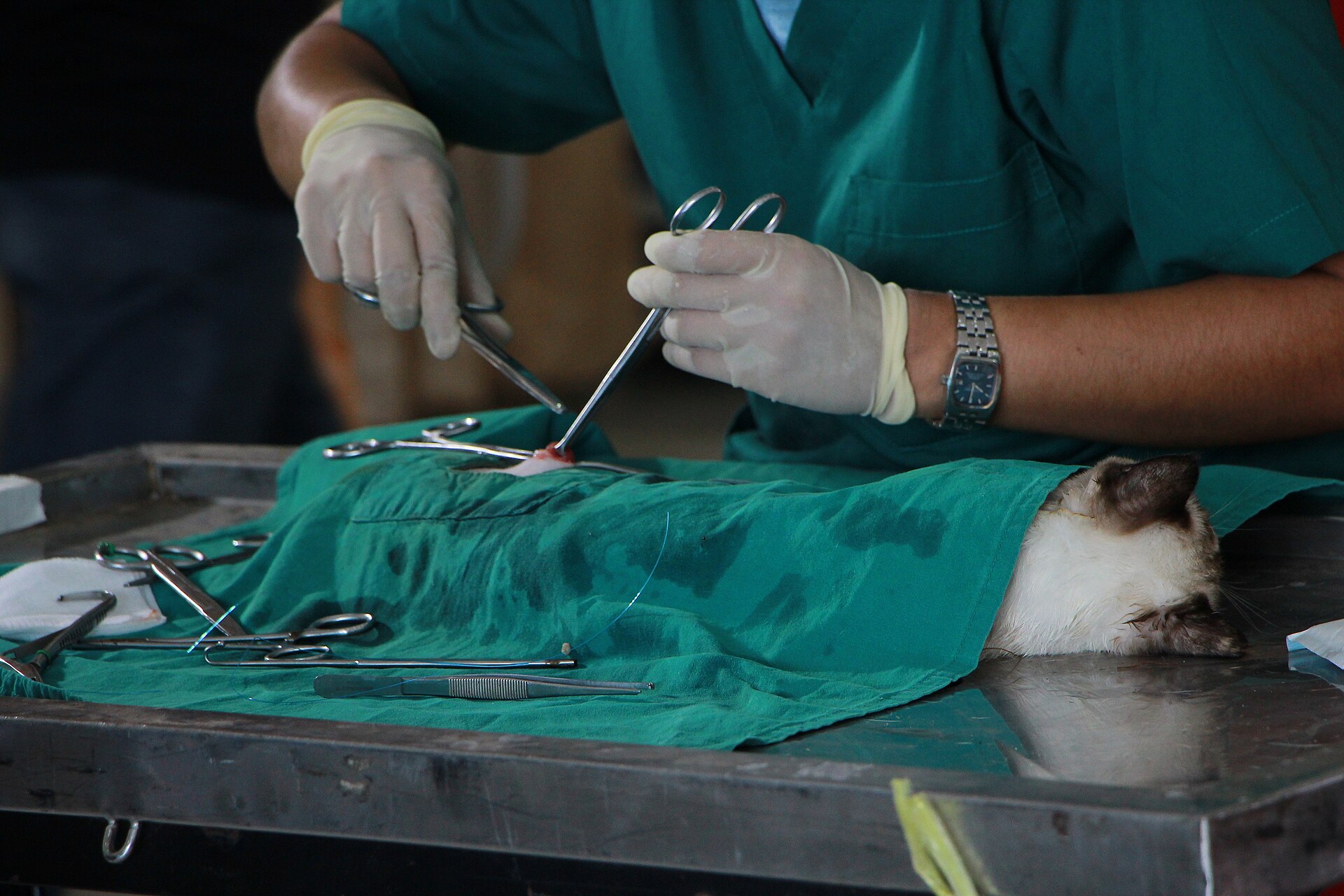
It is grasped with mosquito forceps and lifted out in one piece. Whole is the whole point.
The cavity is flushed with sterile saline and any dead tissue trimmed away.
The wound is left to heal from the inside out, which can take weeks to months, so do not expect it to close over in days.
Sedation is often used, mostly so the animal stays still rather than because it is agonising. Antibiotics get added when the site is already infected, which is common, because that breathing hole is an open door for bacteria.
Removal is a minor procedure done properly, with the opening enlarged and the larva lifted out intact. The aim is one piece, not speed. (Photo: rawpixel.com / Wikimedia Commons, CC0)
The rare version that is genuinely serious
Dogs, cats and ferrets are all accidental hosts, which means the larva has no reliable map inside them. Usually it ends up under the skin and that is the end of it. Occasionally it goes somewhere it should not.
Aberrant migration is documented into the nasal passages, the pharynx, the eyelids and the brain. The signs depend entirely on where it went:
Airway. Sneezing, upper respiratory signs, and in the worst case difficulty breathing. A larva in the upper airway is an emergency.
Brain. Depression, lethargy, seizures, blindness, odd mentation, a temperature that is too high or too low.
There is a history that vets specifically ask about in cats with sudden neurological signs: an episode of violent sneezing weeks to months earlier. That is the larva going up the nose. Central nervous system cases cluster between July and September.
Veterinary pathologists and neurologists at Cornell were the first to propose that feline ischemic encephalopathy, a stroke like brain condition in cats, is caused by this migration. The evidence is case series and pathology reviews rather than a controlled study, and the link is considered likely rather than proven, so treat it as a strong suspicion. The supporting pattern is hard to ignore though: where Cuterebra species do not live, the condition is not reported, and the seasons line up.
One breed note. Merck flags Yorkshire Terriers as possibly at increased risk, and able to mount a severe whole body inflammatory response.
None of this is common. The point is simply that “it is only a lump” is the wrong frame if your pet also has neurological or breathing signs.
When to get to a vet urgently
Any difficulty breathing, or noisy, laboured breathing
Seizures, collapse, circling, sudden blindness or disorientation
Sudden unexplained lethargy in a cat that was outdoors in late summer
A lump that bursts, bleeds heavily or spreads redness and heat across the surrounding skin
Anything that follows an attempt to squeeze it out at home
The intended host. Eggs are laid along rabbit and rodent runways, which is why prevention is mostly about keeping your pet’s nose out of burrows. (Photo: lwolfartist / Wikimedia Commons, CC BY 2.0)
Prevention, such as it is
There is no vaccine and no monthly preventive marketed for this, so prevention is behavioural.
Cut unsupervised outdoor time in late summer and early autumn, which is when infestation peaks.
Know where the burrows are. If there are rabbit or rodent holes in your garden or on your usual walk, that is the hazard. Blocking access to them does more than anything else.
Check your pet over after they have been out, the same habit that catches ticks early. Run your hands over the head, neck and body, and pay attention to any patch of fur that is suddenly damp or matted.
Indoor cats essentially do not get this. Free roaming cats are the ones at risk, and botflies are only one item on a long list of reasons outdoor access costs cats years. We compare the two directly in how long do cats live, indoor versus outdoor.
Obsessive licking at one spot has a long list of possible causes, and most of them are not parasites. We go through them in why is my dog scratching so much.
If what you are looking at is a wound full of small, soft, pale maggots rather than a single large larva in a neat hole, that is a different problem with different urgency, and it is covered in our guide to screwworm in dogs and cats.
Frequently asked questions
Can I pull a botfly out of my dog myself with tweezers?
No. A mature larva is wider than the hole it breathes through and it is anchored in a pocket under the skin, so pulling tends to tear it rather than remove it. A ruptured larva can cause a chronic foreign body reaction, recurrent abscesses and, rarely, a severe allergic reaction. The opening needs enlarging first, which is a vet job.
Can my dog catch a botfly from my cat, or can I catch it?
No. There is no animal to animal or animal to human spread. Every infestation comes from a larva picked up in the environment near rabbit or rodent burrows, so two pets in the same household can both get one from the same garden without either giving it to the other.
What happens if I just leave it alone?
The larva will eventually finish developing and leave on its own to pupate in the soil. The reasons not to wait are that the open breathing hole frequently becomes infected, the animal often traumatises the area by over grooming, and you have no way of knowing whether a second larva went somewhere more dangerous.
Is a botfly lump the same as an abscess?
They look very similar, and an abscess or foreign body is the most common misdiagnosis. The distinguishing feature is the small central breathing pore, and the diagnosis is confirmed by actually finding a larva. If a lump at a previously treated site keeps recurring, that can mean larval fragments were left behind.
Do indoor cats get botflies?
Essentially no. The larva has to be picked up outdoors, near the burrows and runways of rabbits and rodents. Free roaming cats are far more likely to be affected than indoor cats.
Does my pet need treatment if the larva has already gone?
Get the site checked. An empty cavity still needs flushing and often needs antibiotics, because the hole has been open to the environment for weeks. Your vet will also want to be sure nothing was left behind.
The honest summary
A lump with a breathing hole in it, on a dog or cat, in late summer, after time spent outdoors, is very likely a Cuterebra larva. It got in through the nose or the mouth, not through the skin.
Do not squeeze it. Do not smother it and leave it. Do not cut it out. All three carry a real risk of rupturing the larva, and a ruptured larva turns a fifteen minute procedure into weeks of recurrent infection, with a small chance of something far worse.
Take your pet to the vet, mention the breathing hole, and mention anything odd in the preceding weeks, especially a fit of violent sneezing. It is a small problem handled properly and a genuinely nasty one handled with your fingers.
This article is general information and is not a substitute for veterinary advice. If your pet is unwell, contact your vet.
Sources: Merck Veterinary Manual, Cuterebra infestation in dogs and cats; MSD Veterinary Manual, Cuterebra infestation in small animals; Glass and colleagues, Cuterebra myiasis of the central nervous system in cats, 1998; Williams, Summers and de Lahunta, cerebrospinal cuterebriasis and its relationship to feline ischemic encephalopathy, Veterinary Pathology, 1998; University of Guelph Animal Health Laboratory, feline cerebral cuterebriasis.
You part your dog’s fur and there it is: a grey or brown lump, legs buried in the skin. The urge is to grab it and pull, or to reach for whatever the internet told you about petroleum jelly. Both instincts can make it worse.
Removing a tick properly takes about thirty seconds and one tool. The part almost nobody gets right is what happens afterwards, because the single most repeated piece of tick advice, that you are safe if you remove it within twenty four hours, is only true for one disease.
Fine tipped tweezers. Grip the tick where it meets the skin, then pull straight up with steady pressure. No twisting. (Photo: Yapparina / Wikimedia Commons, CC0)
How to remove a tick from a dog
This is the method the US Centers for Disease Control and Prevention gives, and it is the same technique vets use.
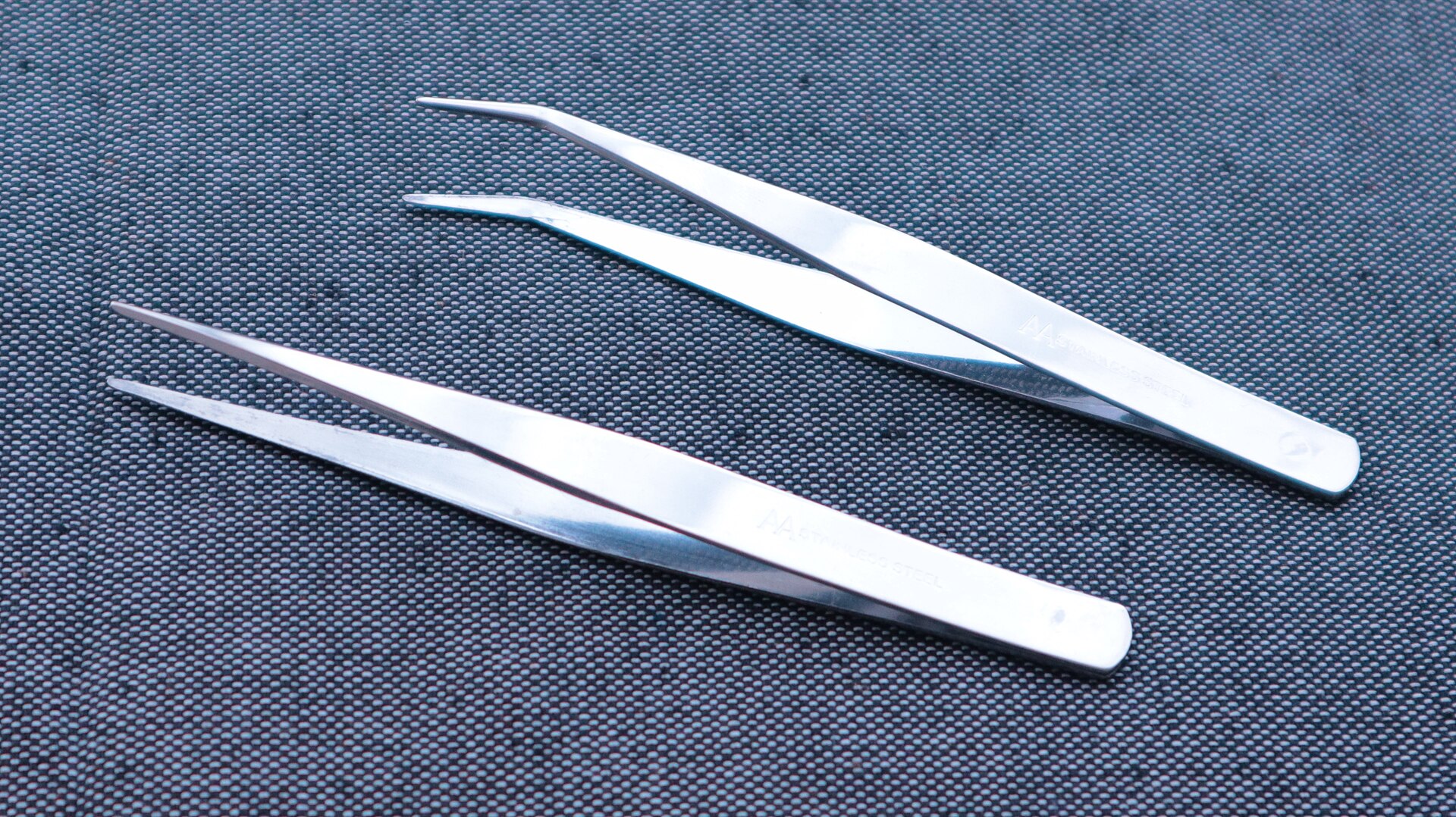
Use fine tipped tweezers. Grasp the tick as close to the skin’s surface as possible, so you are holding its head and not its body. If you have no tweezers, fingers will do, but do not squeeze the body.
Pull straight up with steady, even pressure. Do not twist. Do not jerk. Twisting or jerking is what breaks the mouthparts off in the skin.
Clean the bite and your hands with rubbing alcohol, or soap and water.
Dispose of the tick without crushing it. Never crush a tick between your fingers. Put it in alcohol, seal it in a bag, wrap it in tape, or flush it.
Write down the date. This matters more than people expect. If your dog becomes unwell weeks later, the date of a tick bite is the single most useful thing you can tell your vet.
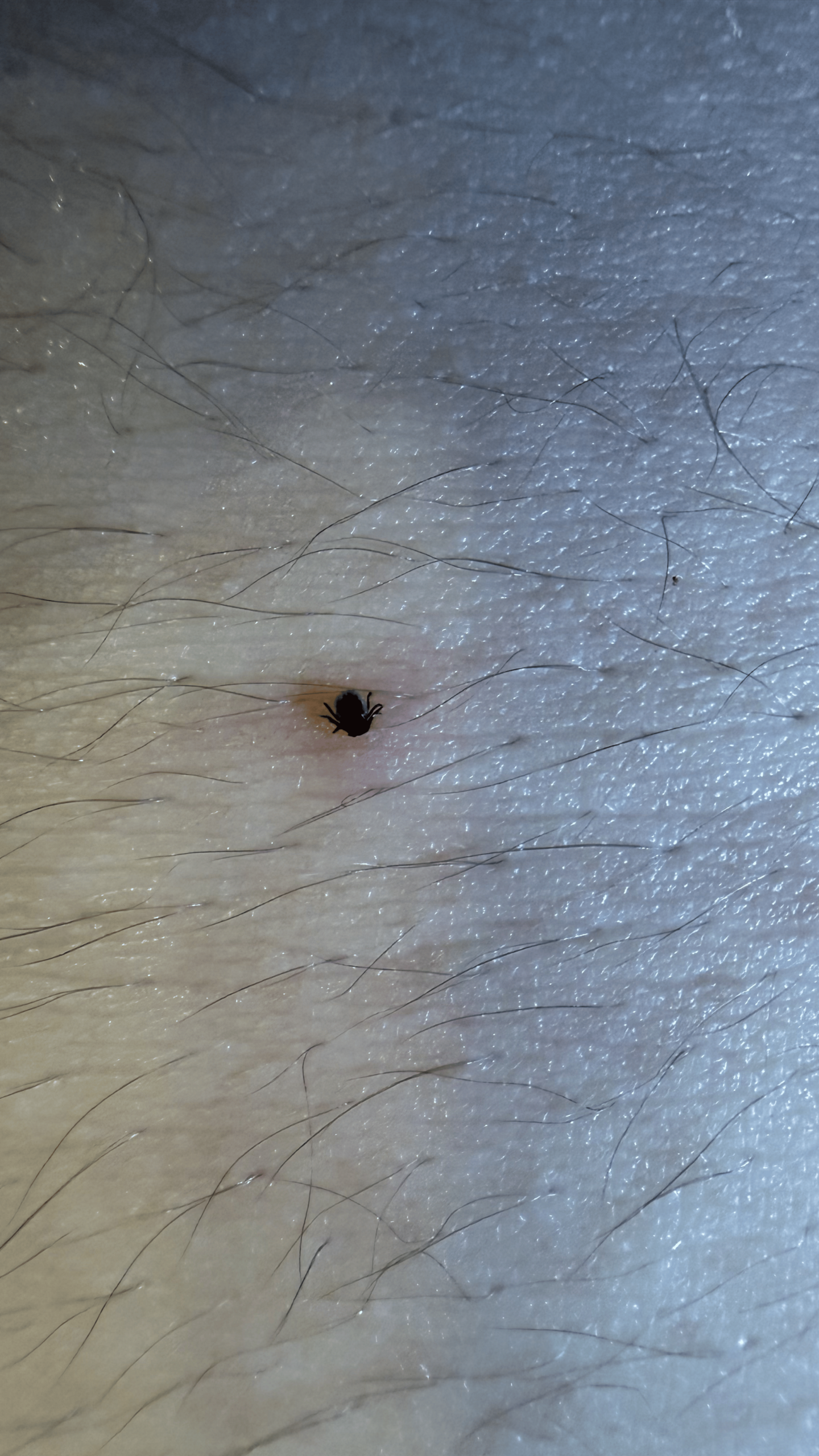
A tick attached and feeding. This is human skin, but attachment looks the same on a dog, and on a thick coat you will often find it by touch. (Photo: Prowler9009 / Wikimedia Commons, CC0)
What not to do, and why it actively increases the risk
The folk remedies all share one idea: irritate the tick until it backs out on its own. The CDC warns specifically against painting the tick with nail polish or petroleum jelly, and against using heat to make it detach.
The reason is not squeamishness. A distressed tick is a dangerous tick. In the CDC’s words, these methods may agitate the tick and force infected fluid from the tick into the skin. You are asking an animal whose gut may contain bacteria to vomit into the bite it has already made.
So, the list of things not to do:
No petroleum jelly, nail polish or soap smothering.
No burning, no matches, no lighters, no hot needles.
No twisting or unscrewing. Ticks do not thread into the skin, so there is nothing to unscrew. Twisting only snaps the mouthparts.
No waiting for it to let go. The CDC is explicit that you remove it promptly rather than waiting for it to detach. Every extra hour matters, for reasons below.
No crushing it with your fingers.
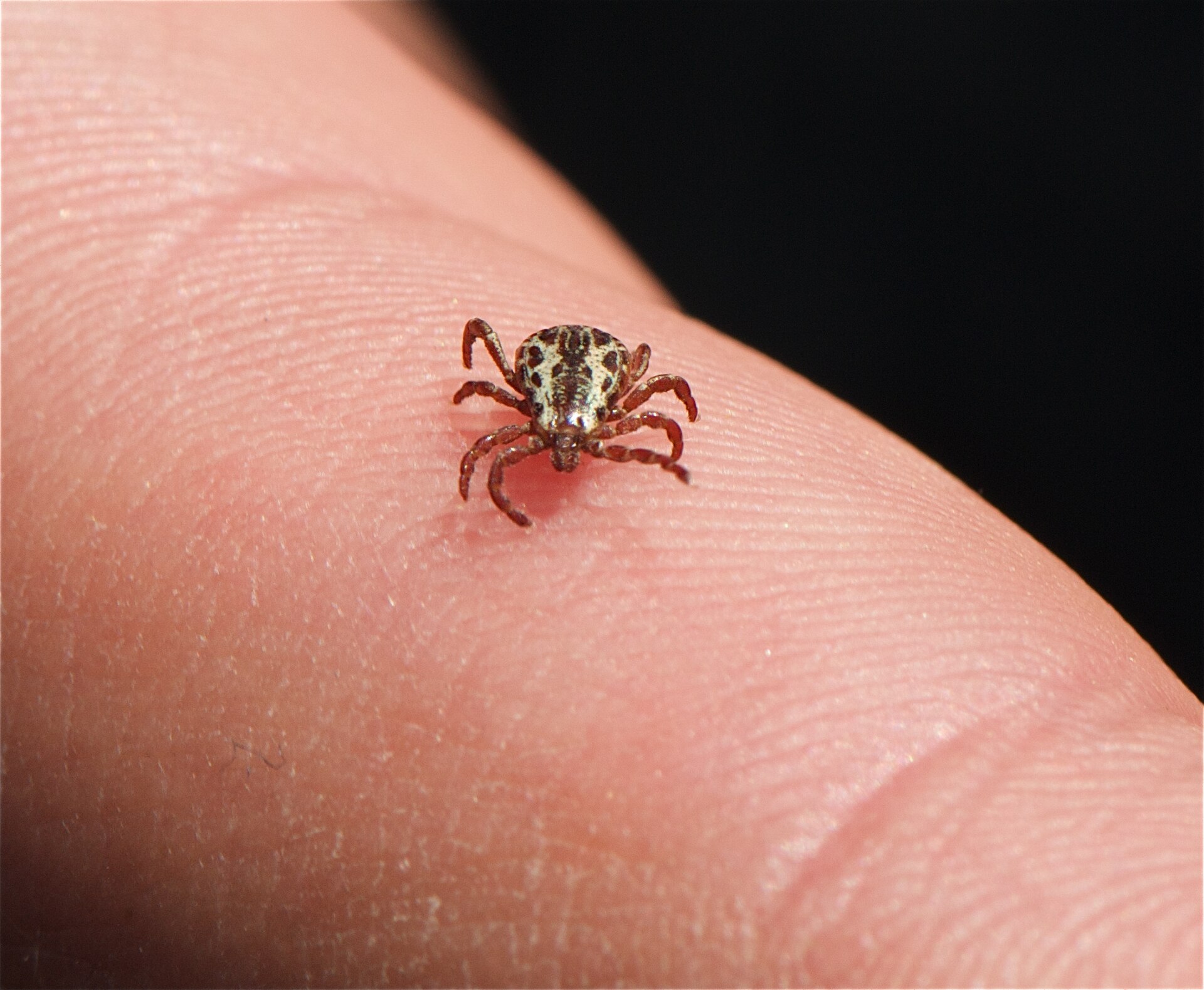
An American dog tick on a fingertip. Scale is the reason ticks get missed: an unfed one is this small, and you will usually feel it before you see it. (Photo: Jerry Kirkhart from Los Osos, Calif. / Wikimedia Commons, CC BY 2.0)
You left the head in. Is that an emergency?
No, and the worry is out of proportion to the risk.
If the mouthparts break off, the CDC’s guidance is to try to remove them with clean tweezers, and then this: if you are unable to remove the mouth easily with clean tweezers, leave it alone and let the skin heal.
Left behind mouthparts cannot transmit disease. There is no tick still feeding, because the tick is gone and what remains is an inert fragment. The body treats it like a splinter and pushes it out. Digging at it with a needle causes far more damage than leaving it, and risks a skin infection that the tick itself was never going to cause.
Watch the spot for a few days. A small bump at a bite site is normal and can persist for a week or two. Spreading redness, heat, swelling or pus is a vet visit, but that is a skin infection from the wound, not tick borne disease.
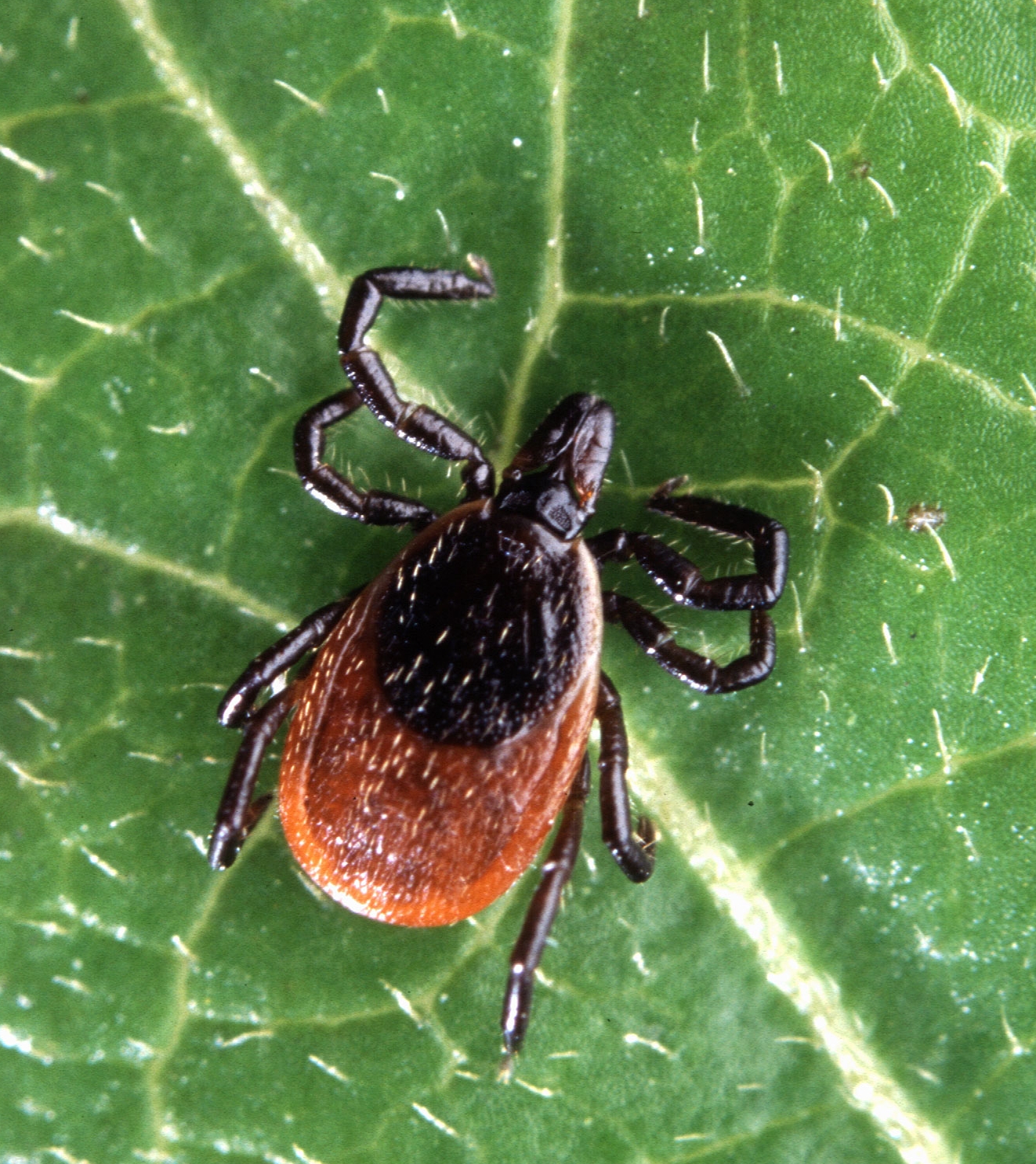
The blacklegged or deer tick, the one that carries Lyme. This is the species the twenty four hour rule was built around. (Photo: Photo by Scott Bauer. / Wikimedia Commons, Public domain)
Why the twenty four hour rule is wrong
This is the part worth reading twice, because it is the opposite of what most articles tell you.
The advice that a tick must be attached for twenty four hours before it can transmit anything comes from Lyme disease, and for Lyme it is broadly right. The Merck Veterinary Manual puts transmission at a minimum of twenty four hours of attachment, usually thirty six to forty eight hours into the blood meal. The risk climbs with time rather than switching on: roughly 10% by forty eight hours from a single infected nymph, around 50% by sixty three to sixty seven hours, 70% by seventy two hours.
Lyme is not the only thing ticks carry, and the others are much faster.
Ehrlichia, which causes ehrlichiosis in dogs, can be transmitted within three to six hours of attachment, according to the Companion Animal Parasite Council.
Rocky Mountain spotted fever is generally thought to transmit five to twenty hours after attachment.
Anaplasma sits somewhere in between, and the research genuinely disagrees, with some experimental transmission reported inside the first twenty four hours.
So “I found it the same day, we are fine” is false comfort. For the fastest of these, a tick attached over a single night has already had time. CAPC’s own wording is that attached ticks should be removed promptly to prevent transmission of any pathogens they may harbor. Promptly means now, not within a day.
This does not mean panic. It means two things. Remove ticks the moment you find them rather than finishing the walk first. And do not use the twenty four hour rule to decide whether a bite was harmless.
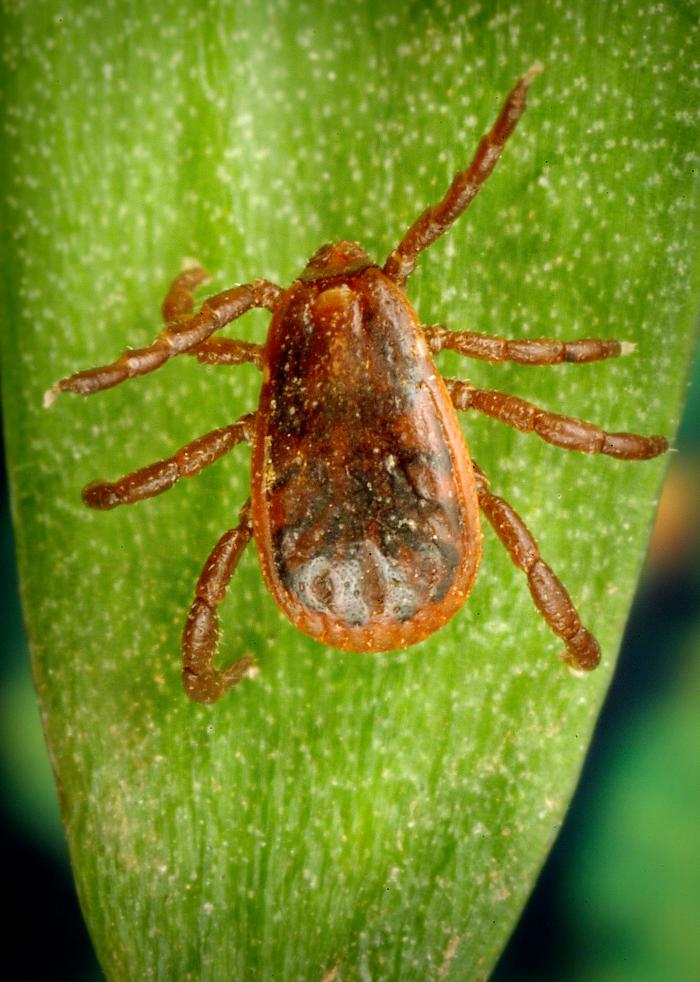
The brown dog tick. Unusually among ticks it can complete its whole life cycle indoors, which is why an infestation can persist in a house long after the dog is treated. (Photo: Wikimedia Commons, Public domain)
What to watch for afterwards
Most tick bites cause nothing at all. If something does develop, it is usually one to three weeks later, which is why that date you wrote down matters.
Lethargy and a dog that is simply not themselves
Fever, loss of appetite
Lameness that moves from one leg to another, which is a classic Lyme sign in dogs
Swollen joints or obvious pain on being touched
Pale gums, bruising or nosebleeds, which can point at a platelet problem from ehrlichiosis or anaplasmosis
Dogs do not get the expanding bullseye rash that people do, so do not wait for a skin sign. Tell the vet there was a tick and when.
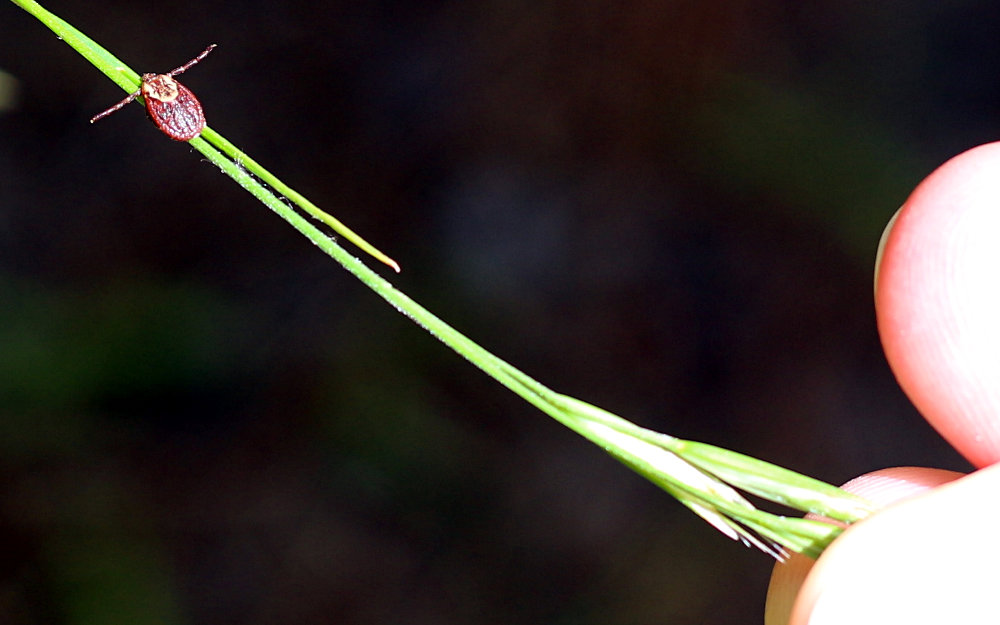
A tick questing: climbing a grass stem and waiting with its front legs out for something to brush past. This is how dogs pick them up, which is why long grass matters more than woodland. (Photo: Mcvoorhis / Wikimedia Commons, CC BY-SA 3.0)
Where ticks hide on a dog
Run your hands over the whole dog after walks, and check the places ticks prefer: inside and around the ears, under the collar, in the armpits and groin, between the toes, under the tail, and around the eyelids. On a thick coated dog you will feel a tick before you see it.
Persistent scratching is not a reliable tick sign, and it has a long list of other causes, which we go through in why is my dog scratching so much.
Ticks do not have a season. They go quiet in hard cold and resume the moment it is above freezing, which is why CAPC advises year round prevention rather than a summer routine. (Photo: Losch / Wikimedia Commons, CC BY-SA 3.0)
Prevention beats removal
CAPC recommends that all dogs be kept on tick control products year round, not seasonally. Ticks are active whenever it is above freezing, and a mild winter week is enough.
Because some of these pathogens transmit within hours, the maths favours products that kill or repel ticks quickly over relying on you finding every tick in time. A product that kills a tick before it has fed for six hours is doing something your daily check cannot reliably do.
Ticks are not the only parasite worth a routine check. Fleas carry tapeworm, so the three problems travel together more often than owners expect, and our guide to worms in dogs and cats covers what a stool test can and cannot tell you.
Ticks and fleas are different problems needing different products, and a flea treatment does not necessarily cover ticks. If you are dealing with both, our step by step flea guide covers the part people miss, which is that most of the flea population is in your house rather than on your dog.
Frequently asked questions
Do I need to send the tick for testing?
Usually no. A tick testing positive does not mean your dog was infected, and a negative result does not rule it out, because your dog may have had another bite you never found. Treatment decisions are made on your dog’s symptoms and blood tests, not on the tick. Keeping the tick in a sealed container is still useful for identification if your vet wants to know the species.
Should my dog have antibiotics straight away after a tick bite?
Generally not. Most bites transmit nothing, and treating every bite would mean a great deal of unnecessary antibiotics. Vets normally watch and test rather than treat blind. That is your vet’s call, and it is a conversation worth having if you live somewhere with high tick numbers.
Can I use a tick hook or tick twister instead of tweezers?
Yes. Purpose made tick removers work well and many vets prefer them, especially on small ticks. Follow the instructions that come with the tool, and whatever you use, the principle is the same: grip at the skin, lift the tick away, do not squeeze its body.
Can my dog give me a tick borne disease?
Not directly. Your dog cannot pass Lyme or ehrlichiosis to you. What a dog can do is carry an unattached tick indoors, which then finds you. That is a real route, and it is another argument for year round tick control on the animal.
Do ticks die in winter?
No. They become inactive in hard cold and then resume whenever the temperature rises above freezing. This is why CAPC recommends year round prevention rather than a tick season.
The honest summary
Fine tipped tweezers, grip at the skin, pull straight up, do not twist. No jelly, no flame, no nail polish, because those make the tick regurgitate into the bite. A broken off mouthpart is a splinter, not an emergency.
And the twenty four hour rule is a Lyme rule. Ehrlichia needs three to six hours. Remove ticks the moment you find them, keep the dog on year round prevention, write down the date, and tell your vet about the bite if your dog goes off colour in the following weeks.
If your dog is lethargic, lame in a leg that keeps changing, or off their food in the weeks after a tick bite, that is a vet visit, not a wait and see.
This article is general information and is not a substitute for veterinary advice. If your pet is unwell, contact your vet.
Sources: US Centers for Disease Control and Prevention, tick removal and what to do after a tick bite; Companion Animal Parasite Council, Ehrlichia and Anaplasma guidelines and Rocky Mountain spotted fever guidelines; Merck Veterinary Manual, Lyme borreliosis in animals; Cornell University Riney Canine Health Center, Lyme disease.
Most owners meet worms the same way: something that looks like a grain of rice, moving, near the dog’s tail. It is a horrible moment, and the internet’s answer is usually a product link. This guide does the part that gets skipped. What the five worms actually are, what you can and cannot see, which ones can infect you, and why a clear test result does not always mean a clear dog.
Worms in dogs and cats are common, treatable, and mostly preventable. The complication is that the signs overlap with a dozen harmless things, and the most recognisable worm is the one a lab test is most likely to miss.
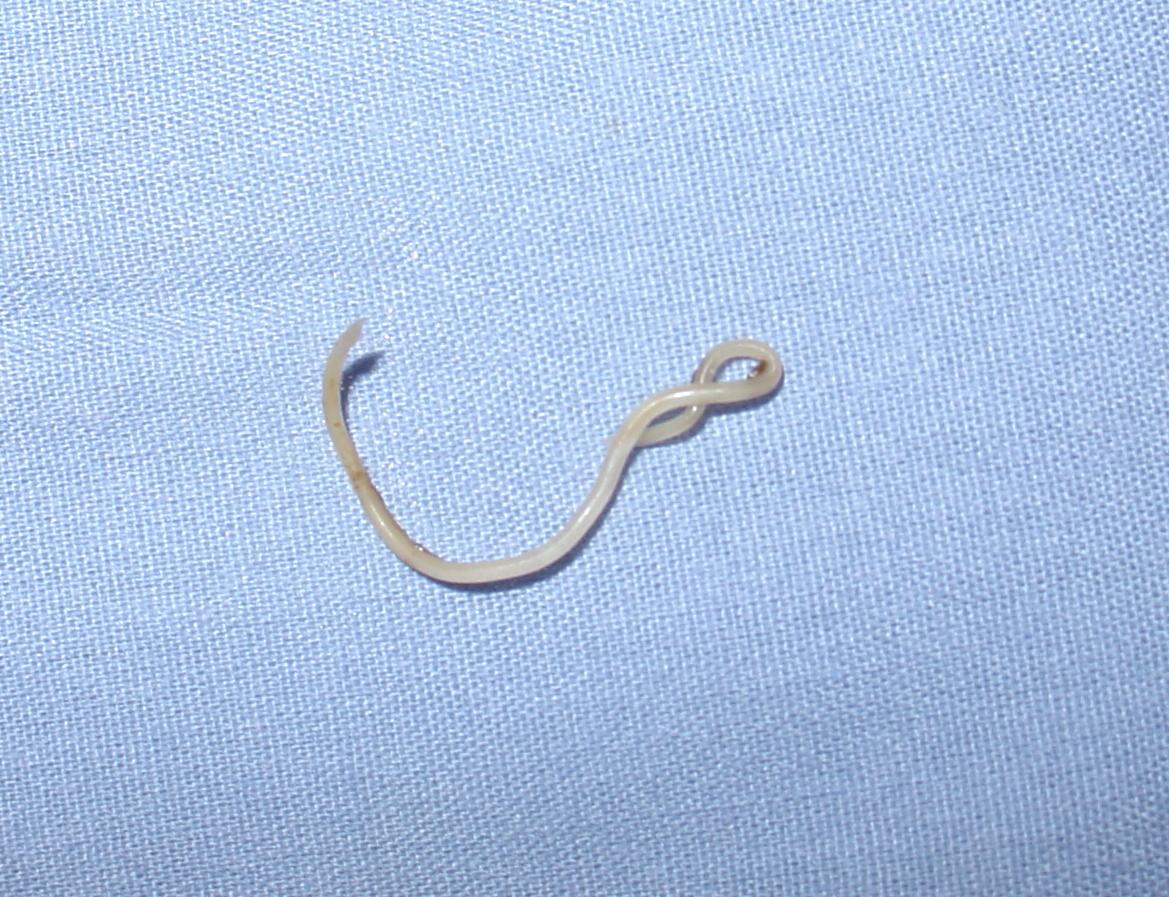
A canine roundworm. These are the ones owners picture, pale and spaghetti like, but you usually only see them after a wormer or in a heavy infection. (Photo: Joel Mills / Wikimedia Commons, CC BY-SA 3.0)
The five worms worth knowing
Four live in the intestine. The fifth lives in the heart and lungs and is a different problem entirely.
Roundworms are the ones most people picture: long, pale, spaghetti like. Pets pick up the eggs from contaminated soil or faeces. In puppies and kittens they cause the classic pot bellied look, poor growth and digestive upset.
Hookworms are small and bite into the intestinal wall to feed on blood. Larvae get in by mouth or straight through the skin, often the feet. They cause anaemia, skin irritation and, in young animals, serious illness. The Companion Animal Parasite Council calls hookworms one of the most significant intestinal parasites of dogs.
Whipworms live in the large intestine and cause chronic watery or bloody diarrhoea and weight loss. They mostly affect adults rather than puppies.
Tapeworms are flat and segmented, and they are the ones you are most likely to see with your own eyes. More on these below, because they behave differently from the rest.
Heartworm is not an intestinal worm at all. It is carried by mosquitoes, lives in the heart and pulmonary arteries, and causes coughing, exercise intolerance and eventually heart failure. Deworming tablets do nothing for it. It needs its own monthly preventive and its own blood test.
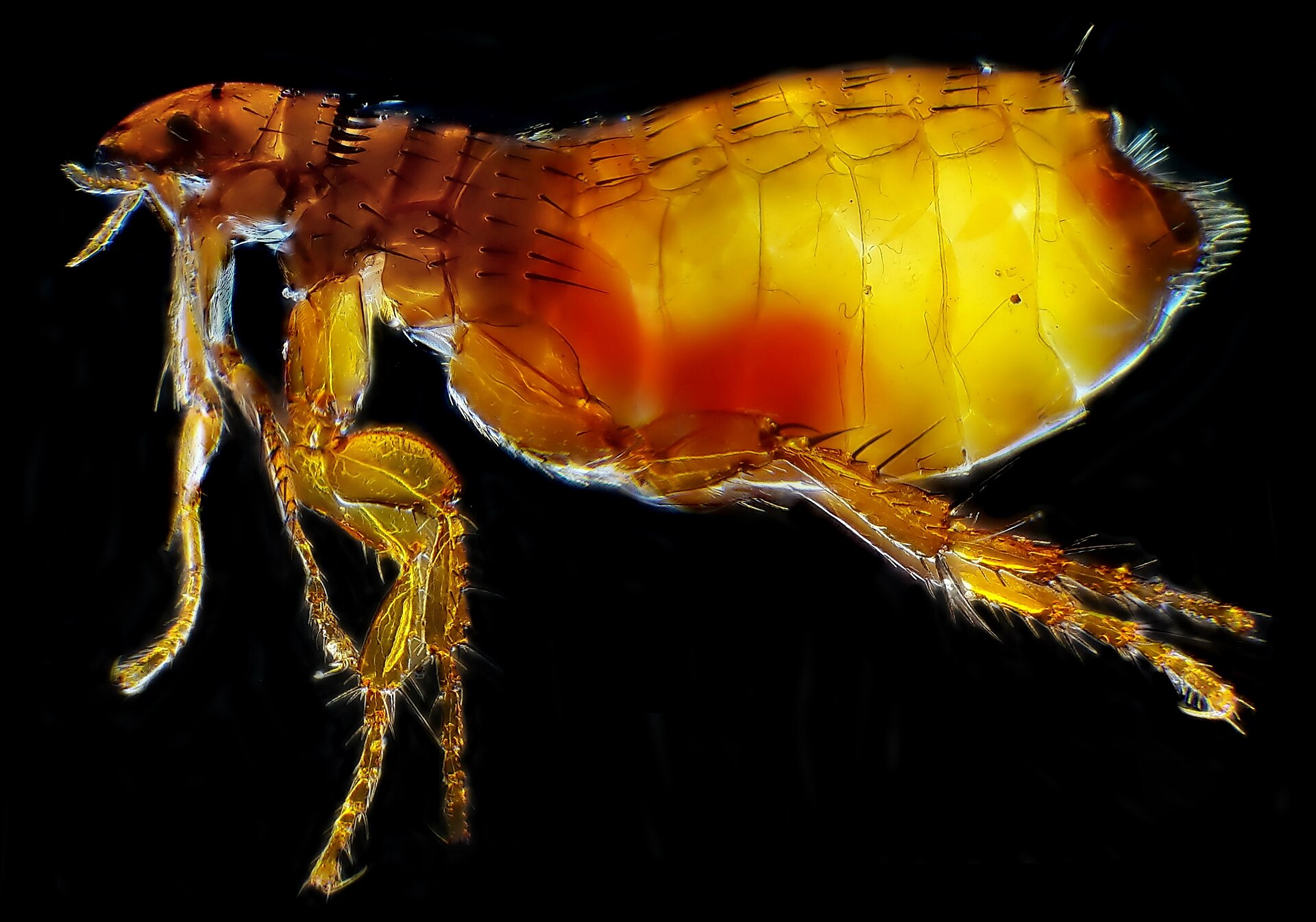
The cat flea. Swallowing one of these while grooming is how dogs and cats get the common tapeworm, which is why worming without flea control fails. (Photo: Andrei Savitsky / Wikimedia Commons, CC BY 4.0)
Tapeworm is a flea problem in disguise
This is the single most useful thing in this article, and it is the part that almost never gets said plainly.
The common tapeworm of dogs and cats is Dipylidium caninum, and animals do not catch it from other animals, or from soil, or from each other. They catch it by swallowing an infected flea, usually while grooming. Cornell’s Riney Canine Health Center is explicit that reinfection happens if the source, meaning fleas or rodents, is not dealt with.
So if you find rice grain segments, you have learned two things, not one. Your pet has a tapeworm, and your pet has or recently had fleas. Treat only the worm and it comes back, because the actual supply line is untouched. Our step by step flea guide covers the part that matters, which is the 95% of the flea population living in your carpets rather than on your dog.
The second tapeworm, Taenia, comes from eating rodents. Same logic. The worm is a symptom of the hunting.
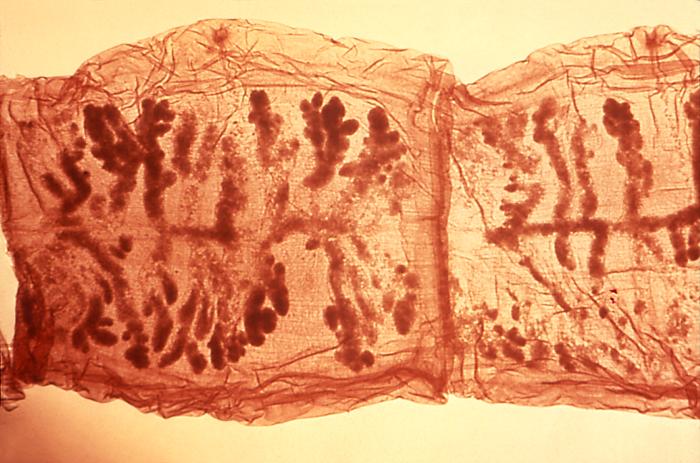
Tapeworm segments, called proglottids, under the microscope. This slide is Taenia solium, but the flea tapeworm sheds similar segments, which reach your floor about the size of a grain of rice. (Photo: Wikimedia Commons, Public domain)
What you can actually see
Honest answer: usually very little, and almost never the worm itself.
Rice grain segments near the anus, in the bedding, or on the stool. Fresh ones move. Dried ones look like sesame seeds. This is tapeworm, and it is the one clear visual sign.
Scooting, dragging the rear along the floor. Often blamed on worms, and tapeworm segments genuinely do cause it, but full anal glands cause it far more often. Persistent itching and scratching has its own long list of causes, most of them not worms at all, which we go through in why is my dog scratching so much.
A pot bellied puppy with a dull coat and poor growth, which points at roundworms.
Chronic diarrhoea, sometimes bloody, which points at whipworms.
Pale gums and lethargy, which can mean hookworm anaemia and needs a vet quickly in a puppy or kitten.
Nothing at all. Plenty of infected adult animals look completely well. This is the normal case, not the exception.
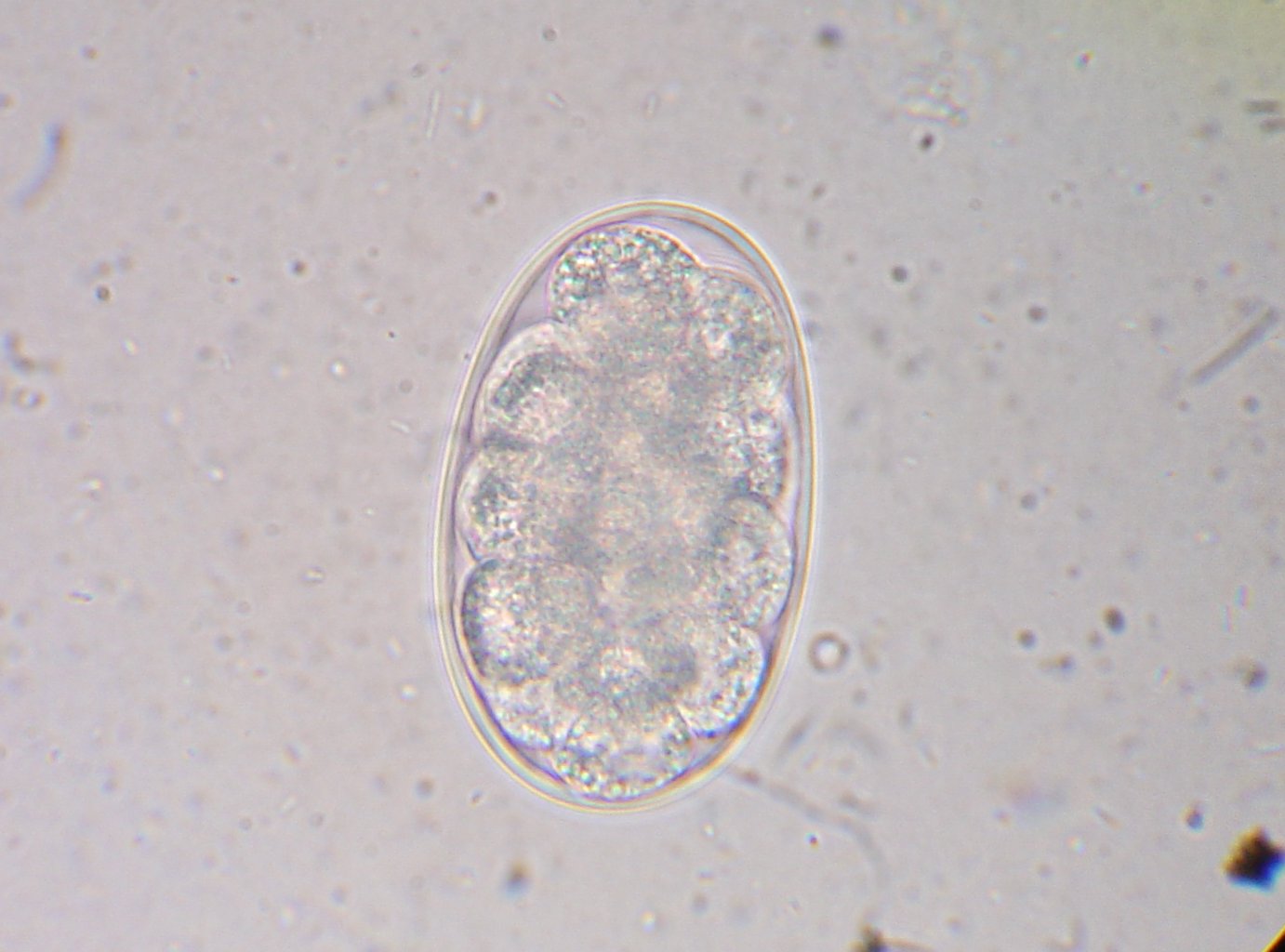
A canine hookworm egg on a faecal flotation test. Hookworms are invisible to the naked eye, so this is the only way they are found. (Photo: Joel Mills / Wikimedia Commons, CC BY-SA 3.0)
Why a clear test does not always mean a clear pet
Diagnosis is usually a faecal flotation, where a stool sample is spun or floated so that any eggs rise and can be counted under a microscope. It works well for roundworm, hookworm and whipworm.
It is unreliable for tapeworm. Cornell notes that faecal testing may find tapeworm eggs but can often miss an active infection. The reason is mechanical: tapeworms shed whole segments containing egg packets rather than releasing loose eggs steadily into the stool, so a given sample may contain none at all.
The practical consequence is worth stating clearly. If you saw rice grain segments, tell your vet you saw them, even if the lab result came back negative. What you saw is better evidence than the test, and treatment is usually given on that basis.
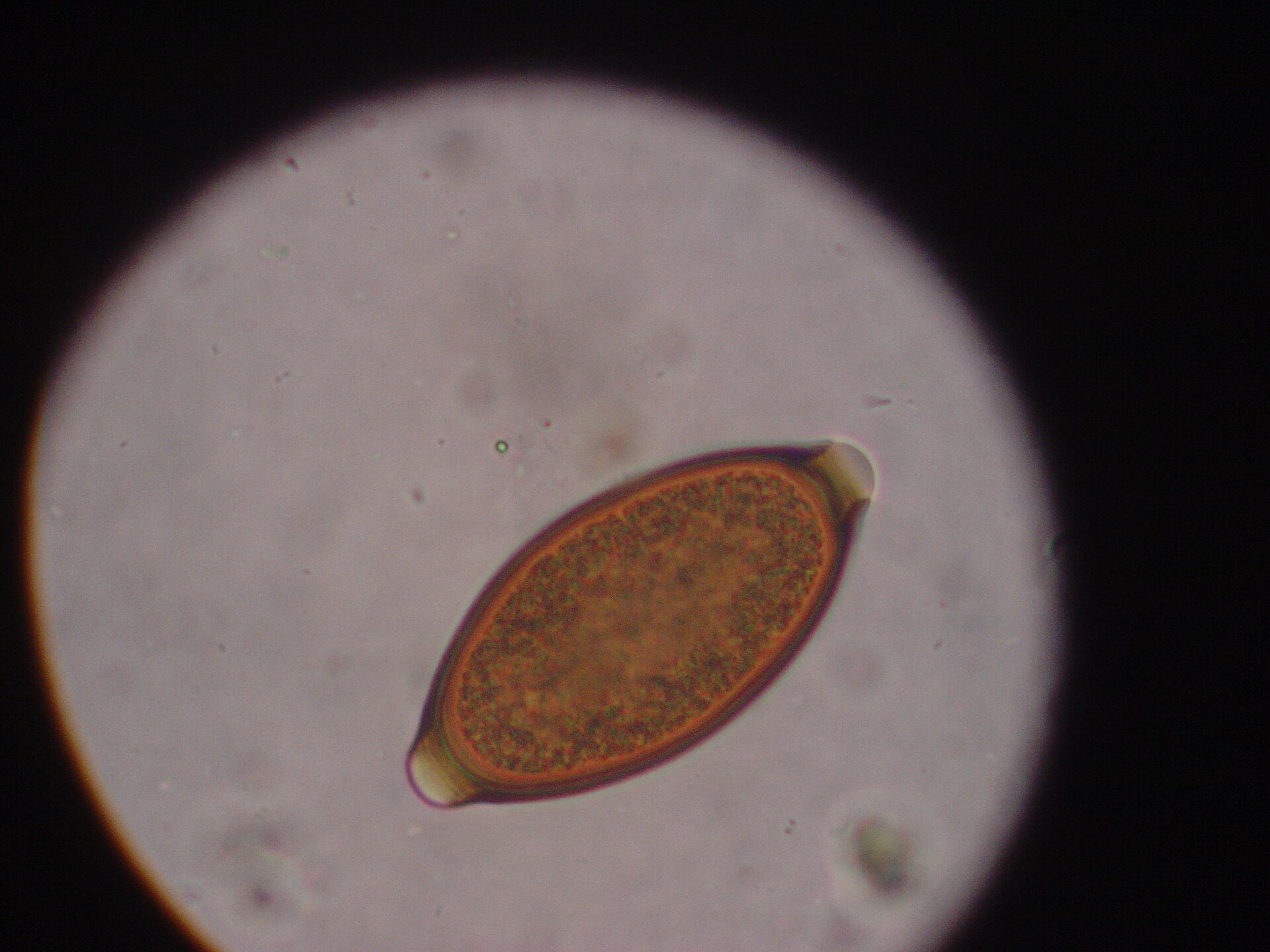
A whipworm egg, with its distinctive lemon shape and plugs at both ends. Whipworm prevalence peaks in winter, not summer. (Photo: Joel Mills / Wikimedia Commons, CC BY-SA 3.0)
Worms are seasonal, and not in the direction you would guess
Most people assume parasites are a summer problem. Research on US fecal data found that prevalence of both whipworm and roundworm peaked in winter, while hookworm peaked in late summer and early autumn.
Year round prevention exists for this reason. Stopping in October because the weather turned is stopping at the wrong moment for two of the four.
Toxocara roundworm eggs. These are the ones that can infect people, usually children, through contaminated soil and unwashed hands. (Photo: Flukeman / Wikimedia Commons, CC BY 3.0)
Can you catch worms from your pet
Yes, for some of them, and this is the part worth taking seriously without panicking about it.
Roundworm. The CDC describes toxocariasis as an infection caught from Toxocara, spreading to people from animals, usually dogs or cats. Eggs in animal faeces reach people’s mouths through contaminated dirt or unwashed hands. It does not spread person to person. Young children are at the highest risk, particularly those playing in or eating contaminated soil. In its ocular form it can damage the retina and cost vision, usually in one eye. In its visceral form it moves into organs such as the liver or the central nervous system.
Hookworm. CAPC describes dog hookworms as the most common cause of cutaneous larva migrans in people, where larvae burrow through skin and leave intensely itchy winding tracks. Gardeners, outdoor workers and people who walk barefoot on contaminated sand or soil are the usual cases.
Tapeworm. Human infection with the flea tapeworm is rare, and it requires swallowing an infected flea, which is why the handful of reported cases are mostly in young children.
None of this is a reason to rehome a pet. It is a reason to pick up faeces promptly, wash hands after the garden, keep sandpits covered and keep the dog wormed.
What to actually do
Do not guess the worm. Different worms need different drugs. The praziquantel that clears a tapeworm does nothing useful against whipworm, and a general wormer may not cover tapeworm at all. Identify first.
Take a stool sample to your vet, and mention anything you saw with your own eyes.
Expect the right drug, not the strongest one. Tapeworm is treated with praziquantel, which works quickly, often within a day.
Deal with the source. For tapeworm that means fleas, every animal in the house, and the house itself. Skipping this guarantees a repeat.
Keep heartworm separate in your head. It is a different parasite with a different route and a different medicine.
Puppies carry the highest worm risk of any age group, and sand and soil are exactly where hookworm larvae wait. (Photo: Andrea Schaffer from Sydney, Australia / Wikimedia Commons, CC BY 2.0)
How often should pets be tested
CAPC recommends testing for intestinal parasites at least four times in the first year of life, and at least twice a year in adults depending on the animal’s health and lifestyle.
For puppies the schedule starts earlier than most owners expect. CAPC advises treating puppies and their mothers when the young are two, four, six and eight weeks old, then moving on to monthly preventives as soon as the product label allows. The reason is blunt: dormant larvae in the mother are so common that essentially every nursing puppy is assumed to be at risk.
What does not work
Eating grass is often read as a sign of worms too. It is not a reliable one, and the reasons dogs do it are covered in why do dogs eat grass.
Garlic, diatomaceous earth, pumpkin seeds, raw carrot and apple cider vinegar are all recommended online as natural wormers. None of them clear an established worm burden, and garlic is toxic to dogs and cats in meaningful amounts. Using them instead of a real wormer means the infection continues, and in a puppy with hookworms that delay matters.
Worming the pet but not the home is the other common miss, and it is the reason the same tapeworm appears to come back a fortnight later.
Frequently asked questions
What do worms in dog poop look like?
Roundworms look like pale spaghetti and are usually only seen after a wormer or in a heavy infection. Tapeworm segments look like moving grains of rice when fresh and sesame seeds when dried, and are more often found on the fur near the anus or in bedding than in the stool itself. Hookworms and whipworms are essentially never visible to the naked eye and are found only on a faecal test.
Can I treat worms without going to the vet?
You can buy wormers over the counter, but you need to know which worm you are treating, because the drugs differ. A product that clears roundworms may do nothing to tapeworms. If your pet is a young puppy or kitten, is losing weight, has bloody diarrhoea or pale gums, see a vet rather than guessing.
My dog has tapeworm but I have never seen a flea. How?
This is the usual situation. A dog only has to swallow one infected flea while grooming, and grooming is also how dogs remove fleas, so the evidence eats itself. Finding tapeworm segments is reliable evidence of flea exposure even when you never saw a flea.
How soon do wormers work?
Praziquantel kills tapeworms quickly, often within about a day, and the worm is digested rather than passed, so you usually see nothing. For other worms you may see dead worms in the stool for a day or two. Not seeing anything does not mean the treatment failed.
Do indoor cats get worms?
Yes. Fleas come indoors on clothing, on other pets and from shared walls in flats, and a single infected flea is enough for tapeworm. Indoor cats that hunt mice in the house can also pick up Taenia.
The honest summary
Four intestinal worms and one heartworm, each with its own route in and its own drug. Most infected animals look fine. The only worm you are likely to see is the tapeworm, and that one is really a flea problem. A negative faecal test rules out a lot, but it does not rule out what you saw with your own eyes.
If your pet is scooting, losing weight, or you have found anything that looks like rice near their back end, book the stool sample and say what you saw.
This article is general information and is not a substitute for veterinary advice. If your pet is unwell, contact your vet.
Sources: Companion Animal Parasite Council hookworm guidelines; US Centers for Disease Control and Prevention, toxocariasis; Cornell University Riney Canine Health Center, tapeworms; American Veterinary Medical Association, intestinal parasites in cats and dogs; VCA Hospitals, internal parasites in dogs.
The short answer: a study published in October 2026 found lead in 99% of the cat foods it tested, along with cadmium in 96% and arsenic in 94%. That sounds terrifying and the number is real, but it is not the part that matters. Detection is not the same as harm, and the study itself does not claim the foods are unsafe.
The testing used inductively coupled plasma mass spectrometry, which can measure metals down to parts per billion. That sensitivity is exactly why almost everything comes back positive. (Photo: Saturnalia0 / Wikimedia Commons, CC0)
What was actually tested
The Clean Label Project, a nonprofit, bought 100 cat food products from 62 brands and screened them for more than 122 industrial and environmental contaminants. The split was 31 dry, 40 wet, and 29 air dried or freeze dried. Testing was done by an independent laboratory holding ISO 17025 accreditation, using inductively coupled plasma mass spectrometry.
The headline results:
Lead detected in 99% of products
Cadmium in 96%
Arsenic in 94%
Mercury detected too, concentrated in fish based products
A plasticizer found in 48 products, at higher levels in cans and pouches
Why 99% is the least interesting number in the story
Here is the thing that gets lost. Lead, cadmium and arsenic occur naturally in soil, water and air. Anything grown in soil picks up traces. Test sensitively enough and you will find them in cat food, dog food, baby food, chocolate, rice and spinach. A 99% detection rate across 100 products is close to what you would predict before testing anything.
The Clean Label Project is clear about this in its own report, and it is worth quoting because the headlines were not: the question “is not whether a product contains heavy metals, but whether it contains relatively high or low levels compared with other products”.
So the study is a ranking exercise, not a safety verdict. It tells you some foods carry more than others. It does not tell you that any of them harmed a cat, and it does not claim to.
Dry foods carried around three times the lead of wet foods in this testing. (Photo: GF38storic / Wikimedia Commons, CC BY-SA 4.0)
The methodology choice that deserves credit
One decision in this study is genuinely clever and almost nobody reported it.
Contaminant levels were expressed per 1,000 kilocalories rather than per kilogram of food. That matters enormously. Wet food is roughly a quarter as calorie dense as dry, because most of it is water. Measure per kilogram and wet food looks several times cleaner purely because of the water, which tells you nothing about what the cat actually swallows in a day.
Normalising to calories compares what a cat genuinely consumes to meet its energy needs. If you only take one methodological point from the whole story, take that one, because it is the correct way to compare and it is rarely done.
Where the differences showed up
Fish and seafood recipes carried the highest mercury and cadmium, which follows the same pattern as fish for human consumption. (Photo: Daniel Case / Wikimedia Commons, CC BY-SA 3.0)
Three patterns came out of the data, and all three are consistent with what you would expect from where the ingredients come from:
Dry food carried about three times the lead of wet food on a per calorie basis.
Fish and seafood recipes carried the highest mercury and cadmium. Predators accumulate mercury up the food chain, which is the same reason human health advice limits certain fish.
Poultry recipes more often carried lead and herbicide residues, which points at feed crops rather than the birds.
That last point is the useful one for an owner: the contamination is arriving with the ingredients, not being added by the manufacturer. Which means switching brands within the same protein may change very little.
Its chief executive, Elise Fennig, pointed out that the products were judged against the Clean Label Project’s own proprietary purity standard rather than the benchmarks used by the Association of American Feed Control Officials or the National Research Council. The institute also asked whether the work had been peer reviewed, whether the underlying product level data would be published, and whether testing a single batch of each product can support conclusions about a brand.
That last objection is the strongest, and the study authors concede it themselves: a single test result only reflects one batch. Ingredient sourcing changes between batches, so one sample is a snapshot rather than a verdict on a brand.
Fennig also made the point that detectable amounts of metals exist in air, water and soil, and that presence alone does not indicate harm, noting that whether a metal is harmful depends on the level and the duration of exposure.
She is right about that. The place the argument gets weaker is the implication that because metals are everywhere, differences between products do not matter. If one food delivers three times the lead of another for the same calories, over a cat’s whole life, that difference is worth knowing about even if neither food breaches a regulatory limit.
So what should you actually do
No vet is recommending anyone stop feeding their cat over this. (Photo: Jay KapLon / Wikimedia Commons, CC BY 4.0)
Honestly? Probably very little, and certainly not panic.
Do not switch food abruptly. A sudden change causes a guaranteed problem, digestive upset, in exchange for a theoretical one. If you do change, do it over a week or more.
Vary the protein. If your cat eats nothing but fish, rotating to poultry or another protein spreads the exposure rather than concentrating it. That is sound advice regardless of this study.
Do not read a detection as a recall. No product here was recalled and no regulator has acted on it. A real recall looks completely different, as the raw food recalls this year did, which we covered in is raw pet food safe.
Keep the actual risks in proportion. The things that measurably harm cats are obesity, dental disease, untreated kidney disease and nutritional gaps such as thiamine deficiency. Portion size is a bigger lever than trace metals, which is why how much you feed matters more than most brand choices.
Ask your vet before a big change, especially for a cat with kidney disease, where diet is doing medical work and should not be changed on the basis of a news headline.
Frequently asked questions
Does this mean my cat’s food is unsafe?
No. The study did not test whether any product causes harm and does not claim the foods are unsafe. It ranked products against each other on contaminant levels. No recall or regulatory action has followed.
Is wet food safer than dry?
On lead, this testing found wet carried roughly a third of what dry carried per calorie. That is one contaminant in one study of one batch per product, so it is not a reason on its own to switch. Wet food has other genuine advantages for cats, particularly water intake.
Should I avoid fish flavoured cat food?
Fish recipes carried the highest mercury and cadmium, which matches what we know about fish generally. Rotating proteins rather than feeding fish exclusively is sensible, and was before this study.
How do heavy metals get into pet food in the first place?
Mostly through the ingredients. Metals occur naturally in soil and water, crops take them up, and animals accumulate them. They are not usually added during manufacturing, which is why the pattern tracks protein source rather than brand.
Which brands were safest?
We are deliberately not publishing a brand ranking from a single batch of each product. The study’s own authors caution that one test reflects one batch. A list built on that would look more authoritative than the evidence supports.
The honest summary
A number like 99% is built to travel, and it travelled. What it actually reflects is a very sensitive instrument finding traces of things that are present in soil and water everywhere, which is roughly what anyone would expect.
The useful finding underneath is narrower and more interesting: contaminant load varies meaningfully between products, it tracks protein source and format rather than brand prestige, and comparing per calorie rather than per kilogram is the only fair way to look at it. That is worth knowing. It is not worth throwing out the cupboard over.
This article is general information, not veterinary advice. Talk to your vet before changing the diet of a cat with any diagnosed condition.
The short answer: raw pet food carries a far higher chance of carrying Salmonella or Listeria than any other kind of pet food, and the FDA has the sampling data to show it. The bigger surprise for most owners is who gets ill. The clearest documented risk is not to the pet, it is to the people in the kitchen.
The FDA screened more than a thousand pet food samples across two years. Raw came out very differently from everything else. (Photo: U.S. Food and Drug Administration, public domain)
What the FDA actually found when it tested
This is the part that rarely makes it into a recall notice. Between October 2010 and July 2012 the FDA’s Center for Veterinary Medicine screened over 1,000 samples of pet food. In the second year it added 196 samples of commercially available raw dog and cat food. The results are published on the FDA’s own site and the gap is not subtle.
Raw pet food, 196 samples: 15 positive for Salmonella, 32 positive for Listeria monocytogenes
Dry dog and cat food, 240 samples: 1 positive for Salmonella, none for Listeria
Jerky type treats, 190 samples: none for either
Semi moist dog and cat food, 240 samples: none for either
Dry exotic pet food, 190 samples: none for either
Put plainly, roughly one in four raw samples carried one of the two organisms. Across nearly 900 samples of everything else, there was a single positive. That is not a rounding difference, it is a different category of product.
Salmonella, magnified and colour enhanced. In a dog it may cause nothing at all. In a toddler it is a different story. (Photo: NIAID, public domain)
The risk lands on your household, not just your pet
Here is the bit that genuinely surprises people. A healthy adult dog can shed Salmonella in its stool while looking completely fine. The animal is not the patient. The patient is whoever touches the bowl, the worktop, the fridge shelf, or the dog’s face afterwards.
The FDA and the CDC both make the same point: contaminated raw pet food can sicken the people handling it, through hands, surfaces, bowls and the pet itself. Young children, adults over 65, pregnant women and anyone with a weakened immune system carry the most risk.
So the honest way to think about a raw diet is not “will my dog cope with this”. It is “am I prepared to run a small raw meat processing operation in my kitchen, every day, without slipping”. If there is a baby crawling on that floor, the question answers itself.
Twenty seconds, every time, is the FDA’s actual instruction. Most people manage it for a week. (Photo: James Heilman, MD / Wikimedia Commons, CC BY-SA 3.0)
Bird flu changed the maths for cats
Until recently this was a bacteria conversation. Then H5N1 arrived in the pet food supply.
At the end of December 2024, Los Angeles County’s public health department advised residents not to feed their pets Monarch Raw Pet Food sold at several California farmers markets. One house cat in the county was confirmed infected with H5N1 and four other cats in the same home were presumed positive. Separately, an Oregon house cat died after eating Northwest Naturals Feline Turkey Recipe, a frozen raw product that tested positive for the virus and was distributed across thirteen states and British Columbia.
Dr Michael Q. Bailey, then president elect of the American Veterinary Medical Association, put it bluntly to CBS News: raw milk and raw meat products can be and are a vector for carrying the virus.
The FDA has since told manufacturers that H5N1 counts as a known or reasonably foreseeable hazard when they use uncooked or unpasteurised material from poultry or cattle, which means it has to be written into their food safety plans. Cats are unusually susceptible, and in them the illness can move fast: fever, lethargy, heavy discharge from the eyes and nose, breathing trouble, then neurological signs.
Why the recalls keep coming
2026 has not been quiet. Northwest Naturals, Viva Raw and Raaw Energy have all pulled product over Salmonella or Listeria, and Go Raw expanded a recall to cover a lot of Steve’s Real Food freeze dried chicken over low thiamine, which is a different failure mode entirely and one we have written about before.
The pattern is structural rather than bad luck. Cooking is a kill step. Take it out and nothing downstream reliably replaces it, so the safety of the finished product depends entirely on the raw material and the handling, every single batch, forever. Freezing does not fix this. Freezing stops bacteria multiplying, it does not kill what is already there.
But cats eat raw prey, surely that settles it
A fresh kill and a frozen supermarket block are not the same object, whatever the marketing says. (Photo: Eddy Van 3000 / Wikimedia Commons, CC BY-SA 2.0)
It is a fair argument and it deserves a real answer rather than an eye roll. Cats do eat raw prey, and they are built for it.
The gap is in what happens between the animal and the bowl. A rabbit caught in the garden is eaten within minutes, by one cat, outdoors. Commercial raw is slaughtered somewhere else, ground, mixed with other carcasses, packed, frozen, shipped, thawed in your kitchen and served next to where you make toast. Each of those steps is a chance for contamination to enter and spread, and grinding in particular takes anything on the surface and distributes it right through the batch.
Owners choose raw for reasons that are easy to understand: better coats, smaller stools, a sense that it is closer to what the animal evolved to eat. Some of that is real and visible. The point is not that those owners are foolish. It is that the food safety risk is measurable and documented, while the health benefits remain largely anecdotal, and that is an uncomfortable trade rather than an obvious win.
If you are going to feed raw anyway
Not an argument that kibble is perfect. Only that it has a kill step, and raw does not. (Photo: James Redekop / Wikimedia Commons, CC BY-SA 2.0)
Plenty of people will read all of the above and carry on, and that is their call to make. The FDA’s own handling guidance is worth following properly rather than approximately:
Wash your hands for a full twenty seconds after any contact with the food, the bowl or the packaging.
Clean and disinfect every surface it touched, hot soapy water first, then a disinfectant. Wiping is not disinfecting.
Thaw in the fridge or the microwave, never on the worktop.
Do not rinse raw meat. Rinsing sprays bacteria around the sink rather than removing them.
Keep it physically separate from human food, with its own board and utensils.
Refrigerate what the pet does not finish straight away, and do not leave a bowl down all day.
Avoid letting a pet lick your face after a raw meal, and keep them off food preparation surfaces.
If anyone in the house is pregnant, under five, over sixty five or immunocompromised, this is the point to talk to your vet about whether a cooked or commercially sterilised alternative gets you most of what you wanted with far less exposure. Portion control matters just as much on raw as on anything else, and our guide to how much to feed a cat still applies.
Frequently asked questions
Does freezing raw pet food kill Salmonella?
No. Freezing halts bacterial growth but does not reliably kill Salmonella or Listeria. Both can survive freezing and become active again once the food thaws, which is why a frozen product can still test positive.
Can my dog get sick from raw food, or only people?
Both. Many dogs carry Salmonella without obvious illness, which is part of the problem, but dogs and cats can become genuinely unwell with vomiting, diarrhoea, fever and lethargy. Cats are also unusually vulnerable to H5N1 through raw poultry.
Is freeze dried or air dried raw any safer?
Not automatically. Drying removes moisture rather than applying a kill step, and freeze dried raw products appear in recalls alongside frozen ones. Check whether the manufacturer applies a validated pathogen treatment, and treat the answer “we test batches” as weaker than “we apply a kill step”.
What should I do if my pet ate a recalled product?
Stop feeding it, keep the packaging with the lot number, wash and disinfect anything it touched, and ring your vet for advice even if your pet seems fine. Watch for vomiting, diarrhoea, fever or lethargy, and take special care if anyone in the household is in a higher risk group.
Where can I check current recalls?
The FDA maintains a running list of pet food recalls, withdrawals and safety alerts, and it is the primary source that news coverage is drawn from. Check the lot numbers rather than the brand alone, because recalls are usually limited to specific batches.
The honest summary
Raw feeding is not a fringe choice and the people who do it are not careless. But the sampling data is what it is: roughly a quarter of raw samples positive, against one positive in nearly nine hundred samples of everything else. The hazard is real, it is mostly aimed at the humans in the house, and it does not go away with a better brand. It only gets smaller with handling discipline that has to hold every single day.
Household chemicals follow the same logic, and the one that kills fastest is antifreeze. Keeping an animal safe is mostly a series of small, boring routines that nobody notices when they work.
This article is general information, not veterinary advice. Talk to your vet about what suits your pet and your household, and contact them straight away if you think your pet is unwell.
Contamination is not only a bacterial question either. A separate 2026 analysis found heavy metals in almost every cat food it tested, and the number is far less alarming than it sounds once you look at what was measured. We went through it in heavy metals in cat food.
The short answer: antifreeze poisoning happens when a pet swallows ethylene glycol, a sweet tasting liquid used in engine coolant. A cat can die from about one teaspoon. Cats need veterinary treatment within roughly three hours of swallowing it, dogs within eight to twelve. Once the kidneys start failing, the odds drop sharply.
That bright green is the colour most people picture, though coolant also comes in orange, pink and blue. (Photo: EvelynGiggles / Wikimedia Commons, CC BY 2.0)
Why a pet would drink something that kills it
This is the part that catches owners out. Antifreeze isn’t something a cat tolerates by accident. It’s something a cat actively wants. Ethylene glycol is a sweet tasting, odourless liquid, and VCA Hospitals notes that cats may be drawn to it by both its smell and its taste.
So the usual mental model, that pets avoid things that are bad for them, just doesn’t hold here. A cat that walks past a drip under a parked car will often stop and lap it up. A dog that finds a puddle in a garage will drink it the way it drinks from any other puddle. Nothing about the experience warns them.
Manufacturers know this. Back in December 2012 the industry agreed voluntarily to add denatonium benzoate, an intensely bitter compound, to antifreeze sold in the United States, and the AVMA reported the agreement at the time. Seventeen states already required it. That’s a genuine improvement. It is not a guarantee, and vets still see cases every winter, because a bitter taste doesn’t do much to stop a thirsty animal that’s already swallowing.
How little it actually takes
Pure ethylene glycol is clear and syrupy. The colour you see in coolant is dye, not the poison itself. (Photo: LHcheM / Wikimedia Commons, CC BY-SA 3.0)
The numbers are genuinely small. The Merck Veterinary Manual puts the minimum lethal dose of undiluted ethylene glycol at 1.4 mL per kilogram of body weight in cats, and 4.4 to 6.6 mL per kilogram in dogs.
Translated into things you can picture, the Pet Poison Helpline puts it at about one teaspoon for a cat, and a tablespoon or two for a dog, depending on size. A four kilogram cat is in lethal territory after roughly a teaspoon of the neat stuff. That is less than a bottle cap.
Cats are far more sensitive than dogs, which is why the same spill can be survivable for the labrador and fatal for the cat that shares the driveway.
The clock starts the moment they swallow
Ethylene glycol is absorbed fast. Merck records peak absorption at one to four hours after ingestion, with a serum half life of about three hours. The poison itself isn’t what destroys the kidneys. The body breaks it down into metabolites, and those are what do the damage. That single fact is why timing matters so much: the antidote works by stopping that breakdown, so it only helps while there’s still unmetabolised ethylene glycol to stop.
Wait until the pet looks properly ill, and that conversion has already happened.
The Pet Poison Helpline gives the working windows as three hours for cats and eight to twelve hours for dogs. The ASPCA’s guidance for professionals is slightly more generous for cats at four hours. Either way, you’re dealing in hours, not days, and the honest advice is to stop reading and phone someone now if this is happening to you.
What the first three days look like
Cases cluster in autumn, winter and early spring, when people top up or change their coolant. (Photo: Von.grzanka / Wikimedia Commons, CC BY-SA 3.0)
Merck describes three stages, and the cruel part is the gap in the middle.
Stage one, roughly 30 minutes to 12 hours. The pet looks drunk. Wobbly on its feet, dazed, vomiting, drinking and urinating far more than usual. Owners often read this as a bug, or as the cat having got into something mildly unpleasant. Around the twelve hour mark many animals appear to pick up.
Stage two, 12 to 24 hours in cats and 36 to 72 hours in dogs. The kidneys begin to fail. The kidneys swell and become painful, heart rate and breathing speed up, the animal goes off food, becomes lethargic, and may develop ulceration in the gut. Seizures and coma are possible.
Stage three. Acute kidney failure that can’t be reversed. Urine output drops and then stops.
Two of those early signs deserve a flag, because they overlap with things owners already worry about. Heavy drinking and urinating is also the classic presentation of diabetes in dogs and cats, and fast breathing is on the list when you’re working out why your dog is panting so much. Sudden onset, in an animal with access to a garage or a driveway, is what pushes antifreeze to the top of the list.
Where pets actually find it
A coolant leak spreads into ordinary puddles, and nothing about the taste puts an animal off. (Photo: Anna Bauer / Wikimedia Commons, CC BY-SA 3.0)
Hardly any of these cases involve a pet knocking a bottle off a shelf. The usual routes are duller and easier to miss:
A slow leak from a car radiator or hose, pooling where the car is parked
Spills from topping up or draining coolant, especially when the job is done outside on a cold morning
An open or badly capped container in a garage or shed the pet can get into
Puddles on a shared driveway or in a car park, where the leak came from someone else’s car entirely
Older toilet antifreeze and some screenwash and brake fluid products, which can also contain ethylene glycol
Outdoor cats and cats with garage access are the highest risk group, partly because they roam and partly because it takes so little to hurt them.
What to do if you even suspect it
There is an in house blood test for ethylene glycol, so a vet can confirm it quickly. (Photo: The National Guard / Wikimedia Commons, public domain)
Treat suspicion as confirmation. The cost of being wrong in the other direction is too high.
Phone a vet or a poison line immediately. In the United States, Pet Poison Helpline is on (855) 764-7661 and the ASPCA Animal Poison Control Center is on (888) 426-4435, both 24 hours. Both charge a consultation fee. Pay it.
Say what you suspect and when. The time of exposure is the single most useful thing you can tell them, even if it’s a guess with a range.
Take the container or a photo of it if you have one, so the product and concentration are known.
Don’t make your pet vomit unless a vet tells you to on that call.
Go in, even if the pet seems fine. Looking fine at hour two means nothing. Looking fine at hour twelve can be the gap between stage one and stage two.
Vets can confirm it quickly. VCA notes there’s an in house test that detects ethylene glycol in the bloodstream, alongside blood and urine work. Treatment is an antidote called fomepizole, which blocks the enzyme that turns ethylene glycol into the metabolites that wreck the kidneys. Cats need a much bigger dose than dogs, 125 mg per kilogram to start against 20 mg per kilogram, which tells you something about how differently the two species handle it.
On prognosis, VCA is blunt: it’s very poor once clinical signs have developed, and a delay of even a few hours usually kills a cat. That sounds harsh written down. It’s also the reason this article exists.
How to cut the risk at home
On winter walks, the puddles worth steering around are the ones near parked cars. (Photo: Helgi Halldórsson / Wikimedia Commons, CC BY-SA 2.0)
None of this needs to be elaborate:
Buy propylene glycol coolant instead. It’s the standard safer substitute and it’s sold everywhere. It isn’t harmless, but it doesn’t carry anything like the same risk.
Fix leaks rather than topping up. A drip you’ve been ignoring since summer is the classic source.
Clean spills properly. Absorb, then wash the area down thoroughly. Don’t leave a rinsed patch that’s still sweet.
Store containers sealed and off the floor, in something the cat can’t get behind.
Check under your car where you park, especially through autumn and winter. Merck notes cases cluster in the colder months.
Steer round puddles on walks near parked cars and in car parks.
It’s the same logic that applies to the other household poisons worth knowing about, from chocolate through to grapes and raisins, which also attack the kidneys in dogs. Assume the pet will find it, and put it out of reach before they do.
Frequently asked questions
How long after drinking antifreeze will a cat show symptoms?
Usually within 30 minutes to 12 hours. Early signs look like drunkenness, with wobbling, vomiting and heavy drinking and urinating. Many cats then seem to improve around the 12 hour mark, which is misleading, because that’s when the kidney damage is getting under way.
Can a dog survive antifreeze poisoning?
Yes, if treatment starts early. Dogs have a longer window than cats, generally eight to twelve hours. Survival drops steeply once kidney failure has set in, so the deciding factor is almost always how fast the animal got to a vet.
Does the bittering agent make antifreeze safe now?
No. Adding denatonium benzoate makes antifreeze less appealing, and it’s a worthwhile change, but poisonings still happen. Treat every coolant as lethal regardless of what’s on the label.
How much antifreeze is toxic to a dog?
Merck gives a minimum lethal dose of 4.4 to 6.6 mL per kilogram of undiluted ethylene glycol. For everyday purposes, a tablespoon or two can kill a dog depending on its size, and smaller dogs are at much greater risk.
Is pet safe antifreeze genuinely safe?
Propylene glycol based products are much safer than ethylene glycol ones, which is why they’re worth buying. They’re still not something you want your pet drinking, so store and clean up after them the same way.
The one thing to take away
If your pet has been near coolant and is behaving oddly, don’t wait to see how they are in the morning. With cats in particular, the morning is usually too late. Phone a vet, say what you think they’ve drunk, and go in.
This article is general information, not veterinary advice. If you think your pet has swallowed antifreeze, contact your vet or an emergency poison line straight away.
Your vet now works from two separate diabetes rulebooks: one for dogs, one for cats. The American Animal Hospital Association split its 2026 guidelines by species for the first time, and the reason matters to you rather than just to the clinic.
Diabetes is not really one disease. In dogs and in cats it behaves differently enough that the treatment, the monitoring and even the odds of the pet coming off medication are not the same.
The Short Answer
Watch for four things: drinking much more, weeing much more, eating well but losing weight, and new tiredness. Every diabetic dog needs insulin for life. Some cats can go into remission, and a few now qualify for a daily liquid or tablet instead of injections. Any of those four signs means a vet appointment.
Drinking and weeing more are the two signs owners spot first, in cats and dogs alike. (Photo: Peter Forster, CC BY SA 2.0, via Wikimedia Commons)
The Four Signs Owners Notice First
These are the classic ones, and they turn up in that order surprisingly often.
Drinking much more than usual. Refilling the bowl more often, or a cat suddenly drinking from taps and glasses when it never did.
Weeing much more. Bigger or more frequent puddles, a house-trained dog asking to go out at night, a litter tray that needs changing far more often.
Eating normally or more, while losing weight. This is the one that should really get your attention. Food is going in and the animal is still shrinking, because the sugar is not reaching the cells that need it.
New tiredness or weakness. Less interest in walks, sleeping more, a cat that stops jumping onto the things it used to.
Individually each of these has a dozen innocent explanations. Two or three together is a pattern. If your cat is drinking more and using the tray more, it is worth ruling this out before assuming it is a litter tray or behaviour problem.
Why Dogs and Cats Now Have Separate Guidelines
AAHA published its 2026 guidelines as two documents, one canine and one feline, in recognition of what it calls the unique nature of the disease process in each species. In plain terms:
Dogs develop a form with an absolute insulin deficiency, caused by permanent loss of the beta cells that make insulin. Those cells do not come back. Every diabetic dog is insulin deficient and every diabetic dog needs insulin therapy. There is no version of this where a dog is managed on diet alone.
Cats are different. Their diabetes more often resembles the human type 2 picture, where the pancreas is still working but the body has stopped responding properly. Catch it early, get the weight and diet right, and some cats stop needing treatment altogether. That is called remission, and it is not available to dogs.
Every diabetic dog needs insulin. Some cats now have an oral alternative. (Photo: Melissa Wiese, CC BY 2.0, via Wikimedia Commons)
What This Means If You Have a Dog
Insulin, twice a day, for life, alongside a consistent feeding schedule. That sounds daunting and it is genuinely a commitment, but AAHA’s own framing is worth quoting back to yourself on the bad days: diabetic dogs can live a good quality of life with few or no clinical signs, given attentive care, dietary and schedule adjustments, and diligent follow-up.
The practical points that make it work are routine ones. Feed at the same times. Inject at the same times. Keep the diet consistent rather than switching foods on a whim. Go to the follow-up appointments even when the dog seems fine, because seeming fine is the goal, not the finish line.
What This Means If You Have a Cat
Two things have changed, and both are good news.
First, injections are no longer the only option for every cat. The 2026 guidelines include recommendations on SGLT2 inhibitors, a class of drug given by mouth, following FDA approval of Bexacat in 2022 and Senvelgo in 2023. These are for otherwise healthy cats with diabetes that have not previously been treated with insulin. That last part matters: they are not a swap-in for a cat already stabilised on injections, and they are not suitable for a cat that is unwell at diagnosis.
Second, the monitoring has changed. Routine in-hospital blood glucose curves are no longer recommended for cats, because stress hyperglycaemia in a hospitalised cat can distort the readings badly enough to be misleading. A frightened cat at the vet produces high sugar readings whether or not its diabetes is controlled. Feline monitoring now leans on clinical signs, continuous glucose monitoring and glucose data collected at home.
If your vet suggests a sensor on the cat’s skin rather than a day of admissions and blood draws, that is the current guidance, not a shortcut.
For cats, at home and continuous monitoring has replaced the routine in clinic glucose curve. (Photo: Christidy, public domain, via Wikimedia Commons)
The Emergency Nobody Warns You About
Untreated diabetes can tip into diabetic ketoacidosis, and that is a life-threatening emergency rather than a bad day. Go straight to a vet if you see:
Vomiting, especially with any of the four signs above
Complete loss of appetite in an animal that was eating well
Rapid or laboured breathing
Sweet or acetone-smelling breath
Collapse, severe weakness, or an animal that cannot be roused properly
This is the reason the four early signs are worth acting on rather than watching for another fortnight. Lethargy and appetite loss can look like a hundred milder things, which is also true of stress in cats and of unexplained panting in dogs. The difference is how fast this one moves once it turns.
What to Do Now
Measure the water. Fill the bowl with a measuring jug for two days and write down how much goes in. “He seems thirsty” is hard for a vet to act on. “She is drinking a litre a day and she is a 4 kg cat” is not.
Weigh your pet. Home scales are fine. Weight loss alongside a good appetite is the single most useful thing you can report.
Book the appointment. Diagnosis is a blood and urine test, not a guess, and it is quick.
Take your notes with you. Water volume, weight trend, appetite, and when you first noticed.
Ask specifically about the 2026 guidelines if you have a cat. Whether an oral option or a glucose sensor suits your cat is a conversation worth having rather than assuming injections are the only path.
Keeping weight sensible is the one thing that genuinely reduces the risk in cats, which makes getting portions right more useful than it sounds.
Two measurements make the appointment far more useful: water drunk per day, and weight. (Photo: Joliot, CC BY SA 3.0, via Wikimedia Commons)
Common Questions
Can diabetes in dogs be cured? No. The insulin-producing cells are permanently lost, so treatment is lifelong. It can be controlled well.
Can a cat really come off insulin? Yes, some do. Remission is most likely when it is caught early and weight and diet are addressed properly. It is not guaranteed and it can be lost again.
Is it caused by feeding sugar? No. Obesity is a genuine risk factor in cats, but a dog does not become diabetic from the odd biscuit. In dogs it is largely immune-mediated and genetic.
Which breeds are more at risk? In dogs, terriers, Samoyeds, Miniature Schnauzers and Poodles turn up disproportionately. In cats, Burmese have a known predisposition, and overweight middle-aged neutered males are the classic picture.
How much does it cost to manage? Ask your own vet, because insulin type, dose and monitoring vary widely. Ask at diagnosis rather than later, so you can plan properly.
The Bottom Line
Drinking more, weeing more, eating well while losing weight, and new tiredness. That is the list. In a dog it means insulin for life and a routine that works. In a cat it might mean remission, or a tablet instead of a needle, especially if you catch it early.
The 2026 guidelines are aimed at vets rather than owners, but the headline is worth knowing: your dog and your cat have genuinely different diseases with the same name. You can read AAHA’s own summary of the 2026 canine guidelines and the feline guidelines.
This article is general information for pet owners, not veterinary advice. If you think your dog or cat may be diabetic, contact your veterinary practice.
Most pet food recalls are about bacteria. This one is the opposite problem. In 2026 the FDA warned that testing found eight lots of one cat food with extremely low or no thiamine, and thiamine is a vitamin cats cannot go without for long.
The reason it matters is the speed. A cat eating a thiamine deficient diet can go from slightly off its food to neurological signs in a matter of weeks, and most owners have never been told what those signs look like.
The Short Answer
Thiamine, or vitamin B1, is essential for cats and they cannot make enough of it themselves. Early deficiency looks like a poor appetite, drooling and vomiting. Later it becomes neurological: a head that droops toward the floor, wobbling, circling and seizures. Caught early it is usually reversible.
Cats store very little thiamine, so they need it from food every single day. (Photo: Nick.mon, CC0, via Wikimedia Commons)
Why Cats Are Especially Vulnerable
Thiamine is water soluble, which means the body stores very little of it. Cats have to take it in from food every day, and they need more of it per kilogram than dogs do. There is no reserve to fall back on.
That is normally fine, because complete cat foods are formulated to include it. The vitamin is fragile though. It degrades with heat during processing, and it can be destroyed by certain preservatives or by thiaminase, an enzyme found in some raw fish. So deficiency turns up in three situations: a food that was made wrong, a home prepared diet that was never balanced properly, or a cat eating a lot of raw fish.
It is also worth saying what does not cause it. A cat on a reputable complete food, wet or dry, is not at risk. This is a manufacturing and formulation problem, not something you cause by choosing the wrong flavour.
What the 2026 Recalls Actually Said
Go Raw LLC began with a voluntary recall of a single lot of Quest Cat Food Chicken Recipe Freeze Dried Nuggets, a 10 oz bag with lot code C25288 and a best by date of 15 October 2027, because it may have contained low levels of thiamine.
It did not stop there. The company later expanded the recall across Quest products and enacted a stop sale on all of them, and expanded again to include a lot of Steve’s Real Food Freeze Dried Chicken Recipe. The FDA then issued its own advisory saying agency testing showed eight lots of Quest cat food contained extremely low or no thiamine, and that continued feeding could cause serious harm including death.
If any of that is in your cupboard, stop feeding it and check the current lot numbers on the FDA advisory rather than on any article, because recalls get expanded.
Check the brand, the product and the lot code, not just the flavour. (Photo: Wikimedia Commons, CC BY SA 3.0)
The Early Signs, Which Are Easy to Dismiss
This is the stage where it is still simple to fix, and also the stage most owners sail past because the signs look like a hundred ordinary things.
A drop in appetite, or going off food entirely.
Drooling or excess salivation.
Vomiting.
Weight loss over days or weeks.
Any one of those alone is unremarkable. A cat that has gone quiet and stopped eating is worth attention regardless of the cause, and the same goes for changes in how much it vocalises or where it chooses to sit. We have written about the signs a cat is stressed and what changes in meowing can mean, because behaviour shifts are often the first thing an owner notices about anything.
What makes this different is the combination, and the context. Poor appetite plus drooling plus a food that has been recalled is not a coincidence to wait out.
Drooling and a sudden loss of appetite are the signs owners most often wave away. (Photo: Augustus Binu, CC BY SA 3.0, via Wikimedia Commons)
The Sign That Means Go Now
If deficiency continues, it moves to the nervous system, and one posture in particular is close to diagnostic.
Cervical ventroflexion is the term. In plain language, the cat’s neck bends downward and it cannot lift its head properly. The chin tucks toward the chest or the floor and stays there. A cat crouching low to the ground is normal. A cat that cannot raise its head to look at you is not.
Alongside it you may see:
A wobbly, unsteady walk
Circling
Falling over
Dilated pupils
Seizures
Those are emergency signs. Not tomorrow, not the weekend clinic if it gets worse. That day.
A relaxed cat like this one can still lift its head. That is the difference to watch for. (Photo: Alvesgaspar, CC BY SA 3.0, via Wikimedia Commons)
The Good News About Treatment
Here is the part worth holding on to: treated promptly, thiamine deficiency is typically reversible. Vets give thiamine, usually by injection at first, alongside a corrected diet, and cats caught at the early stage often improve strikingly fast.
The qualifier is that word promptly. The longer the neurological signs go on, the more likely some damage sticks. That is the whole reason for learning the head droop: it is the difference between a cat that bounces back and one that does not.
What to Do Right Now
Check what you are feeding. Look at the brand, the product and the lot code on the bag or tin, then compare with the FDA advisory and the recall notices.
Stop feeding anything recalled immediately. Do not use up the bag.
Keep the packaging. If your cat does become unwell, the lot code is what your vet and the FDA need.
Call your vet if your cat is off its food, drooling or vomiting, and say which food it has been eating. That context changes how they prioritise you.
Go straight in for any neurological sign, above all a head that will not lift.
Report it. Owners can report pet food problems to the FDA through its Safety Reporting Portal, which is how patterns get spotted.
If you are switching foods as a result, do it gradually where you can, and keep an eye on litter tray habits during the change. A sudden diet swap is a common trigger for litter tray problems, and portion sizes often need adjusting too, which we cover in how much to feed a cat.
Crouching low is normal feline behaviour. Being unable to raise the head is not. (Photo: Jennifer C., CC BY 2.0, via Wikimedia Commons)
Common Questions
Can dry food cause thiamine deficiency? Any food can if it was made or stored badly, because heat degrades thiamine. Complete foods from established manufacturers are formulated with that loss allowed for.
Is raw feeding riskier? It can be, for two reasons. Some raw fish contains thiaminase, which destroys thiamine, and home prepared raw diets are easy to get wrong nutritionally. Both recalled products here were freeze dried raw style foods.
How quickly does deficiency develop? Faster than most owners expect. Because cats store so little, signs can appear within weeks of starting a deficient diet rather than months.
Can I just buy a B1 supplement? Do not treat this at home. If you suspect deficiency your cat needs a vet, because dosing and the route matter and the neurological signs need assessing properly.
Are dogs at risk too? Dogs can develop thiamine deficiency, but they need less of it relative to body weight and have a little more margin. These particular recalls were cat foods.
The Bottom Line
Thiamine deficiency is rare, entirely preventable and genuinely dangerous when it happens. The practical action is small: know what is in your cupboard, check the lot codes against the FDA notices, and learn one posture. A cat that cannot lift its head needs a vet today.
This article is general information for cat owners, not veterinary advice. If you think your cat may be affected, contact your veterinarian straight away.
That recall sat alongside a run of Salmonella and Listeria recalls in raw pet food, and the FDA’s own sampling shows why raw keeps appearing on those lists. We went through the numbers in is raw pet food safe.
Most of the screwworm coverage this year has been about cattle. That leaves a lot of dog and cat owners with one obvious question nobody is answering directly: can this happen to my pet, and what am I supposed to look for?
The short version is yes, it can. A dog has already been confirmed. Here is what the signs actually look like, where to check, and what to do if you find something.
The Short Answer
New World screwworm is a fly whose maggots feed on the living flesh of animals. It can infest dogs and cats, not just livestock. Check any open wound and the eyes, ears, nose, mouth and genitals for maggots, white egg masses or a foul smell, and call your vet immediately if you find them.
Any healing wound is worth a proper look, not a glance. (Photo: Pexels)
What New World Screwworm Actually Is
New World screwworm, usually shortened to NWS, is a fly. The adult lays its eggs in a wound or in a body opening such as the eyes, ears, nose, mouth or genitals. Those eggs hatch into maggots, and the maggots feed on living tissue rather than dead tissue. That is the part that makes it different from the ordinary flystrike some owners have seen before, and it is why the damage gets serious so quickly.
USDA describes it plainly: it mostly affects livestock, but it can also infest cats, dogs, wildlife and people. A wound does not need to be large. A scratch, a tick bite, a healing surgical site or even a newborn animal’s navel is enough of an opening.
Has It Reached Pets in the United States?
Yes. USDA confirmed the first US detection on 3 June 2026, in a cow in Zavala County, Texas. Days later, on 8 June, officials confirmed two more cases: a calf in La Salle County, Texas, and, importantly for pet owners, a dog. That dog was first reported in Andrews County, Texas, but actually lived in Lea County, New Mexico, which made it the first confirmed case in that state. A goat in Gillespie County, Texas was confirmed as well.
So this is no longer hypothetical for pets. It is one confirmed dog, not an epidemic, and the distinction matters. But it is enough that knowing the signs is worth ten minutes of your attention.
Case numbers change. USDA keeps a live dashboard of confirmed detections by county, state and species at screwworm.gov, and that is the place to check rather than any article, including this one.
One dog has been confirmed in the United States so far, in Lea County, New Mexico. (Photo: Pexels)
The Signs to Check For
USDA’s guidance for cat and dog owners lists three things to watch for. They are worth learning properly, because the first one is unmistakable once you know it.
Maggots or white egg masses in wounds or body openings such as the eyes, ears, nose, mouth or genitals. The egg masses look like small clusters of white or cream coloured grains, often at the edge of a wound.
A foul odour, or the smell of decay. Owners often notice this before they see anything. A wound that has started to smell wrong is a wound that needs looking at today.
Signs of pain. USDA lists irritated behaviour, depression, not eating, and isolating themselves from other animals or people.
That last group is the one people miss, because it looks like a hundred other things. A dog that suddenly wants to be left alone, or a cat that stops eating and hides, is telling you something. Behaviour changes are worth taking seriously in general, which is why we wrote about the signs a cat is stressed and what unexplained panting in dogs can mean.
One thing worth telling apart before you panic. Screwworm means a wound crawling with many small, soft maggots. A single large, dark, firmly anchored larva sitting in a neat round hole under the skin is something else entirely, almost certainly a botfly larva, which is far more common in North America and handled very differently.
Where to Check on Your Dog or Cat
You are looking at two categories: anything open, and anything moist.
Any wound at all. Cuts, grazes, bite wounds, torn nails, hot spots, surgical sites that are still healing.
Ears, inside and around the base.
Eyes and the skin immediately around them.
Nose and mouth, including the gum line.
Genitals and rear end.
Under the collar and harness, where rubbing creates small sores owners rarely see.
If your dog scratches or chews itself raw, you have a standing supply of small open wounds, which is worth fixing for its own sake. Our guide to why dogs scratch so much covers the usual causes, and dealing with fleas removes one of the biggest.
Ears, eyes, nose, mouth and genitals are all openings USDA tells owners to check. (Photo: Pexels)
What to Do If You Suspect It
Do not try to treat it yourself, and do not wait to see how it looks tomorrow.
USDA’s instruction is to report signs of NWS immediately to your local veterinarian, your State veterinarian’s office, or USDA. Ring your vet first and tell them what you have seen, because they may want to take precautions before you arrive.
If you think a person has been affected, contact your healthcare provider right away. Healthcare providers are asked to report suspected cases to local or state public health authorities.
Resist the urge to pull maggots out or flush the wound with something from the cupboard. This is a reportable situation, and the animal needs a vet who can treat the wound properly and notify the right people.
Travelling With a Dog or Cat
This is where most owners will actually run into the rules, and the requirements have teeth.
Dogs arriving from NWS affected countries, including dogs returning home to the United States, need a health certificate signed by an official government veterinarian in the country of departure. That certificate has to confirm two things: that the dog was inspected for NWS within 5 days of travel, and that the dog does not have an infestation.
USDA is blunt about the consequence of getting this wrong. Pets showing signs of infestation may be denied entry into the United States and sent back to the country of departure at the owner’s expense. That is a long flight and a large bill.
Before you travel, USDA suggests talking to your vet about the risk factors and the signs, booking exams both before and after the trip, asking honestly whether the trip with your pet is necessary at all, and finding veterinary resources at your destination in advance. The US Embassy or consulate in your destination country can often help you find local vets. Full details are in USDA’s traveller guidance for cats and dogs.
Dogs returning from affected countries need a vet certificate dated within 5 days of travel. (Photo: Pexels)
How Worried Should You Actually Be?
Honestly? Aware, not frightened.
One dog has been confirmed in the United States so far, against a background of cases that are overwhelmingly in livestock. If you live nowhere near the affected counties, do not travel with your pet, and keep wounds clean and covered, your practical risk today is low.
What makes this worth knowing anyway is how cheap the precaution is. Checking a wound properly takes a minute. Noticing a smell takes no time at all. And the cost of missing it is severe, because the maggots are feeding on living tissue while you wait.
The sensible position is the same one vets take with most parasites: know the signs, check when there is a reason to, and call early rather than late.
Call the vet early rather than late. The maggots feed on living tissue while you wait. (Photo: Pexels)
Common Questions
Can my cat catch screwworm from another animal? Not directly in the way an infection spreads. The fly lays eggs in a wound or body opening, so the route in is the wound, not contact with another animal.
Does my pet need an open wound to be at risk? A wound is the usual route, but USDA specifically lists body openings too: eyes, ears, nose, mouth and genitals. Intact skin is not an invitation, but those openings are.
What does an egg mass look like? Small clusters of white or cream coloured grains, usually at the edge of a wound or opening rather than deep inside it.
Is there a vaccine or a preventative I can buy? No. Prevention is wound care, checking your pet, and following the travel rules if you cross a border.
Can people get it? Yes, though it is uncommon. Contact your healthcare provider straight away if you suspect it.
The Bottom Line
New World screwworm is in the United States, one dog has been confirmed, and the signs are specific enough to learn in a couple of minutes. Maggots or white egg masses, a smell of decay, or a pet in obvious pain that has stopped eating and taken itself away from everyone. Any of those means a call to your vet today, not tomorrow.
For current case numbers, check USDA’s live dashboard rather than a news story, and read the CDC situation summary if you want the public health picture.
This article is general information for pet owners, not veterinary advice. If you think your dog or cat may be affected, contact your veterinarian, your State veterinarian’s office or USDA straight away.
You’re halfway across the park and your dog stops dead, drops its head, and starts cropping grass like a sheep. Why do dogs eat grass? The old answer, “he’s making himself sick”, is almost certainly wrong. When researchers actually watched what dogs do, fewer than one in four showed any sign of illness beforehand, and most never vomited at all.
Grass eating is one of the most normal things a dog does. This guide covers how common it really is, the eight genuine reasons behind it, the vomiting myth in full, the handful of situations where it is dangerous, and what to do if your dog does it obsessively.
The Short Answer
For the great majority of dogs, eating grass is ordinary canine behaviour, a mix of instinct, boredom, taste and texture. It is not usually a sign of illness, a nutritional gap, or a dog “self-medicating”. It only becomes a concern when it is sudden, frantic, constant, or paired with other symptoms.
A dog on a treated lawn: the grass is harmless, what is sprayed on it may not be. (Photo: Pexels)
How Normal Is It? Very
Surveys of dog owners put the figure at roughly four dogs in five eating plants at least occasionally, with grass by far the most common choice. Younger dogs do it more than older ones. Wild relatives do it too: wolves, coyotes and foxes all have plant matter turning up in their droppings, which tells you this predates kibble by a very long way.
In other words: if your dog grazes now and then, eats normally, and is otherwise well, you are looking at a dog being a dog.
8 Reasons Dogs Eat Grass
1. It’s instinct
Dogs are scavenging omnivores, not pure carnivores. Their ancestors ate whole prey, stomach contents included, plus fruit, roots and greenery when meat was scarce. The urge to sample plants never went away.
2. They like it
The least glamorous explanation and probably the most common. Fresh spring grass is sweet, wet and crunchy. Plenty of dogs are simply picky about which grass they eat, which is a strong hint that taste and texture are driving it rather than distress.
3. Boredom
An under-stimulated dog in a garden will find a job to do, and grazing is an easy one. If the grass eating happens mostly when your dog is alone, bored, or waiting around, that’s your answer. The same restlessness often shows up as pacing, digging, or shadowing you from room to room. See why your dog follows you everywhere.
4. Attention
If eating grass reliably makes you turn round, walk over and say the dog’s name, it has been trained, by you, accidentally. Dogs repeat whatever gets a reaction.
Grazing that only happens when your dog is bored or alone is a boredom problem, not a stomach one. (Photo: Pexels)
5. Fibre
Grass is roughage. Some dogs on low-fibre diets, or with mild constipation or sluggish digestion, appear to seek it out. This is a real but minor effect, a dog on a decent complete diet is not fibre-starved.
6. Nausea or an upset stomach
A genuinely nauseous dog may eat grass, and a small number vomit afterwards. The important part is the direction of cause: illness can prompt grass eating, but grass eating is rarely evidence of illness. Watch for the rest of the picture: lip licking, drooling, swallowing repeatedly, a hunched posture, refusing food.
7. Anxiety and stress
Some dogs graze the way people bite their nails, a self-soothing, repetitive habit that surfaces during thunderstorms, fireworks, separation, or upheaval at home. Anxious grass eating usually comes packaged with other signs: panting with no heat or exercise to explain it (more on that here), trembling, yawning, pacing or clinginess.
8. Hunger or meal timing
Dogs on one meal a day, or on a restricted diet, sometimes graze more, particularly in the long gap before breakfast. Splitting the same daily ration into two meals often quietly ends it.
The Vomiting Myth, Properly Examined
The belief that dogs eat grass to induce vomiting is the most repeated claim on this subject and the least supported. When behaviour researchers at the University of California, Davis surveyed hundreds of owners and watched dogs directly, the pattern was clear:
Only about one dog in ten showed signs of illness before eating grass.
Fewer than one in four vomited afterwards, and the same dogs tended to be the ones that did.
The overwhelming majority ate grass, carried on with their day, and vomited nothing at all.
A more sensible reading: dogs eat grass because they want to. Occasionally a mouthful of coarse blades tickles the stomach on the way down and something comes back up. That’s a side effect, not a plan.
Most dogs eat grass, carry on with their day, and vomit nothing at all. (Photo: Pexels)
When Grass Eating IS a Problem
The grass itself is harmless. What’s on it, or around it, may not be.
Pesticides, herbicides and fertiliser. Treated lawns, verges and parks are the single biggest risk. Keep your dog off recently treated ground. Check for the little warning flags, and rinse paws and muzzle after.
Slug pellets. Metaldehyde is rapidly and often fatally toxic. Tremors or seizures after garden access is a 999-level emergency.
Lungworm and intestinal parasites. Grass carries slug and snail slime trails, which carry lungworm larvae. Lungworm can cause coughing, unexplained bruising and bleeding that won’t stop. Stay on top of worming.
Toxic plants mixed in with the grass. Daffodil and tulip bulbs, foxglove, yew, oleander, sago palm, autumn crocus, lily of the valley, and for cats, all true lilies. Dogs grazing indiscriminately can get a mouthful of the wrong thing.
Grass awns (foxtails). Barbed seed heads in dry summer grass. They burrow into paws, ears, noses and throats and travel inward. Swelling between the toes, violent head shaking or relentless sneezing after a walk needs a vet.
Pica. Compulsive eating of non-food items: soil, stones, fabric, plastic. That’s a different problem from grazing and warrants a proper veterinary work-up.
When to Call the Vet
Grass eating that starts suddenly and is frantic or non-stop
Repeated vomiting, or vomiting with blood
Diarrhoea, or no appetite for 24 hours
Lethargy, hiding, or a dog that just isn’t itself
Straining to poo, or no poo at all
A swollen, hard or painful belly, with unproductive retching this is a bloat emergency, go now
Known access to a treated lawn, slug pellets or a toxic plant
Tremors, wobbliness or seizures: emergency
Worth having to hand: if your dog eats something it shouldn’t, don’t try to induce vomiting yourself without veterinary advice. For chocolate specifically, see our guide on what to do.
Dry summer grass hides foxtails. Check between the toes after a walk. (Photo: Pexels)
How to Cut Down the Grazing
You don’t need to stop it entirely. Normal grazing is fine. If it’s excessive, work through these:
Rule out the medical side first. A vet check, a faecal test and up-to-date worming, especially if the habit is new.
Split meals. Two or three smaller meals instead of one, so the fasting gap shrinks.
Add safe greens. Small amounts of steamed green beans, broccoli or carrot give the same crunch and fibre. Never onion, garlic, grapes or raisins.
Grow dog grass. A pot of untreated wheatgrass or oat grass indoors gives a safe outlet and keeps them off the park.
Exercise the brain, not just the legs. Sniffing walks, scatter feeding, snuffle mats, puzzle feeders and chews. Boredom grazing dissolves when there’s a better job available.
Teach “leave it” and pay well. A reliable “leave it” plus a high-value treat beats pulling on the lead every time.
Stop rewarding it. No eye contact, no chasing, no commentary. Redirect calmly and move on.
Keep your own lawn untreated: or check the interval on the label before letting the dog out.
Give the mouth a better job to do and boredom grazing tends to fade. (Photo: Pexels)
Common Questions
Is grass actually bad for dogs? Plain, untreated grass is harmless in normal amounts. The chemicals, parasites and seed heads it carries are the real risk.
My dog eats grass and then vomits every time. That’s not typical. Get a vet check. Persistent vomiting points to something else going on.
Does it mean the diet is wrong? Usually no. Dogs on complete, balanced food graze just as much as any other. If you’re already suspicious about the food, raise it with your vet rather than switching on a hunch.
Puppies do it constantly, normal? Largely yes; puppies explore with their mouths. Supervise closely, because they’re also the ones most likely to swallow something they shouldn’t.
Should I punish it? No. Punishment tends to produce a dog that eats grass faster and further away from you, which is worse.
The Bottom Line
Grass eating is normal, widespread, and in most dogs means nothing more alarming than “I fancied some grass”. The myth about self-induced vomiting doesn’t survive contact with the evidence. Keep an eye on where your dog grazes rather than whether it grazes, and treat any sudden, frantic change in the habit as a reason to ring the vet rather than to worry about the lawn.