
Home Blog Page 2

Can Dogs Eat Chocolate? How Much Is Toxic, Symptoms and What to Do

0

You turn your back for thirty seconds and the dog has the Easter eggs, the advent calendar, or the bar you left on the arm of the sofa. Can dogs eat chocolate? No. Chocolate is genuinely toxic to dogs, and it’s one of the most common reasons owners ring a pet poison line. But “toxic” doesn’t mean every nibble is an emergency. Whether your dog is fine, needs watching, or needs a vet right now depends on three things: what kind of chocolate, how much, and how big your dog is.

This guide explains why chocolate poisons dogs, how much is dangerous by dog size and chocolate type, the symptoms and when they start, exactly what to do if your dog has eaten some, and how to stop it happening again.

Why Is Chocolate Toxic to Dogs?

Chocolate contains two stimulants from the methylxanthine family: theobromine and, in smaller amounts, caffeine. Humans metabolise theobromine in a few hours. Dogs take up to 17 to 18 hours to clear half of it, so it builds up in their system, over-stimulating the heart, nervous system and kidneys. That’s why a dog can seem fine for hours and then get suddenly worse.

The rule of thumb: the darker and more bitter the chocolate, the more theobromine it contains, and the more dangerous it is.

Which Chocolate Is Most Dangerous?

Approximate theobromine content per 28 g (1 oz):

  • White chocolate: about 0.25 mg. Essentially non-toxic, but full of fat and sugar (see pancreatitis, below).
  • Milk chocolate: 44 to 60 mg. The most common culprit; dangerous in quantity for small dogs.
  • Dark / semi-sweet chocolate: 130 to 450 mg, rising with cocoa percentage. A 70 to 85% bar is at the top of that range.
  • Baking (unsweetened) chocolate: 390 to 450 mg. Extremely dangerous even in small amounts.
  • Cocoa powder: 400 to 740 mg. The most concentrated form; a few tablespoons can be serious for a small dog.
  • Cocoa bean mulch (garden) is also high in theobromine and smells irresistible to dogs.
Assorted dark, milk and white chocolate bars on marble. The darker the chocolate, the more toxic it is to dogs
Dark and baking chocolate can contain ten times the theobromine of milk chocolate. (Photo: Pexels)

How Much Chocolate Is Toxic to Dogs?

Vets work in milligrams of theobromine per kilogram of body weight:

  • Around 20 mg/kg brings mild signs: vomiting, diarrhoea, restlessness, thirst.
  • 40 to 60 mg/kg brings heart effects: racing or irregular heartbeat, high blood pressure.
  • 60 mg/kg and above: tremors, seizures, collapse.
  • 100 to 200 mg/kg: potentially fatal without treatment.

In practice, here’s roughly how much of each chocolate it takes to reach the mild-symptom threshold (20 mg/kg). Anything approaching these amounts is a call to the vet:

Small dog, 5 kg (11 lb), e.g. Chihuahua, Yorkie, small terrier

  • Milk chocolate: about 50 g (one standard bar)
  • Dark chocolate (70%): about 10 to 15 g (2 to 3 squares)
  • Baking chocolate or cocoa powder: 5 to 7 g (one square / one heaped teaspoon)

Medium dog, 15 kg (33 lb), e.g. Beagle, Cocker Spaniel, Border Collie

  • Milk chocolate: about 150 g (three bars)
  • Dark chocolate (70%): about 35 to 45 g (half a bar)
  • Baking chocolate or cocoa powder: 15 to 20 g

Large dog, 30 kg (66 lb), e.g. Labrador, Golden Retriever, German Shepherd

  • Milk chocolate: about 300 g (six bars, or a large box of chocolates)
  • Dark chocolate (70%): about 70 to 90 g (one bar)
  • Baking chocolate or cocoa powder: 30 to 40 g

Two important caveats. First, these are thresholds for mild signs. Serious symptoms arrive at two to three times these amounts. Second, dogs don’t read charts: puppies, seniors, and dogs with heart conditions, epilepsy or pancreatitis can react at lower doses. If you’re anywhere near these numbers, or you simply don’t know how much was eaten, call your vet.

Dog looking longingly at a pie held by its owner. Dogs will help themselves to chocolate left within reach
Most chocolate poisonings happen around Christmas, Easter, Halloween and Valentine’s Day. (Photo: Pexels)

Symptoms of Chocolate Poisoning in Dogs

Signs usually start 6 to 12 hours after eating chocolate and can last up to 72 hours because theobromine leaves the body so slowly. Watch for:

  • Vomiting and diarrhoea (often with a chocolate smell)
  • Excessive thirst and urination
  • Restlessness, pacing, hyperactivity
  • Panting, drooling
  • Racing heart or irregular heartbeat
  • Muscle tremors, twitching, stiffness
  • High body temperature
  • Seizures, collapse, coma (severe cases)

Because symptoms are delayed, don’t wait for them to appear before ringing the vet. Treatment works best in the first one to two hours, before the chocolate has been absorbed.

My Dog Ate Chocolate: What Do I Do?

  1. Take the chocolate away and check the dog can’t reach any more (including wrappers, which can cause blockages).
  2. Find the packaging. Note the type of chocolate, the cocoa percentage if given, the weight of the bar or box, and how much is missing.
  3. Weigh or estimate your dog in kilograms.
  4. Call your vet or a poison line straight away, even if your dog seems fine. Give them the numbers from steps 2 and 3. In the UK: your vet or Animal PoisonLine on 01202 509000. In the US: ASPCA Animal Poison Control on (888) 426-4435 or Pet Poison Helpline on (855) 764-7661 (both charge a consultation fee).
  5. Do not make your dog vomit at home unless a vet specifically tells you to. Salt water, hydrogen peroxide and other home remedies can cause serious harm.
  6. Don’t “wait and see”. If the vet asks you to bring the dog in, go now. The window for emptying the stomach closes fast.
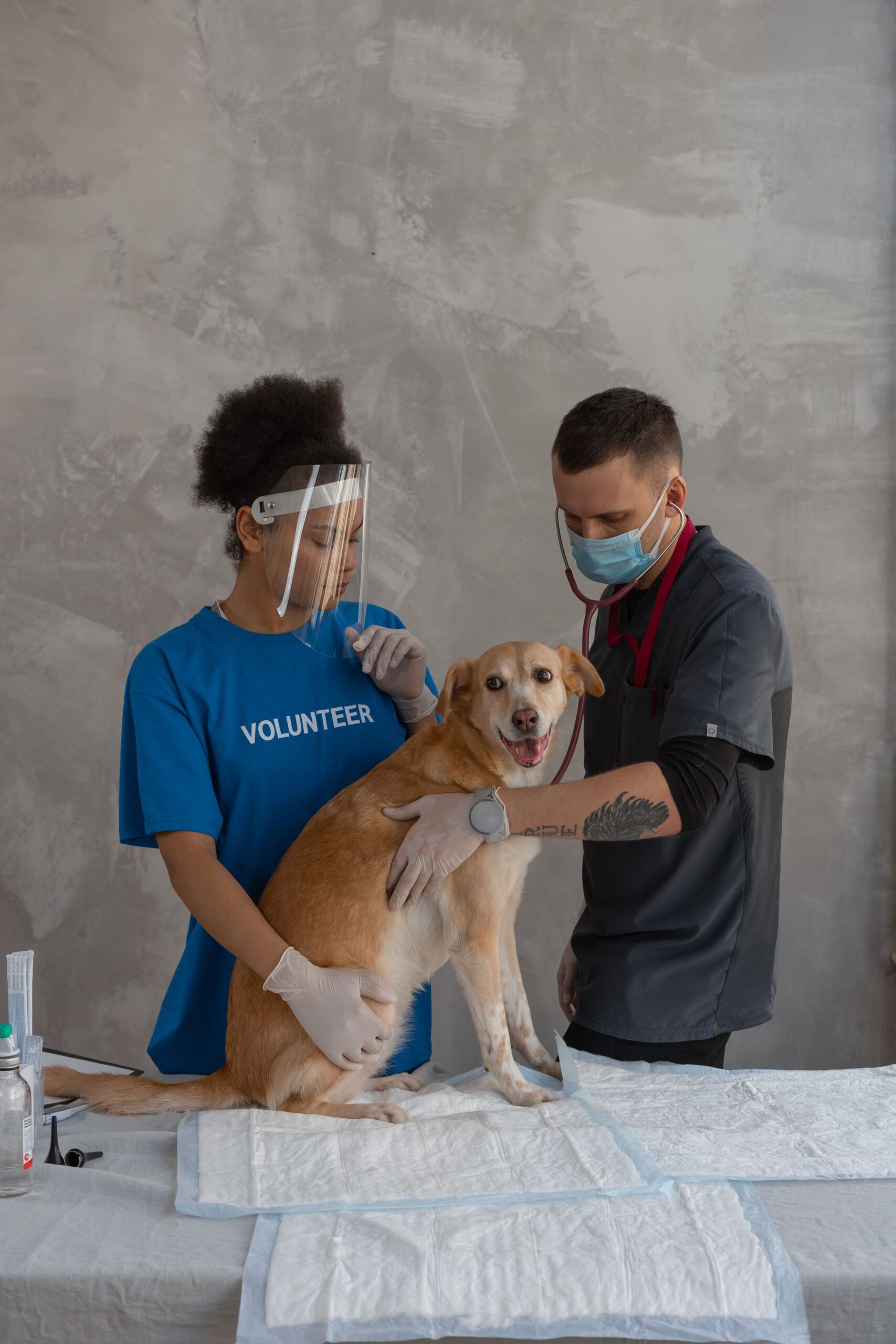
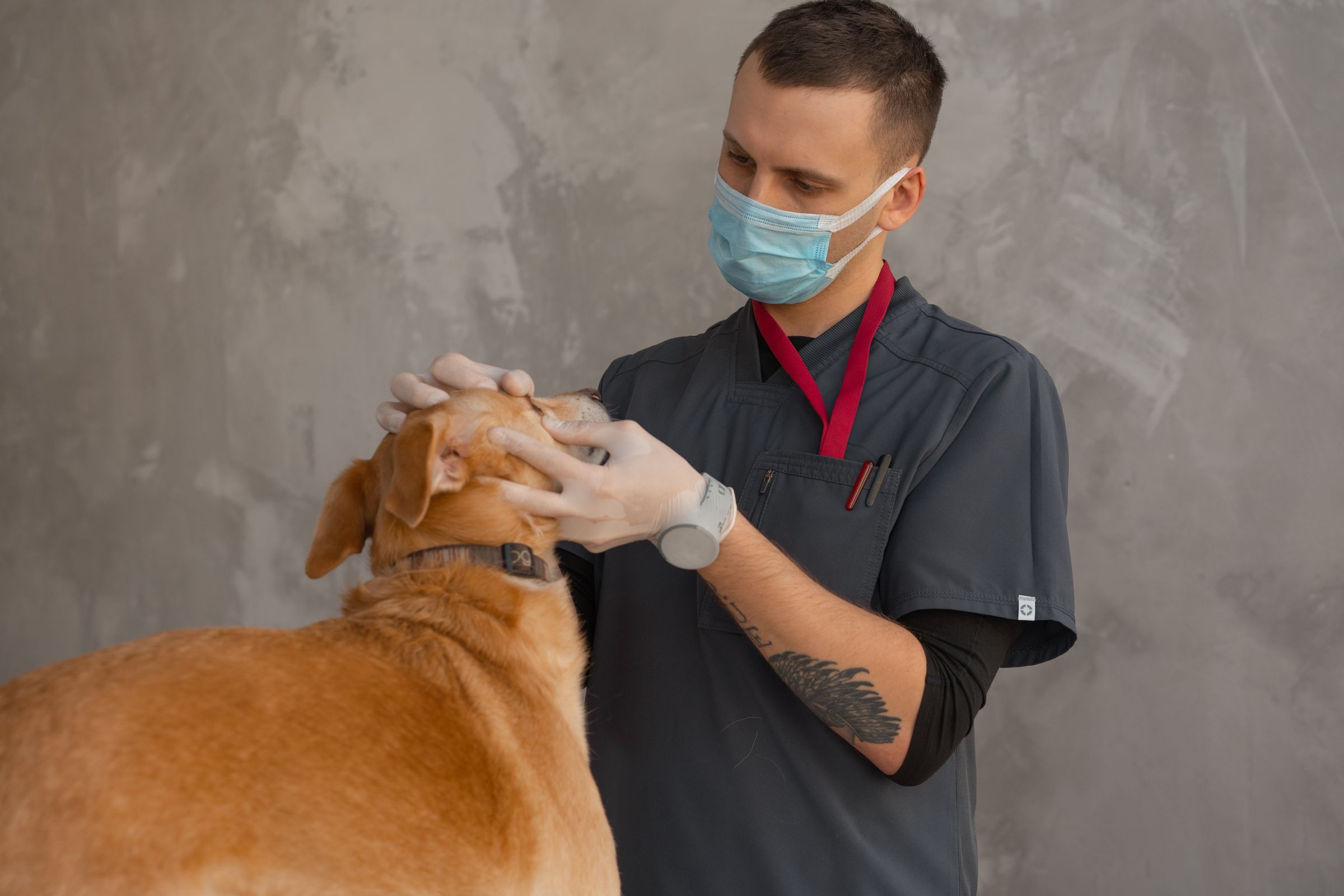
Veterinarian examining a dog during a check-up. Chocolate poisoning is treatable when caught early
Treated early, the vast majority of dogs make a full recovery. (Photo: Pexels)

What Will the Vet Do?

If the chocolate was eaten within the last couple of hours, the vet will usually induce vomiting with an injection, then give activated charcoal to absorb any theobromine already in the gut (sometimes repeated over 24 hours, because theobromine recirculates). Dogs with symptoms may need an intravenous drip to flush the toxin out, medication to control heart rate and tremors, and monitoring overnight. Prognosis is excellent when treatment starts early; it’s the untreated, high-dose cases, usually small dogs and dark or baking chocolate, that become fatal.

Other Hidden Dangers in Chocolate Products

  • Xylitol: a sweetener in “sugar-free” chocolate, gum and some baked goods. It’s far more toxic to dogs than chocolate, causing a dangerous blood-sugar crash and liver damage within an hour. Treat any xylitol ingestion as an emergency.
  • Raisins: in chocolate raisins, fruit-and-nut bars and Christmas cake. Even a handful can cause kidney failure; see why grapes and raisins are toxic to dogs.
  • Macadamia nuts: found in some luxury chocolates; cause weakness and tremors.
  • Fat and sugar: a big binge on any chocolate, even white, can trigger painful and sometimes serious pancreatitis a day or two later.
  • Foil and wrappers: can cause vomiting or an intestinal blockage.
Dark chocolate dusted with cocoa powder. Cocoa powder and baking chocolate are the most concentrated sources of theobromine
Cocoa powder and baking chocolate are the most concentrated. A few teaspoons matter for a small dog. (Photo: Pexels)

How to Keep Chocolate Away From Your Dog

  • Store chocolate in high, closed cupboards, not on tables, sofas or in handbags on the floor.
  • Be extra careful at Christmas, Easter, Halloween and Valentine’s. No chocolate under the tree, no eggs hidden where the dog can find them first.
  • Tell children and guests never to share sweets with the dog.
  • Avoid cocoa-shell mulch in the garden.
  • Teach a solid “leave it” and “drop it”. It will pay for itself the first time it works.
  • Want to treat your dog? Give banana slices, carrot sticks or blueberries instead. Carob-based “dog chocolate” is also safe, as it contains no theobromine.
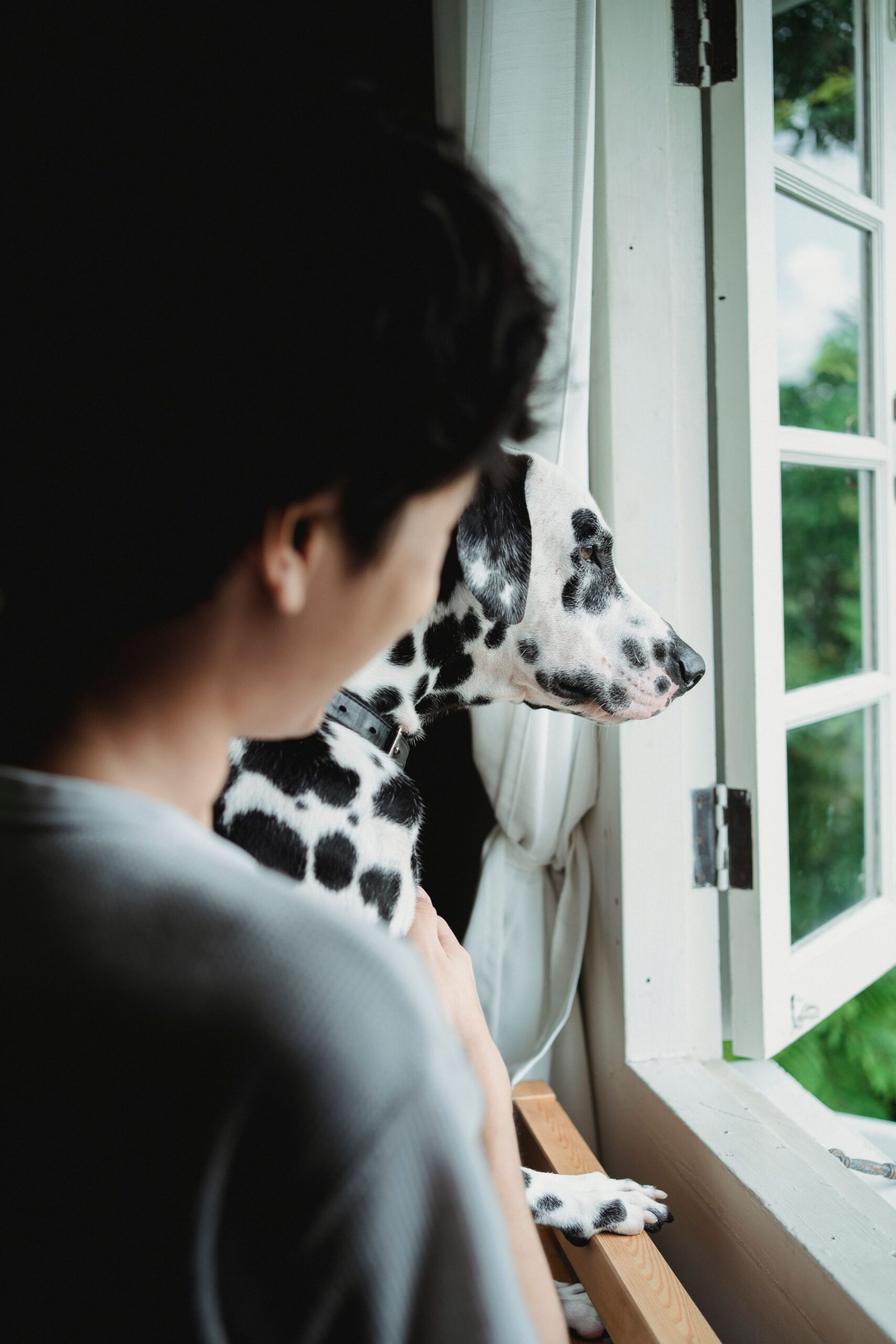
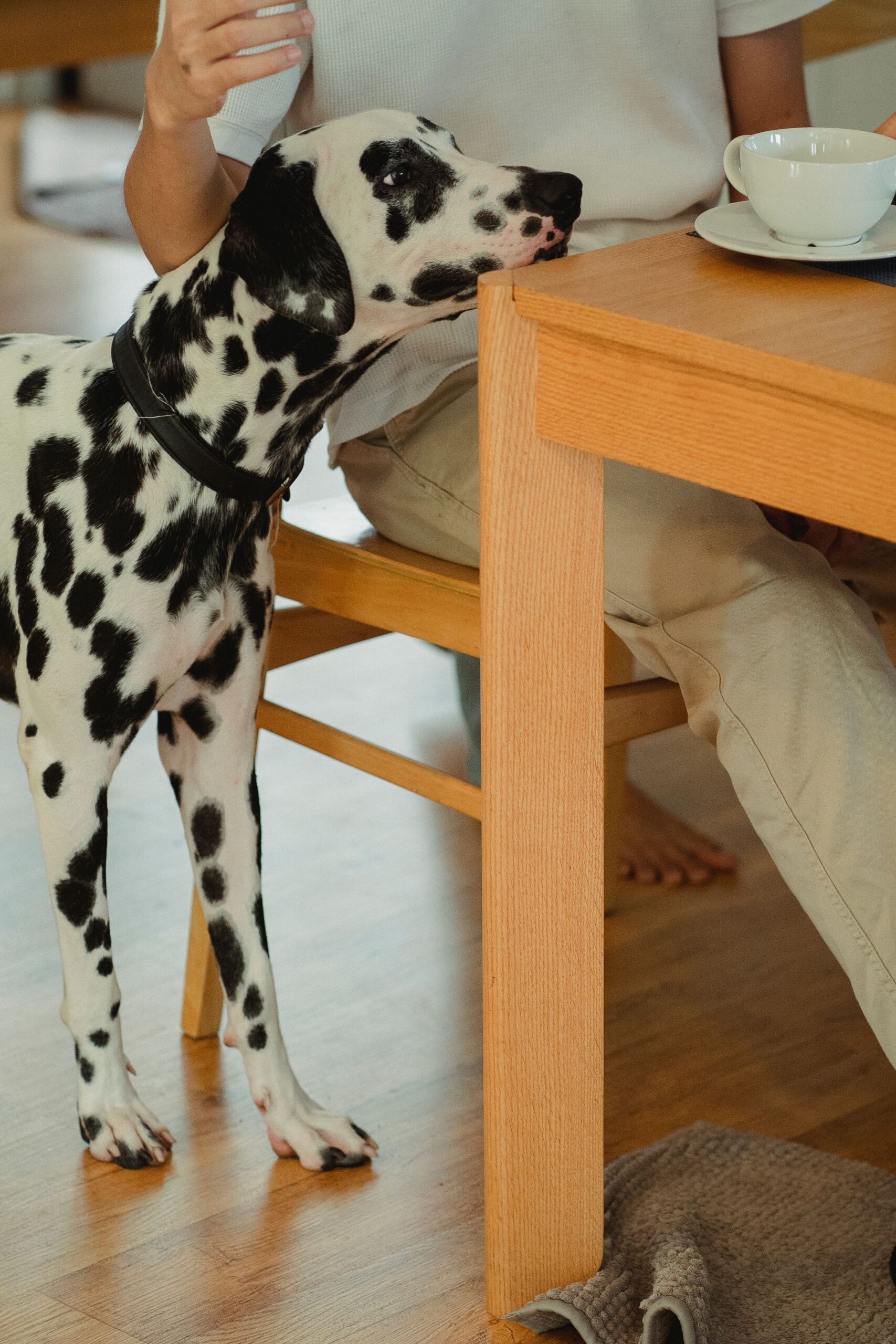
Dalmatian resting its head on a dining table next to its owner. Keep food and chocolate out of reach
If it’s on the table, assume it’s on the menu. (Photo: Pexels)

Frequently Asked Questions

Can dogs eat chocolate in small amounts?

A single small square of milk chocolate is unlikely to harm a medium or large dog, but there’s no “safe” amount. It’s just a question of how much it takes to cause problems, and for small dogs that can be very little. Don’t feed chocolate deliberately.

My dog ate chocolate but seems fine. Should I worry?

Possibly. Symptoms take 6 to 12 hours to appear. Work out the type and amount, compare it to the thresholds above, and call the vet if you’re anywhere near them or unsure.

Can dogs eat white chocolate?

White chocolate contains almost no theobromine, so chocolate poisoning is unlikely. But it’s very high in fat and sugar and can cause vomiting, diarrhoea or pancreatitis, so it’s still not a treat for dogs.

How long after eating chocolate will a dog get sick?

Typically 6 to 12 hours, occasionally sooner with large amounts of dark chocolate. Signs can persist for up to three days.

Can chocolate kill a dog?

Yes, at high doses. That means dark, baking or cocoa-powder chocolate in small dogs, especially if untreated. With prompt veterinary treatment, deaths are rare.

Is chocolate toxic to cats too?

Yes, and cats are even more sensitive per kilogram. They’re just less likely to eat it because they can’t taste sweetness. Keep it away from both.

Final Thoughts

So, can dogs eat chocolate? No, but panic isn’t necessary either. Grab the wrapper, do the maths on type, amount and weight, and ring the vet with the numbers. Treated early, almost every dog recovers completely. Put the chocolate somewhere the dog can’t reach, and if you want to spoil them, there are plenty of safe treats they’ll love just as much. Chocolate gets all the attention, but the poison that kills fastest around a house is antifreeze, and that one gives you hours rather than days.

Why Does My Cat Sleep on Me? 7 Reasons (and What the Spot Means)

0

It’s 2 a.m., you’re pinned to the mattress, and a warm, purring weight has settled on your chest, or your legs, or, on a really good night, your face. Why does my cat sleep on me? If you’ve ever asked that while trying not to move, here’s the good news: a cat who chooses to sleep on you is paying you the highest compliment it has. Cats are at their most vulnerable when asleep, and they do not sleep on things they don’t trust.

But there’s more to it than love. Warmth, scent, security, routine and a little bit of ownership all play a part, and where your cat sleeps on you says something too. This guide covers the seven real reasons cats sleep on people, what the spot they pick means, whether it’s healthy, and how to share a bed with a cat and still get some sleep.

7 Reasons Why Cats Sleep on You

1. You’re warm

Cats run hotter than we do, a normal feline body temperature is 38 to 39°C (100.5 to 102.5°F), and they lose heat quickly through their thin coats, so they’re always chasing warmth. You are a large, reliable, self-heating radiator. That’s why cats gravitate to your chest, lap and the crook of your knees, and why the sleeping-on-you habit often ramps up in winter.

2. You make them feel safe

Cats spend 12 to 16 hours a day asleep, and for a small predator that’s a long time to be vulnerable. In the wild, cats sleep in high, hidden or defended spots. In your home, the safest place on offer is next to the biggest, most trusted animal in the house, which is you. A cat sleeping on you is saying “I trust you to keep watch.”

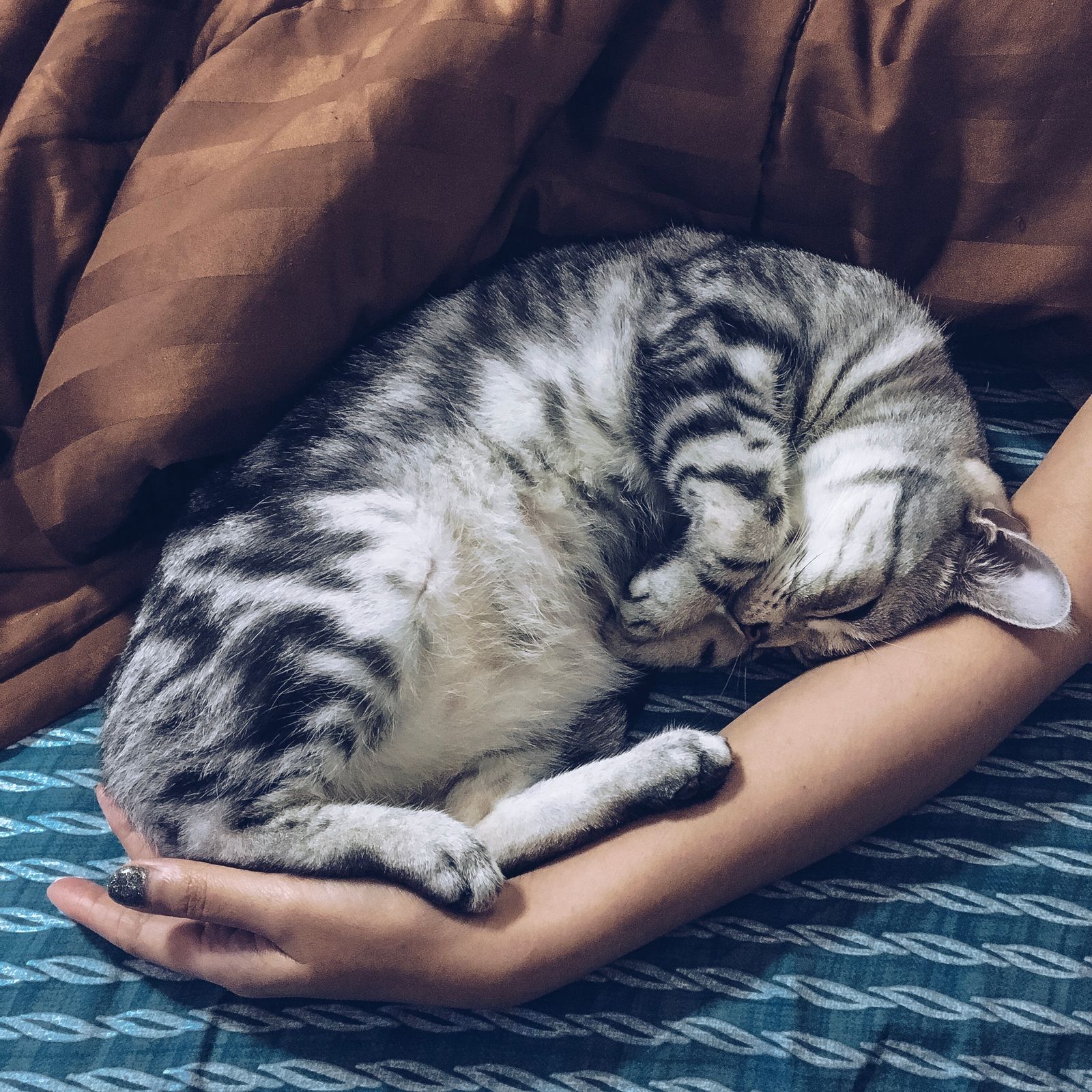
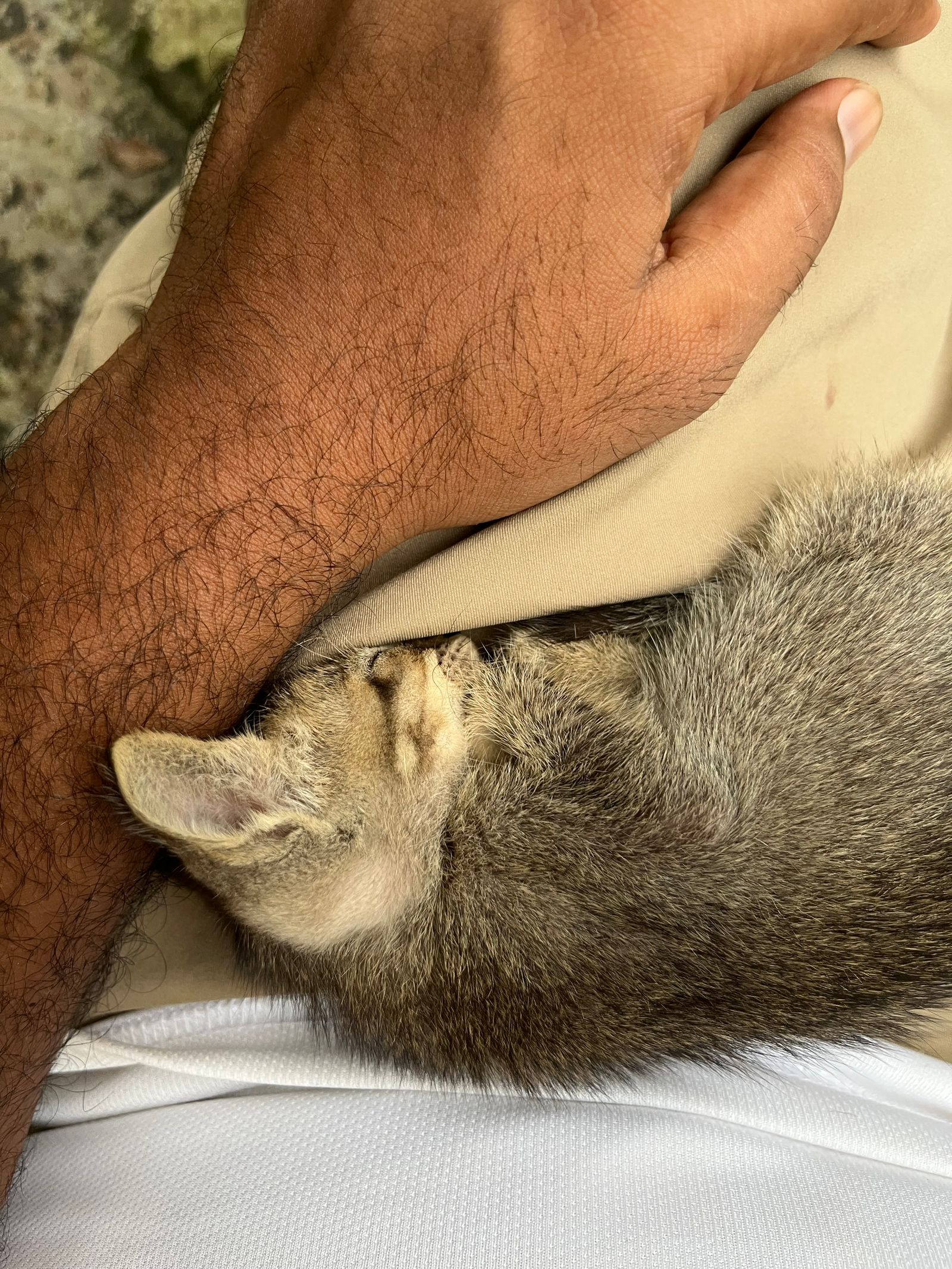
Grey tabby cat sleeping soundly on a person's arm, a cat that sleeps touching you trusts you completely
A cat that falls into deep sleep while touching you has decided you’re safe. (Photo: Pexels)

3. They’re bonding with you

Cats that live together and get along sleep in a heap. Behaviourists call it pillowing. It’s how bonded cats share warmth, scent and companionship. When your cat curls up on you, it’s including you in that inner circle. The same instinct is behind why your cat licks you and purrs when you stroke it.

4. You smell like home

Scent is how cats understand the world. Your skin, hair and bedding are saturated with your smell, and after a while, with theirs too. Sleeping on you lets your cat top up that shared “family scent”, and mark you as its territory. Cats have scent glands on their cheeks, paws and flanks, so all that kneading and cheek-rubbing before settling down is your cat signing its name on you.

5. It’s the routine

Cats love predictability. If you go to bed at the same time each night and stay still for eight hours, you’ve become the most dependable sleeping spot in the house. Many cats also learn that sleeping on you means being first in line for breakfast.

Sleeping kitten curled up on a person's lap, cats choose warm, safe places to sleep
Kittens learn early that a lap is warm, safe and rarely moves. (Photo: Pexels)

6. Your heartbeat and breathing are soothing

The slow rhythm of a resting human’s heartbeat and breathing has a calming effect on cats. It mimics the feeling of being curled up with mum and littermates as a kitten. This is why the chest is such a popular spot, and why cats often start purring the moment they settle there.

7. They’re claiming you

In a multi-cat or multi-person household, the cat who sleeps on you may be making a point. Sleeping on a resource is a quiet way of saying “mine”, and to your cat, you are a resource: warmth, food, safety and affection all in one.

What It Means Where Your Cat Sleeps on You

  • On your chest: warmth plus heartbeat. The most affectionate spot; your cat wants to be as close as possible.
  • On your head or pillow: your head is the warmest part of you and moves the least at night. Some cats also love the smell of your hair.
  • On your lap: comfort and attention. It’s the daytime version of the chest.
  • Between your legs or in the crook of your knees: a warm, walled “nest” that feels protected on three sides.
  • On your feet: affection with an escape route. Cats that sleep at the foot of the bed like you nearby but want to be able to leave quickly. Common with more independent or slightly anxious cats.
  • Back to you, facing away: not a snub. Cats guard the direction they think danger might come from and trust you to cover the rest.
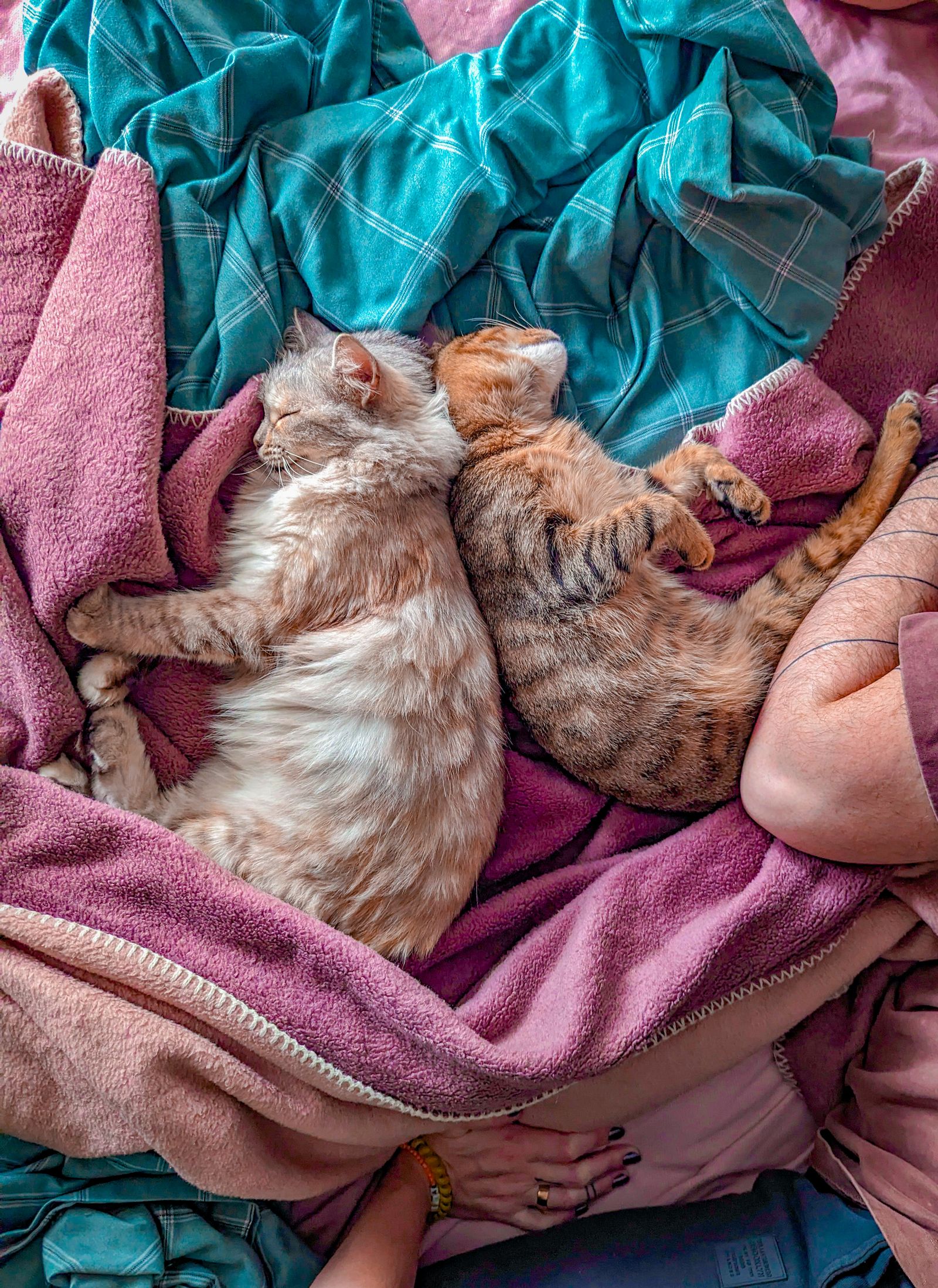
Two cats sleeping on a bed next to their owner, sharing a bed is normal social behaviour for bonded cats
Bonded cats sleep in a pile, and you count as part of the pile. (Photo: Pexels)

Is It Good for You, and for Your Cat?

For you: mostly yes. Sleeping with a purring cat lowers stress and anxiety for many people, and a cat’s purr (25 to 150 Hz) is genuinely relaxing. The downsides are real, though: disrupted sleep (cats are crepuscular, most active at dawn and dusk), allergies, and a small hygiene risk if your cat uses a litter tray then walks on your pillow. Anyone with asthma, severe allergies or a weakened immune system should think twice. Babies and toddlers should never share a bed with a cat.

For your cat: it’s a healthy sign of a secure, bonded cat. The only concern is if the sleeping-on-you is sudden and intense: a cat that suddenly won’t leave you alone may be anxious, cold, unwell or in pain. Cats also seek out warmth more when they’re older, arthritic or losing weight, so a new obsession with your lap in a senior cat is worth a vet check. See our guide to how long cats live and how to help them age well.

Why Does My Cat Sleep on Me and Not My Partner?

This one causes arguments in a lot of households. The usual reasons: you’re warmer, you move less in your sleep, you feed the cat, you smell more familiar, or you were simply the person the cat bonded with first. Cats also tend to prefer people who let them approach on their own terms rather than grabbing them for cuddles. If your partner wants a turn, the fix is patience, treats, and lying still.

Woman relaxing in bed with her sleeping cat, how to share a bed with your cat and still sleep well
You can share a bed with a cat and still sleep. It just takes a routine. (Photo: Pexels)

How to Sleep Well With a Cat on You

  1. Play before bed. A 10 to 15 minute wand-toy session followed by a meal mimics the hunt-eat-groom-sleep cycle and takes the edge off the 4 a.m. zoomies.
  2. Feed the last meal late. A full cat is a sleepy cat. An automatic feeder set for early morning stops the dawn wake-up call.
  3. Offer a heated bed on the bed. A self-warming pad by your feet gives your cat the warmth without the chest-crushing.
  4. Keep the litter tray clean and wipe paws if hygiene worries you.
  5. Wash bedding weekly if you’re allergy-prone, and keep the cat off the pillow.
  6. Don’t reward 3 a.m. wake-ups. If you get up and feed the cat, you’ve trained it. Stay still; it passes.

How to Stop Your Cat Sleeping on You (If You Need To)

If it’s genuinely ruining your sleep, don’t just shut the cat out abruptly. That causes crying at the door and stress. Instead, make somewhere else better: a heated cat bed on a chair next to the bed, a blanket that smells of you, and a treat there at bedtime. Move it gradually further away if you want the cat out of the room altogether. Most cats accept a “next to you” compromise within a couple of weeks.

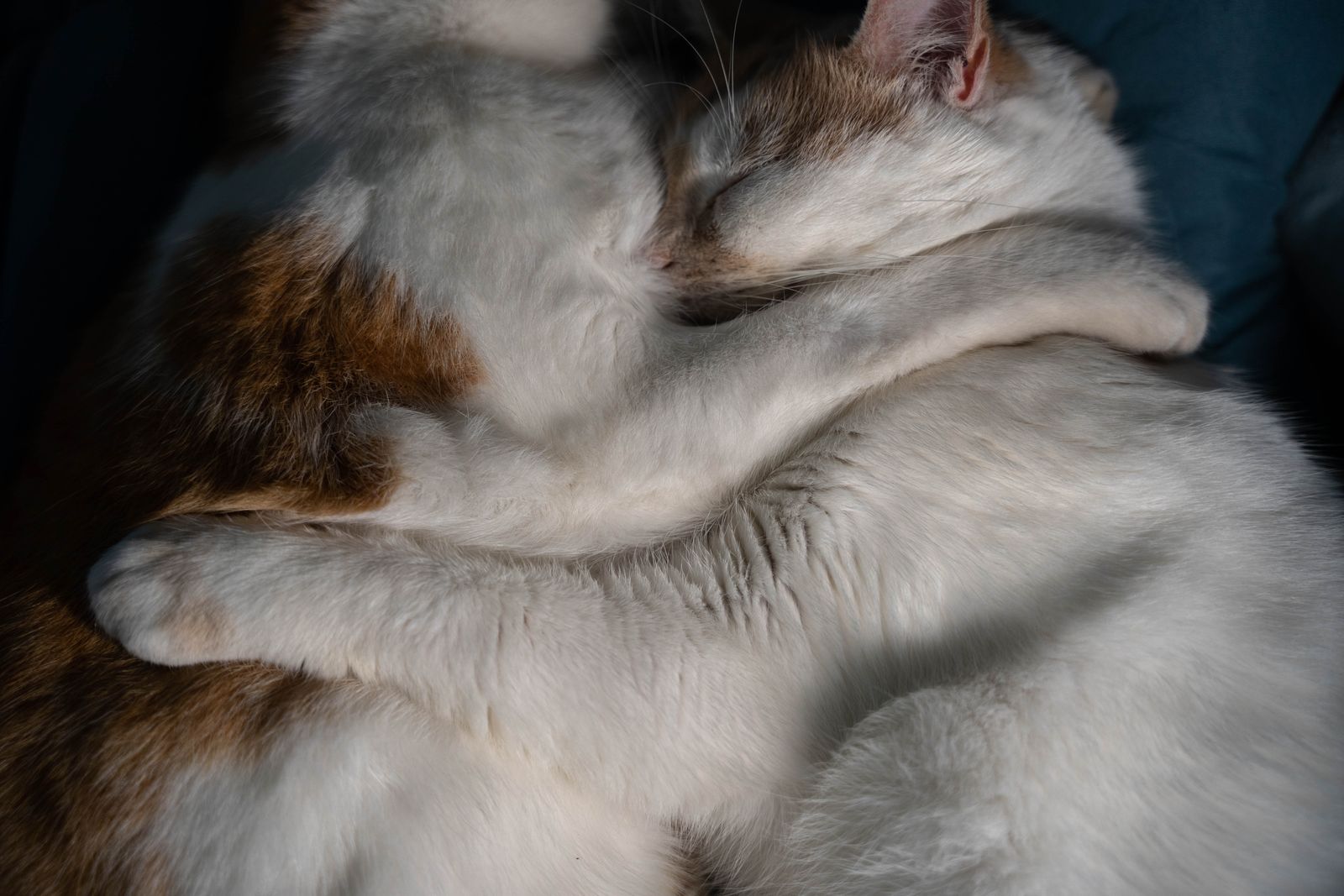
Two cats snuggled together asleep, cats sleep in a pile with the cats they trust, and you are in that circle
Cats only sleep in contact with animals they trust. Being chosen is a compliment. (Photo: Pexels)

Frequently Asked Questions

Why does my cat sleep on my chest?

Warmth, your heartbeat, and closeness. The chest is the warmest, most rhythmic part of you. It feels like being curled up with mum. It’s the strongest sign of affection a sleeping cat can give.

Why does my cat sleep on my head?

Your head is the warmest, stillest part of you at night, and your hair carries your scent. Cats that sleep on heads also like the elevated position. It’s the highest point on the bed.

Why does my cat sleep on my feet?

It wants to be near you but keep an exit route. Foot-sleepers are often slightly more independent or cautious cats. It’s still affection, just affection with a plan B.

Why does my cat sleep on me when I’m sick?

Partly warmth, because fevers make you a better radiator, and partly because you’re lying still for longer. Cats also pick up on changes in your scent, breathing and behaviour, and many seem to respond by sticking close.

Is it OK to let my cat sleep in my bed?

For healthy adults, yes, as long as your cat is flea-treated, wormed and using a clean litter tray. Keep cats out of babies’ and toddlers’ beds, and out of the bedroom if you have asthma or severe allergies.

Does my cat sleeping on me mean it loves me?

Yes. Cats don’t sleep on things they don’t trust, and they don’t seek out contact with people they don’t like. It’s one of the clearest signs of a bonded cat.

Final Thoughts

So, why does my cat sleep on me? Because you’re warm, you’re safe, you smell like home, and, in your cat’s eyes, you’re family. Enjoy it, set a bedtime routine so you both actually sleep, and only worry if the clinginess is new and sudden. For more on what your cat is really telling you, read why does my cat lick me? and 8 signs your cat is stressed.

Why Does My Dog Lick Me? 9 Reasons and When to Worry

0

You sit down, your dog trots over, and within seconds a warm, wet tongue is working its way across your hand, your arm or, if you let it, your entire face. Why does my dog lick me? It’s one of the most searched questions dog owners ask, and the short answer is reassuring: most of the time your dog is telling you it loves you. But licking is also how dogs communicate hunger, stress, curiosity and, occasionally, that something isn’t right.

This guide covers the nine real reasons dogs lick people, what it means when the licking is aimed at your face, hands or feet, whether “dog kisses” are safe, when licking is a warning sign, and how to gently reduce it if it’s getting a bit much.

9 Reasons Why Dogs Lick You

1. Affection, it really is a “dog kiss”

The most common reason by far. Licking releases endorphins in a dog’s brain, so it feels good, and dogs learn early that licking the people they love earns cuddles, attention and warm words. Mother dogs lick their puppies from the moment they’re born, and adult dogs lick pack members they’re bonded to. When your dog licks you, it’s treating you as family.

2. Instinct they were born with

Puppies lick their mother’s mouth to ask her to regurgitate food, a behaviour wolves still show in the wild. That instinct never fully disappears. A dog that licks your face or mouth, especially when you’ve just eaten, is running a very old piece of programming.

Two dogs affectionately licking each other in warm sunlight, licking is natural social behaviour between bonded dogs
Dogs lick the pack members they’re bonded to, and you count as pack. (Photo: Pexels)

3. You taste good

Human skin is salty, and after a workout, a hot day or a meal it carries all sorts of interesting flavours: sweat, food residue, hand cream, sun lotion, the dog next door. Dogs have far fewer taste buds than we do (around 1,700 versus our 9,000), but a superb nose, and licking is how they “read” the smells on your skin.

4. Gathering information

Dogs have a second scent organ, the Jacobson’s (vomeronasal) organ, in the roof of the mouth. Licking pushes scent molecules towards it, giving your dog a chemical read-out of where you’ve been, who you’ve touched and how you’re feeling. That’s why many dogs lick you more intensely when you come home.

5. Seeking attention

If licking gets a laugh, a stroke, eye contact or a “stop it!” (which is still attention), a smart dog will repeat it. Dogs that lick you when you’re on your phone, working or watching TV have usually learned that a lick is the fastest way to get you to look at them.

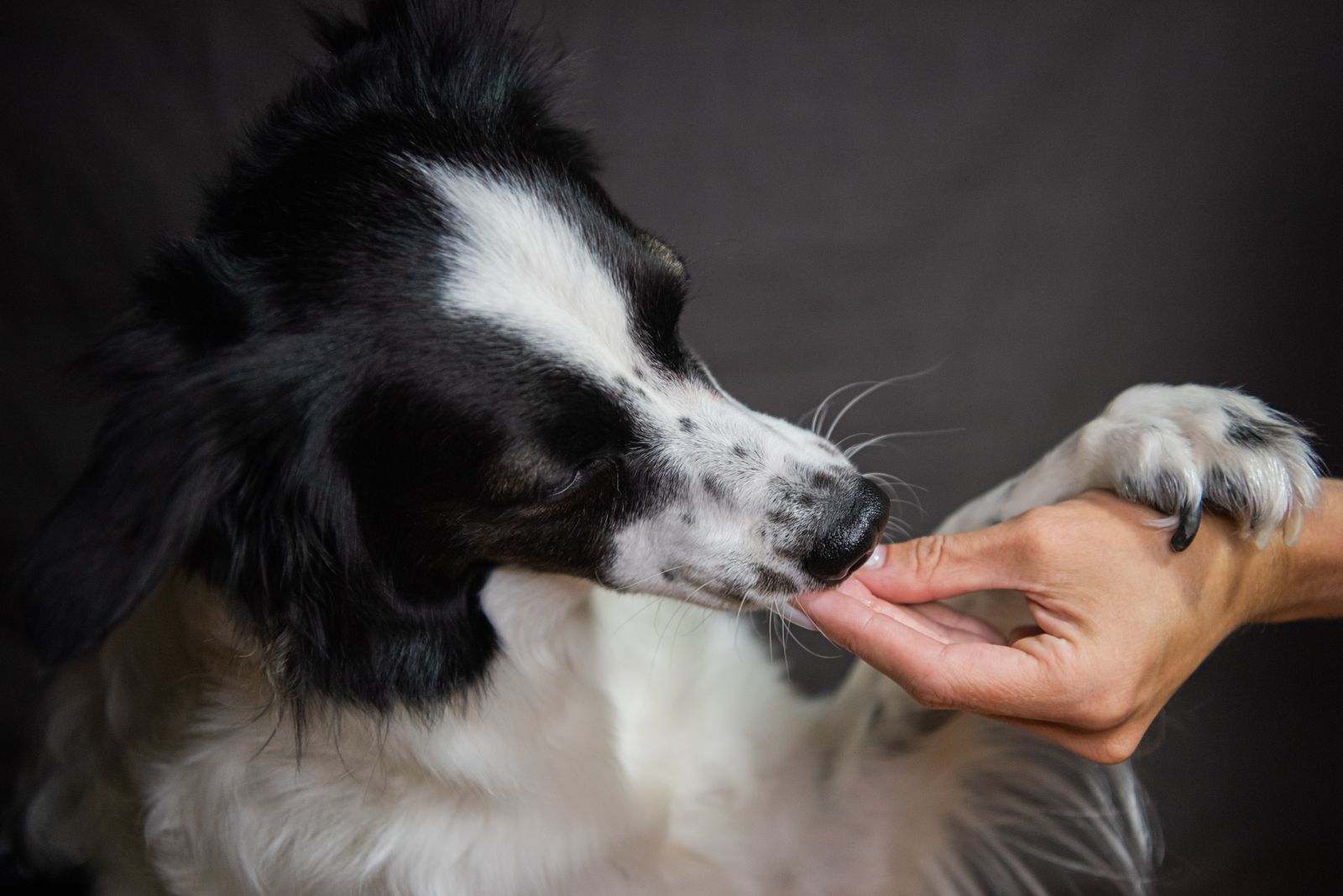
Close-up of a black and white dog licking a person's hand, a classic sign of affection and attention-seeking
A quick lick of the hand is a polite way of saying “Hey. Human. Look at me.” (Photo: Pexels)

6. Empathy and comfort

Studies have found that dogs are more likely to approach and lick people who are crying or upset than people who are humming or talking normally. If your dog licks you when you’re sad, stressed or unwell, it’s almost certainly trying to comfort you, the same way it would soothe a distressed pack member.

7. Asking for something

Licking around meal times, near the door, or beside an empty water bowl is a request. Dogs quickly learn which behaviours get results, and a lick followed by a stare at the treat cupboard is not subtle.

8. Stress, anxiety or boredom

Licking is self-soothing, so an anxious or under-stimulated dog may lick you, the sofa, the floor or itself far more than usual. Watch for other stress signals: yawning, lip-licking, whale eye (whites of the eyes showing), pacing, panting when it isn’t hot. New babies, house moves, fireworks and long hours alone are common triggers. More exercise, mental enrichment (puzzle feeders, sniff walks) and a predictable routine usually help.

9. A medical problem

Less commonly, a sudden increase in licking, of you, of objects, or of the dog’s own paws, points to something physical: nausea (dogs lick and drool when they feel sick), dental pain, allergies, an itchy skin condition, arthritis, or in older dogs, cognitive decline. Compulsive licking that the dog can’t be distracted from deserves a vet visit.

Brown puppy lying down and licking its paw, excessive paw licking can signal allergies, pain or anxiety
Paw licking that won’t stop is one of the most common signs of allergies or anxiety in dogs. (Photo: Pexels)

What It Means Where Your Dog Licks You

  • Face and mouth: the strongest affection and submission signal, rooted in puppy behaviour. Also the tastiest spot after meals.
  • Hands: taste and information gathering. Your hands touch everything, so they carry the most smells.
  • Feet: feet are sweaty and salty, and feet smell strongly of you. Foot-licking is usually pure affection plus flavour.
  • Ears: ear wax has a distinctive smell dogs find fascinating. Mildly gross but harmless.
  • Wounds or sore spots: dogs instinctively lick injuries. Don’t let them: dog saliva can introduce bacteria and slow healing.

Is It Safe to Let My Dog Lick Me?

For healthy adults, yes, with a few sensible limits. A dog’s mouth isn’t “cleaner than a human’s” (that’s a myth); dog saliva can carry bacteria such as Pasteurella, Salmonella and, rarely, Capnocytophaga, plus parasite eggs if the dog isn’t wormed.

  • Don’t let your dog lick open cuts, scratches or broken skin.
  • Avoid licks on the mouth, eyes and nose, where bacteria can enter easily.
  • Wash your hands after being licked, especially before eating.
  • Be extra careful with babies, young children, elderly relatives, pregnant women and anyone with a weakened immune system.
  • Keep your dog wormed, flea-treated, vaccinated and with clean teeth. Our guide to getting rid of fleas on dogs covers the parasite side.
Dog gently licking a child's hand indoors, supervise licking around children and wash hands afterwards
Dog kisses and kids are fine together, just supervise, keep it off the face, and wash hands after. (Photo: Pexels)

When Licking Is a Red Flag

Book a vet appointment if you notice any of the following:

  • Licking that starts suddenly or gets much more intense than usual
  • Licking paired with drooling, lip-smacking, gulping or refusing food (nausea)
  • Constant licking of one paw, leg or patch of skin, especially with redness or hair loss
  • Licking the air, floor or walls repeatedly (can be gastrointestinal or neurological)
  • Licking that the dog cannot be distracted from, or that stops it sleeping

How to Stop a Dog Licking You Too Much

You don’t need to stop licking altogether. It’s healthy, normal bonding. But if it’s excessive, slobbery or embarrassing when guests visit, these steps work without punishment:

  1. Ignore it completely. The moment the tongue comes out, stand up, turn away and withhold eye contact. Attention is the reward; remove it.
  2. Reward the alternative. When your dog sits or lies calmly beside you instead, praise and stroke it. You’re teaching “calm gets cuddles, licking gets nothing”.
  3. Redirect. Offer a lick mat, a stuffed KONG or a chew. It satisfies the urge to lick in a way you’re happy with.
  4. Wash off the temptation. Shower after exercise, skip scented lotions before cuddle time, and wash your hands after cooking.
  5. Burn off the energy. A tired, mentally stimulated dog licks far less. Add a sniff walk, training session or puzzle feeder to the day.
  6. Be consistent. Everyone in the house needs to follow the same rule, or the dog will simply lick the person who still rewards it.

Never shout at or push a dog away for licking. It either reads as play (more licking) or as scary (more stress licking).

Frequently Asked Questions

Why does my dog lick me so much?

Usually because it works: licking earns attention, and it feels good to the dog. Excessive licking can also mean boredom, anxiety or a medical issue, so if it’s new or obsessive, rule out health problems first.

Why does my dog lick me when I pet him?

It’s a return of affection. You groom the dog, the dog grooms you. Many dogs also lick during stroking because being touched is slightly arousing, and licking helps them stay calm.

Why does my dog lick my face in the morning?

Morning licks combine greeting, affection, “I’m hungry/need to go out”, and the fact that you smell strongly of sleep and last night’s dinner. Dogs greet returning pack members by licking their faces.

Why does my dog lick my feet?

Feet are salty and carry your unique scent. Foot-licking is mostly taste plus affection, and some dogs find the sweat glands on feet particularly interesting. It’s harmless unless you have athlete’s foot or cuts.

Do dogs lick to show dominance?

No. Licking is a submissive, appeasing and affectionate behaviour, not a dominant one. The “dominance” theory of dog behaviour has been widely discredited by modern behaviourists.

Why does my dog lick my wounds?

Instinct. Dogs lick their own injuries and those of pack members. Dog saliva does contain some antibacterial compounds, but it also carries harmful bacteria, so keep dogs away from human wounds.

Final Thoughts

So, why does my dog lick me? Nine times out of ten it’s affection, greeting, or a bit of harmless flavour-hunting, the canine equivalent of a hug. Enjoy it, keep it off your face and any cuts, and only worry if the licking suddenly changes or turns obsessive. If you share your home with a cat too, you might be surprised how similar the reasons are. See why does my cat lick me?, and for the other big question owners ask, read our guide on why dogs eat grass.

How Much Should I Feed My Cat? Portions by Weight, Age and Food Type

0

How much should I feed my cat? It’s a surprisingly hard question to answer from the back of a food packet. The feeding guides are generous, cats vary enormously, and “one cup” means something different for every brand. The result is that more than half of pet cats are overweight, and obesity is now the biggest nutritional problem vets see in cats.

This guide gives you the numbers: how many calories your cat actually needs, a feeding chart by weight, portion sizes for kittens, adults and seniors, how to convert calories into grams of wet or dry food, how often to feed, and how to tell whether you’re getting it right.

How Many Calories Does a Cat Need?

The single most useful number is your cat’s daily calorie requirement. Vets calculate it from body weight, then adjust for age, activity and whether the cat is neutered. As a rule of thumb:

  • Typical indoor, neutered adult cat: 20 calories per pound (about 45 per kg) of ideal body weight per day.
  • A 10 lb (4.5 kg) cat therefore needs roughly 200 calories a day.
  • Active, outdoor or intact cats may need 25 to 30% more; overweight or elderly cats often need less.

Note the words ideal body weight. If your cat is already overweight, feed for the weight it should be, not the weight it is.

Cat Feeding Chart by Weight (Adult Cats)

Ideal weight Calories per day (indoor, neutered) Approx. dry food* Approx. wet food*
2.5 kg (5.5 lb) 120 to 140 kcal 30 to 35 g 1½ pouches (85 g)
3.5 kg (8 lb) 160 to 180 kcal 40 to 45 g 2 pouches
4.5 kg (10 lb) 200 to 220 kcal 50 to 55 g 2½ pouches
5.5 kg (12 lb) 230 to 250 kcal 58 to 63 g 3 pouches
6.5 kg (14 lb) 260 to 280 kcal 65 to 70 g 3½ pouches

*Based on an average dry food of 400 kcal per 100 g and wet food of 80 kcal per 85 g pouch. Always check the calorie content (“kcal/100 g” or “ME”) printed on your food’s label, as it varies a lot between brands.

Overhead view of a tabby cat eating dry food from a bowl, measuring dry cat food portions
Weigh food with kitchen scales. A ‘cup’ can vary by 30% depending on the kibble. (Photo: Pexels)

How to Work Out the Exact Portion for Your Food

  1. Find the calories on the packet, usually written as kcal per 100 g (dry) or kcal per pouch/can (wet).
  2. Divide your cat’s daily calories by that number. Example: a 200 kcal cat on a dry food of 380 kcal/100 g needs 200 ÷ 380 × 100 = 53 g a day.
  3. Weigh it with kitchen scales. Measuring cups are unreliable. Different kibble shapes and sizes mean a “cup” can vary by 30% or more.
  4. Subtract treats. Treats should be no more than 10% of daily calories (about 20 kcal for a typical cat, so that’s only 3 to 4 commercial treats).

How Much to Feed a Kitten

Kittens need two to three times the calories per kilogram of an adult cat because they’re growing so fast. They also have tiny stomachs, so they need frequent meals:

Age Meals per day Notes
4 to 8 weeks 4 to 6 (weaning) Wet kitten food mashed with a little water or kitten milk replacer
2 to 4 months 4 Complete kitten food; feed as much as they will eat in 20 minutes
4 to 6 months 3 Growth slows; start measuring portions using the packet’s kitten guide
6 to 12 months 2 to 3 Move gradually to adult portions; switch to adult food at 12 months (18 for large breeds like Maine Coons)

Always feed a food labelled “kitten” or “all life stages”. Adult food doesn’t contain enough protein, fat or calcium for growth.

Ginger kitten eating from a red bowl, kittens need several small meals a day
Kittens burn through calories fast and need three to four meals a day until six months. (Photo: Pexels)

How Much to Feed a Senior Cat

Cats over 7 tend to become less active, so many need 10 to 20% fewer calories to avoid weight gain. From about 11 onwards, however, digestion becomes less efficient and many cats start losing weight and muscle. Senior cats do best on a highly digestible, high-protein food fed in smaller, more frequent meals. Weigh your senior cat monthly. Unexplained weight loss is the earliest sign of common conditions like kidney disease, hyperthyroidism and diabetes, all of which are treatable when caught early.

Wet Food vs Dry Food: How Much of Each?

  • Wet food is about 75 to 80% water, so it’s low in calories per gram (roughly 70 to 100 kcal per 85 g pouch or 3 oz can). It helps cats stay hydrated, which supports the kidneys and bladder, and is more filling, good for weight control.
  • Dry food is calorie-dense (350 to 450 kcal per 100 g), convenient and better for puzzle feeders, but it’s easy to over-pour and cats on dry-only diets drink less than they should.
  • Mixed feeding is a popular compromise: for a 200-kcal cat, one 80-kcal pouch morning and evening plus about 10 g of dry food, or one pouch plus 30 g of dry.

Whichever you choose, the total calories are what matter. If you switch foods, do it gradually over 7 to 10 days to avoid stomach upsets.

How Often Should I Feed My Cat?

Cats are natural grazers that would eat 10 to 20 small prey meals a day in the wild. For most pet cats, two meals a day (morning and evening) is the practical minimum; three or four smaller meals is better still if your schedule allows, and automatic feeders make this easy. Regular timed meals also let you notice quickly when a cat goes off its food, an important early warning sign.

Should I free-feed my cat?

Leaving dry food down all day works for a minority of self-regulating cats, but for most it’s the fastest route to obesity, and it makes appetite changes impossible to spot. If you do free-feed, measure the day’s total portion out in the morning and don’t top up.

Chubby grey tabby cat lying on a stone surface, over half of pet cats are overweight
You should be able to feel your cat’s ribs easily but not see them. (Photo: Pexels)

Is My Cat the Right Weight? The Body Condition Check

Scales tell you the number; the body condition score tells you whether it’s right. Run your hands over your cat:

  • Ideal: you can feel the ribs easily under a thin layer of fat but not see them; there’s a visible waist behind the ribs from above and a slight tummy tuck from the side.
  • Overweight: ribs are hard to feel, no waist, a rounded belly and a fat pad swinging under the tummy (a small “primordial pouch” is normal, a heavy swinging pouch is not).
  • Underweight: ribs, spine and hip bones visible; an obvious hollow behind the ribs.

Weigh your cat at home monthly (weigh yourself holding the cat, then without) and adjust portions by about 10% at a time. Aim for weight loss of no more than 1 to 2% of body weight per week. Crash dieting a cat can cause fatty liver disease, which is life-threatening.

Common Feeding Mistakes

  1. Trusting the packet guide blindly: guides are written for active, intact cats and usually overfeed neutered indoor cats.
  2. Eyeballing portions: use scales.
  3. Ignoring treats and “just a bit” of human food: a single tablespoon of cheese is a tenth of a cat’s daily calories.
  4. Feeding for the weight the cat is rather than the weight it should be.
  5. Giving milk: most adult cats are lactose intolerant.
  6. Letting multiple cats share a bowl: the dominant cat gets fat and the shy one goes hungry.
Two domestic cats eating from separate bowls at home, feed multi-cat households separately
In multi-cat homes, separate bowls (and rooms) stop one cat eating everyone’s dinner. (Photo: Pexels)

Frequently Asked Questions

How much wet food should I feed my cat per day?

For an average 4.5 kg (10 lb) indoor cat, about 2½ standard 85 g pouches (roughly 200 kcal) a day if fed wet food only. Check your brand’s calories. Some pouches are 60 kcal, others over 100.

How much dry food should I feed my cat?

Usually 45 to 65 g a day for an average adult, depending on the food’s calorie density. Weigh it rather than using a cup.

Why is my cat always hungry?

Some cats are simply food-driven, but constant hunger with weight loss can indicate hyperthyroidism, diabetes, parasites or a poor-quality diet. If your cat is eating well yet losing weight, see your vet.

Can I feed my cat once a day?

Adult cats can cope, but it isn’t ideal. They may vomit bile on an empty stomach and are more likely to overeat. Twice a day is the sensible minimum.

How much should a cat eat by age?

Kittens: as much as they want in frequent small meals. Adults (1 to 7): around 20 kcal per lb of ideal weight. Seniors: often 10 to 20% less, unless they’re losing weight.

Final Thoughts

So, how much should you feed your cat? Roughly 20 calories per pound of ideal body weight, split into at least two meals, weighed rather than guessed, and adjusted every month based on what your hands tell you about your cat’s ribs and waist. Getting this right is one of the biggest things you can do for your cat’s health: lean cats live longer, and our guide on how long cats live explains why. And if your cat is off its food rather than hungry, check the signs your cat is stressed.

One thing worth checking beyond portion size is what is actually in the food. The FDA found eight lots of one cat food with almost no thiamine in 2026, and cats store so little of it that deficiency shows up within weeks. Here are the signs of thiamine deficiency in cats and the head posture that means call the vet today.

Food safety is the other half of the feeding question. If you are weighing up a raw diet, the FDA’s own testing found roughly one in four raw samples positive for Salmonella or Listeria, which we unpack in is raw pet food safe.

How to Get Rid of Fleas on Dogs: A Complete Step-by-Step Guide

0

Your dog is scratching, you’ve spotted a tiny dark speck jumping in its coat, and now you want to know how to get rid of fleas on dogs: fast and for good. The good news: flea infestations are very treatable. The bad news: most people treat only the dog, and the fleas keep coming back. That’s because the fleas you can see are just 5% of the problem. The other 95% are eggs, larvae and pupae hidden in your carpets, bedding and sofa.

This guide walks you through the whole job: confirming fleas, treating your dog, treating your home, breaking the flea life cycle, and stopping them from returning. Follow all the steps, not just the first one, and you’ll be flea-free within a few weeks.

Signs Your Dog Has Fleas

  • Scratching, biting and licking: especially around the base of the tail, back legs, belly and groin
  • Flea dirt: tiny black specks in the coat that look like ground pepper (it’s flea faeces, digested blood)
  • Live fleas: small, dark brown, fast-moving insects, most easily seen on the belly or at the base of the tail
  • Red bumps or scabs, hair loss and hot spots, particularly on the lower back
  • Restlessness and sudden jumping up as if bitten
  • Pale gums in puppies or small dogs, a sign of flea anaemia, which is an emergency
  • Tapeworm segments (like grains of rice) near the tail, because fleas carry tapeworm

The paper towel test

Run a fine-toothed flea comb through the coat and tap the debris onto a damp white paper towel. If the black specks smear red-brown, it’s flea dirt and your dog has fleas, even if you never see a live one.

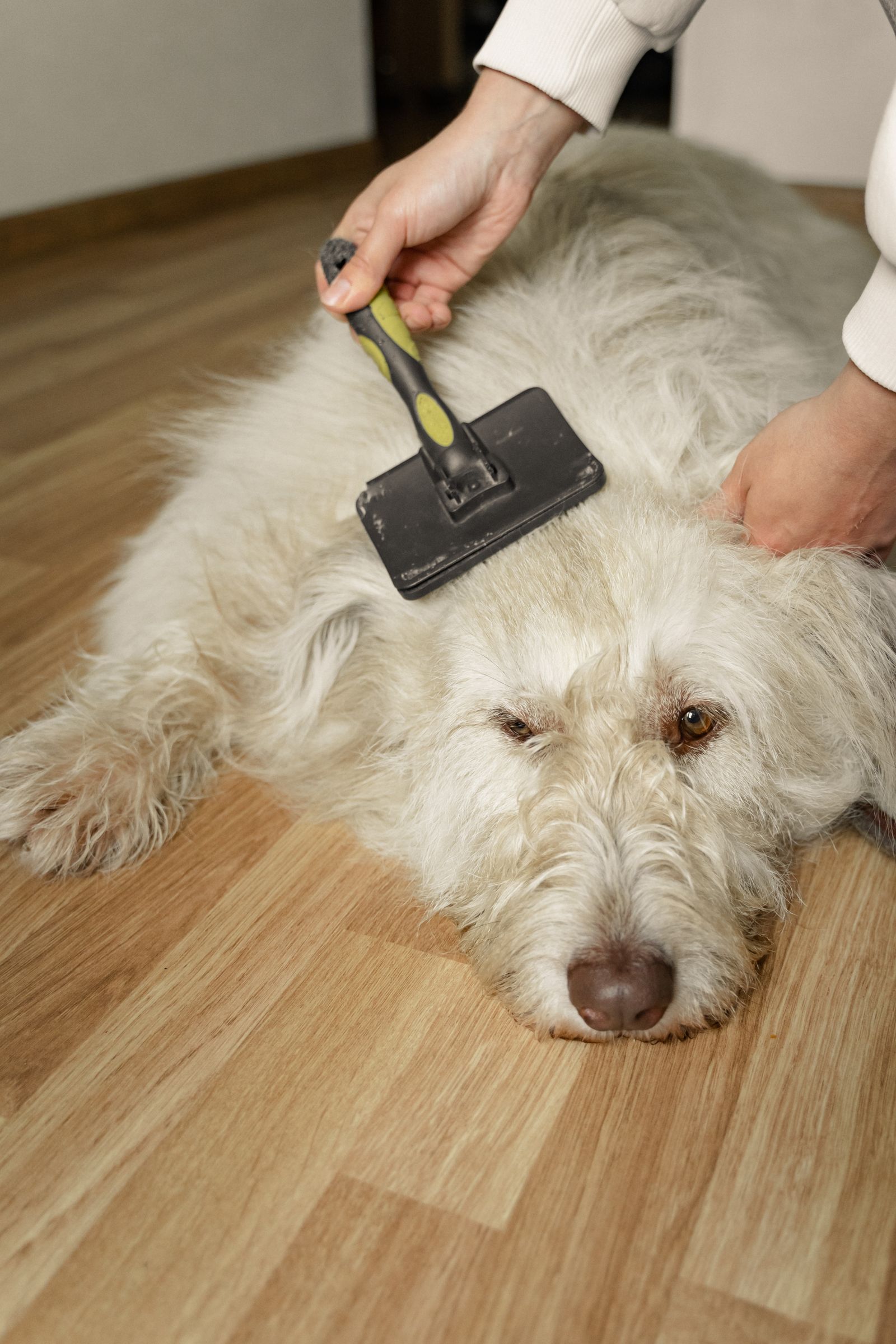
White dog being brushed with a grooming comb on a wooden floor, a fine-toothed flea comb reveals fleas and flea dirt
Comb over a white paper towel: black specks that turn red-brown when wet are flea dirt. (Photo: Pexels)

Understanding the Flea Life Cycle (Why Fleas Keep Coming Back)

To beat fleas you have to understand the enemy. A single female flea lays up to 50 eggs a day. The eggs fall off your dog wherever it goes, then:

  1. Eggs (2 to 10 days) hatch in carpets, bedding and floorboard cracks.
  2. Larvae (5 to 20 days) burrow away from light, feeding on flea dirt.
  3. Pupae (1 to 4 weeks, but up to several months) sit in a cocoon that is resistant to almost every insecticide, waiting for warmth and vibration, a passing dog or person, before hatching.
  4. Adults jump onto a host within seconds and start feeding and laying eggs within 24 to 48 hours.

This is why you may still see a few fleas two or three weeks after treating. Pupae are hatching. It doesn’t mean the treatment failed; it means you need to keep going.

How to Get Rid of Fleas on Dogs: 7 Steps

Step 1: Treat every pet in the house with a proper flea product

This is the single most important step, and it must include every dog, cat and rabbit in the home, not just the one that’s scratching. The most effective options are prescription or vet-recommended products:

  • Oral chewable tablets (e.g. those containing fluralaner, afoxolaner, sarolaner or lotilaner): kill fleas within hours, last 1 to 3 months, unaffected by bathing or swimming. Most vets’ first choice.
  • Spot-on treatments (e.g. fipronil, imidacloprid, selamectin): applied to the skin at the back of the neck monthly. Effective, but don’t bathe your dog for 48 hours either side of application.
  • Flea collars: modern ones containing imidacloprid + flumethrin last up to 8 months and work well. Cheap supermarket collars generally don’t.
  • Fast-acting tablets (nitenpyram): kill adult fleas within 30 minutes but only last a day; useful as a quick knock-down alongside a longer-lasting product.

Never use a dog flea product on a cat: permethrin, common in dog spot-ons, is lethal to cats. And always dose by your dog’s current weight.

Yorkshire Terrier being showered during a bath, a flea bath removes adult fleas but does not prevent new ones
A bath kills fleas on the dog today, but 95% of the infestation is in your home, not on the dog. (Photo: Pexels)

Step 2: Flea comb and bathe your dog

A bath with a gentle dog shampoo (or a vet-approved flea shampoo) drowns and removes many adult fleas and soothes itchy skin. Comb the coat daily with a fine flea comb, dipping it in soapy water to kill what you catch. Remember: bathing alone will not solve an infestation. It removes today’s fleas, not tomorrow’s.

Step 3: Wash everything washable

Strip your dog’s bed, blankets, your own bedding if the dog sleeps on it, cushion covers, throws and soft toys. Wash on the hottest cycle the fabric allows (60°C / 140°F kills all flea stages) and tumble dry on high. Anything that can’t be washed should be bagged for two weeks or thrown away.

Step 4: Vacuum like you mean it

Vacuum carpets, rugs, sofas (under the cushions), mattresses, skirting boards, floorboard gaps and under furniture, every day for at least two weeks. Vacuuming removes eggs and larvae, and the vibration triggers pupae to hatch so they can be killed. Empty the vacuum outside into a sealed bag immediately; fleas survive inside the canister.

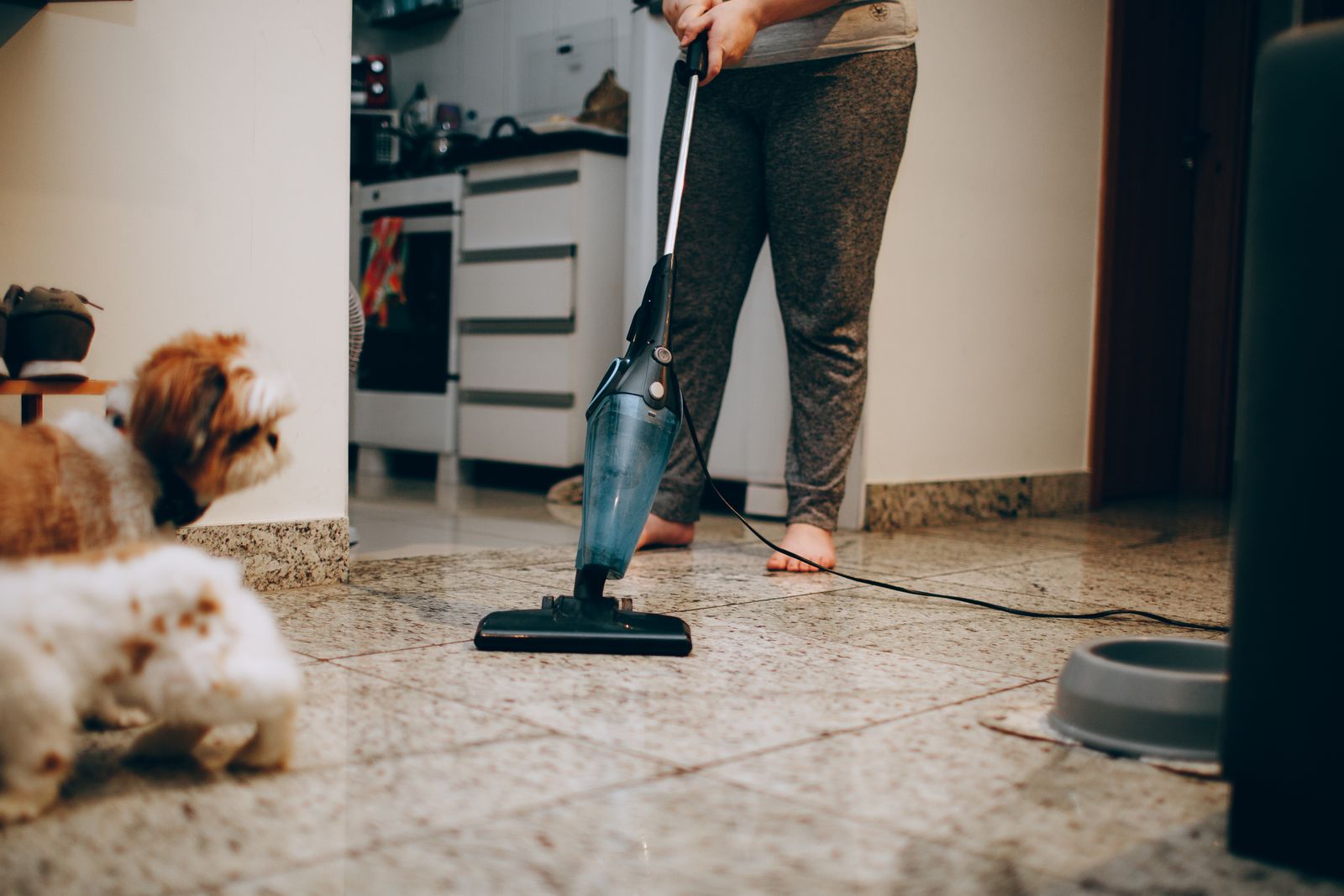
Woman vacuuming the floor while her dog watches, vacuuming daily removes flea eggs and larvae from the home
Vacuum daily for at least two weeks and empty the vacuum outside every time. (Photo: Pexels)

Step 5: Treat the house

Use a household flea spray containing an insect growth regulator (IGR, look for methoprene or pyriproxyfen) plus an adulticide. The IGR stops eggs and larvae developing for up to 12 months and is what actually breaks the cycle. Spray carpets, under furniture, along skirting boards, in the car and anywhere your dog rests. Keep pets and people out of the room until it’s dry, and never spray near fish tanks. For heavy infestations, a professional pest controller is worth the money.

Step 6: Don’t forget the garden and car

Fleas thrive in shaded, damp areas: under decking, in long grass, in kennels and in the car boot. Mow regularly, clear leaf litter, wash kennel bedding and vacuum the car. Wildlife (foxes, hedgehogs, stray cats) can reintroduce fleas, so year-round prevention on your dog matters.

Step 7: Keep treating for at least 3 months

Because pupae can lie dormant for months, one round of treatment is never enough. Keep every pet on their flea product without gaps for a minimum of three consecutive months, and keep vacuuming. Most infestations are fully cleared within 4 to 8 weeks; stubborn ones can take three months.

Veterinarian with a stethoscope examining a Pomeranian, vets prescribe the most effective flea treatments
Prescription flea products work faster and more reliably than supermarket alternatives. (Photo: Pexels)

Home Remedies for Fleas on Dogs: What Works and What Doesn’t

  • Flea comb + soapy water: ✅ genuinely useful for removing and monitoring fleas.
  • Washing and vacuuming: ✅ essential, not optional.
  • Diatomaceous earth (food-grade): ⚠️ can help in carpets and bedding but is slow, dusty and irritating to lungs; don’t put it directly on your dog.
  • Apple cider vinegar: ❌ doesn’t kill fleas; may mildly repel them at best.
  • Lemon or citrus sprays: ❌ ineffective, and citrus oils can irritate skin.
  • Essential oils (tea tree, eucalyptus, pennyroyal, cinnamon): ❌ dangerous. Several are toxic to dogs and deadly to cats.
  • Garlic or brewer’s yeast in food: ❌ no evidence, and garlic is toxic to dogs.
  • Dish soap baths: ⚠️ kills fleas on contact but strips natural oils; a proper dog shampoo is better.

Home remedies can support a treatment plan, but none of them replace a licensed flea product.

How to Stop Fleas Coming Back

  • Keep every pet on year-round flea prevention, because fleas live happily indoors through winter thanks to central heating.
  • Set a phone reminder for the next dose; missed doses are the number-one cause of reinfestation.
  • Wash pet bedding weekly and vacuum high-traffic areas regularly.
  • Check your dog with a flea comb after walks in long grass or contact with other animals.
  • Worm your dog regularly, because fleas transmit tapeworm.

When to See the Vet

Book an appointment if your dog has raw, bleeding or infected skin, hair loss, pale gums, lethargy, or if fleas persist after a month of thorough treatment. Some dogs develop flea allergy dermatitis: an intense reaction to a single bite that needs medication to settle. Puppies under eight weeks and very small or elderly dogs should only be treated on a vet’s advice, as many products aren’t licensed for them. And if you’re using a supermarket product without success, ask your vet for a prescription option. The difference in effectiveness is significant.

Frequently Asked Questions

How long does it take to get rid of fleas on a dog?

Adult fleas on your dog die within hours of a good treatment. Clearing the home completely usually takes 4 to 8 weeks, occasionally up to 3 months, because of dormant pupae.

Can I get fleas from my dog?

Dog and cat fleas will bite humans, usually around the ankles, but they can’t live and breed on people. Bites on you usually mean the home is infested.

Why does my dog still have fleas after treatment?

Almost always because pupae in the house are still hatching, another pet wasn’t treated, the dose was too low for the dog’s weight, or a supermarket product was used. Keep treating and clean the home thoroughly.

Can fleas kill a dog?

Rarely, but heavy infestations can cause life-threatening anaemia in puppies and small dogs. Pale gums and weakness need urgent veterinary care.

Do fleas die in winter?

Outdoors, cold slows them down. Indoors, a heated home is flea paradise all year round, which is why year-round prevention is recommended.

Final Thoughts

Getting rid of fleas on dogs comes down to three things: a proper vet-grade product on every pet, a serious clean of the home to attack eggs and larvae, and the patience to keep going for three months so dormant pupae don’t restart the cycle. Do all three and the scratching stops. For more on keeping your dog comfortable and healthy long-term, see our guides on why dogs eat grass and how long dogs live.

Fleas are the parasite most owners deal with, but they are not the only one that matters. USDA has now confirmed New World screwworm in a dog in the United States, so it is worth reading what screwworm looks like on a dog or cat and which body openings to check.

Why Does My Cat Lick Me? 8 Reasons Behind Those Sandpaper Kisses

0

You’re stroking your cat on the sofa when a rough little tongue starts rasping across your hand. Why does my cat lick me? It’s one of the most common questions cat owners ask, and, for the most part, the answer is a compliment. Cats lick the people they trust and consider family. But licking can also be a way of asking for something, coping with stress, or, occasionally, a hint that something is wrong.

This guide explains the eight real reasons cats lick people, why a cat’s tongue feels like sandpaper, when licking is a warning sign, and how to gently stop the habit if it’s getting a bit much.

8 Reasons Why Cats Lick You

1. It’s a sign of affection

The most common reason. Cats that live together groom each other. Behaviourists call it allogrooming, and they only do it with cats they are bonded to. When your cat licks you, it is treating you as part of its social group. In cat language, that’s as close to “I love you” as it gets.

2. You’re being groomed

Kittens are groomed by their mother from the day they are born, and they grow up seeing licking as normal family behaviour. Your cat may simply be trying to “clean” you, smoothing your hair or licking your arm the way it would tidy up a littermate. It doesn’t mean you smell (though see reason 6).

Mother cat lovingly licking her kitten on the grass, cats learn to lick as social grooming
Kittens learn licking from their mother. She grooms them from the moment they are born. (Photo: Pexels)

3. Marking you as theirs

Cats are territorial, and scent is how they claim things. Licking deposits your cat’s scent on you, marking you as a safe, familiar part of its territory. That’s also why cats rub their cheeks against you and against furniture. Being licked means you’ve been claimed, in a good way.

4. Seeking attention

If licking gets a reaction, whether you laugh, talk, stroke or feed the cat, a smart cat learns to repeat it. Many cats lick their owners first thing in the morning or around dinner time for exactly this reason. It’s a polite (if scratchy) way of saying “Hey. Human. Pay attention.”

5. Self-soothing and stress

Licking releases endorphins, so cats use it to calm themselves. A cat that starts licking you (or itself) more than usual after a house move, a new pet, a new baby, or a change in routine may be anxious. Look for other signs such as hiding, over-grooming bald patches, or changes in appetite. Our guide to the signs your cat is stressed covers what to watch for.

Close-up of a cat grooming itself by licking its paw, a cat's tongue is covered in tiny hooks
Those backward-facing hooks (papillae) are why a cat’s lick feels like sandpaper. (Photo: Pexels)

6. You taste interesting

Sometimes it’s simply about flavour. Salty skin after exercise, hand cream, food residue on your fingers, or the scent of another animal can all be irresistible. Cats have far fewer taste buds than we do, but they are very sensitive to salt and to the smell of protein.

7. Kitten behaviour that never stopped

Kittens weaned too early, before eight weeks, often keep kitten habits into adulthood, including licking, suckling on blankets and kneading. If your cat licks you while kneading and purring, it is essentially reliving the comfort of nursing.

8. A medical problem

Less commonly, a sudden increase in licking, of you, of objects, or of itself, can point to nausea, dental pain, hyperthyroidism, skin allergies or a neurological issue. If the licking is new, intense or compulsive, book a vet check.

Why Does It Feel Like Sandpaper?

A cat’s tongue is covered with hundreds of tiny, backward-facing hooks called papillae. They are made of keratin, the same material as claws and your fingernails, and they work like a built-in comb, pulling loose fur, dirt and parasites out of the coat and spreading saliva to help the cat cool down. Research using CT scans has shown that each papilla is hollow-tipped and wicks saliva right down to the skin, which is how cats keep such clean coats. On your skin, though, those hooks feel exactly like fine sandpaper.

Happy woman stroking an attentive cat on the sofa, licking is a sign of affection and bonding
Grooming you is one of the highest compliments a cat can pay. (Photo: Pexels)

Is It Safe to Let My Cat Lick Me?

For most healthy adults, yes. Cat saliva does contain bacteria (including Pasteurella and, rarely, Bartonella, the cause of cat-scratch disease), so there are a few sensible precautions:

  • Don’t let your cat lick open cuts, scratches or wounds.
  • Avoid licks on the face, especially the mouth and eyes.
  • Wash your hands after being licked, particularly before eating.
  • People with weakened immune systems, very young children and pregnant women should be more cautious.
  • Keep your cat wormed, flea-treated and vaccinated.

Also think about what’s on your skin: some hand creams, sunscreens, essential oils and medicated ointments are toxic to cats if ingested. If you’ve just applied any of these, gently move your cat away.

Why Does My Cat Lick Me and Then Bite Me?

The lick-then-bite combination confuses a lot of owners. There are three usual explanations:

  1. Grooming with teeth: cats nibble as part of normal grooming to work out tangles. A gentle nibble after a lick is just thorough grooming.
  2. Overstimulation: too much stroking builds up static-like excitement, and the bite is a “that’s enough” signal. Watch for a twitching tail, flattened ears or rippling skin on the back, and stop before the bite.
  3. Play: young cats especially may switch from licking to play-biting because your hand has become a toy. Redirect to a proper toy.

If you’d like to understand more of your cat’s mixed signals, read why cats purr. It isn’t always because they’re happy either.

Devon Rex cat grooming itself on a soft blanket, excessive licking can signal stress or illness
Compulsive licking, of you or itself, can be a sign of anxiety or a medical problem. (Photo: Pexels)

How to Stop Your Cat Licking You (Kindly)

Licking is a bonding behaviour, so never punish it. Instead:

  • Redirect: when the licking starts, calmly move your hand away and offer a toy, a brush or a chin scratch instead.

  • Don’t reward it: if licking is attention-seeking, quietly get up and walk away for a minute. Give attention when the cat is calm and not licking.
  • Cover up: long sleeves or a light blanket on your lap remove the temptation.
  • Add enrichment: puzzle feeders, climbing space, scheduled play sessions and a predictable routine reduce stress-driven licking.
  • Keep hands clean: wash off food, lotions and other animals’ scents.
  • Check the basics: regular meals, fresh water, clean litter trays and a quiet safe space reduce the anxiety that drives compulsive licking.

When to See a Vet

Make an appointment if licking is accompanied by any of these: a sudden change in behaviour, bald patches or sores from over-grooming, drooling, bad breath, weight loss, vomiting, increased thirst, restlessness, or licking of unusual objects such as plastic or walls (a sign of pica). Most underlying causes are very treatable when caught early.

Frequently Asked Questions

Why does my cat lick my hair?

Hair is the closest thing you have to fur, so your cat is grooming you the way it would groom another cat. It’s a strong sign of bonding.

Why does my cat lick my face?

Face-licking is usually affection combined with scent-marking, and sometimes interest in the salt on your skin. For hygiene reasons it’s worth gently discouraging.

Why does my cat lick me at night?

Cats are most active at dawn and dusk. Night-time licking is usually attention-seeking. It’s bored, hungry, or wants you awake. A play session and a small meal before bed often solves it.

Why does my cat lick me but not my partner?

Cats lick the people they are most bonded to, and they often choose one favourite human. Diet, scent, who feeds them and who they sleep with all play a part.

Do cats lick you to say sorry?

Not in the human sense. Cats don’t feel guilt. But a cat that licks you after a scuffle is re-establishing the bond and calming itself, which is about as close to “sorry” as a cat gets.

Final Thoughts

So, why does your cat lick you? Nine times out of ten, because it loves you and considers you family, a scratchy but genuine compliment. Keep an eye on sudden changes, keep your skin free of anything harmful, and redirect gently if it becomes too much. And if you’re wondering how many years of sandpaper kisses lie ahead, our guide on how long cats live has the answer. And if those licks keep turning into teeth, why your cat bites you covers what that switch actually means.

Can Dogs Eat Bananas? Benefits, Risks and How Much Is Safe

0

Can dogs eat bananas? Yes. Bananas are one of the safest fruits you can share with your dog. They’re non-toxic, low in fat, easy to digest and packed with potassium, vitamin B6, vitamin C and fibre. Most vets consider a few slices of banana a perfectly healthy treat.

The catch is sugar. Bananas are one of the sweetest fruits, so the key word is moderation. In this guide you’ll learn the real benefits of bananas for dogs, exactly how much is safe for your dog’s size, whether puppies can have them, which banana products to avoid (peels, banana bread, banana chips) and some fun ways to serve them.

Are Bananas Good for Dogs?

In small amounts, yes. Here’s what a banana brings to the bowl:

  • Potassium: supports heart function, muscles and nerve signalling.
  • Vitamin B6: important for red blood cell production, brain function and hormone regulation.
  • Vitamin C: an antioxidant that supports the immune system.
  • Fibre: helps regulate digestion; a little banana can firm up mildly loose stools.
  • Magnesium: helps the body absorb vitamins and supports bone health.
  • Low in fat, sodium and cholesterol: a far healthier reward than most shop-bought treats.

Because they’re soft, bananas are also a good option for senior dogs with sensitive teeth and for hiding pills.

Whole and sliced bananas on a neutral background, banana slices make a safe dog treat
A few thin slices is plenty. Banana is a treat, not a meal. (Photo: Pexels)

The Risks: Why Moderation Matters

Sugar

A medium banana contains around 14 grams of sugar. That’s fine for a large dog having a few slices, but a daily whole banana adds up fast, contributing to weight gain and, over time, raising the risk of diabetes. Dogs that are overweight or diabetic should have bananas only with a vet’s approval.

Digestive upset

Too much banana, especially in a dog that isn’t used to it, can cause constipation (from the fibre and starch) or, less often, loose stools and gas. Introduce it slowly.

Choking and blockages

Large chunks or a whole banana swallowed greedily can be a choking hazard, particularly for small breeds. Always slice it.

Allergies

Rare, but possible. When you offer banana for the first time, give a small piece and watch for itching, swelling, hives, vomiting or diarrhoea over the next 24 hours.

How Much Banana Can a Dog Eat?

Follow the standard treat rule: treats (including fruit) should make up no more than 10% of your dog’s daily calories. A medium banana has roughly 105 calories, so most dogs should have only a fraction of one. A practical guide:

Dog size Example breeds Safe amount
Extra small (under 5 kg / 10 lb) Chihuahua, Yorkie, Pomeranian 1 to 2 thin slices
Small (5 to 10 kg / 10 to 20 lb) Pug, Dachshund, Shih Tzu 2 to 3 slices
Medium (10 to 25 kg / 20 to 55 lb) Beagle, Cocker Spaniel, Border Collie 4 to 5 slices
Large (25 to 40 kg / 55 to 90 lb) Labrador, Golden Retriever, German Shepherd Up to half a banana
Giant (over 40 kg / 90 lb) Great Dane, Newfoundland, Mastiff Up to half a banana

Even for giant breeds, a whole banana in one sitting is more sugar than they need. Two or three times a week is plenty.


Owner giving a brown Labrador a treat outdoors, how much banana can a dog eat
Keep treats, banana included, under 10% of your dog’s daily calories. (Photo: Pexels)

Can Puppies Eat Bananas?

Yes, puppies can eat banana once they’re on solid food, but keep it to a tiny amount, one or two small pieces, because their digestive systems are still developing and their calorie needs should be met by a complete puppy food. Mashed banana is a handy way to make a lick mat or training reward more exciting.

Can Dogs Eat Banana Peels?

No. Banana peels aren’t toxic, but they are extremely fibrous and hard to digest. Eating a peel commonly causes vomiting and can, in smaller dogs, lead to an intestinal blockage that needs veterinary treatment. If your dog swallows a peel, watch for vomiting, loss of appetite, a painful belly or straining, and call your vet if any appear.

Banana Products: What’s Safe and What Isn’t

  • Fresh banana: ✅ safe in moderation.
  • Frozen banana slices: ✅ a great summer treat; freeze thin slices on a tray.
  • Mashed banana: ✅ ideal for lick mats, KONG toys or hiding medication.
  • Dried banana chips: ⚠️ avoid shop-bought chips: most are fried and coated in sugar or honey. Home-dehydrated, unsweetened slices are fine in small amounts.
  • Banana bread and muffins: ❌ usually contain sugar, butter, and sometimes raisins, chocolate chips, macadamia nuts or xylitol, all harmful to dogs.
  • Banana peel: ❌ blockage risk.
  • Banana-flavoured sweets, yoghurts or “sugar-free” products: ❌ check for xylitol (also labelled birch sugar), which is deadly to dogs.

Grapes and raisins are a different story entirely. See our guide to why dogs must never eat grapes.

Close-up of ripe spotted bananas, ripe bananas are high in sugar, so feed dogs sparingly
The riper the banana, the more sugar it contains. (Photo: Pexels)

5 Easy Ways to Serve Banana to Your Dog

  1. Simple slices: the classic training reward. Cut thin and offer one at a time.
  2. Frozen “coins”: freeze slices for a cooling treat on hot days that also takes longer to eat.
  3. Stuffed KONG: mash banana with a spoonful of plain, unsweetened, xylitol-free peanut butter, stuff into a toy and freeze.
  4. Banana and yoghurt bites: mix mashed banana with plain Greek yoghurt, spoon into an ice-cube tray and freeze.
  5. Two-ingredient biscuits: mash one banana with a cup of oat flour, roll out, cut into shapes and bake at 180°C (350°F) for about 15 minutes.

Other Fruits Dogs Can (and Can’t) Eat

Safe in moderation: apple slices (no core or seeds), blueberries, strawberries, seedless watermelon, cantaloupe, pear (no core), mango (no stone), pineapple, peach flesh (no stone), cucumber.

Never: grapes, raisins, sultanas, currants, cherries (stones and pits), avocado, unripe tomatoes, and any fruit stone or pip.

Shih Tzu puppy looking up at a treat, small dogs and puppies should only have a few banana slices
Small dogs and puppies need only a couple of small pieces. (Photo: Pexels)

Frequently Asked Questions

Can dogs eat bananas every day?

It’s better not to. A slice or two a few times a week is plenty; daily banana adds unnecessary sugar. Vary treats with lower-sugar options like cucumber or blueberries.

Are bananas good for dogs with diarrhoea?

A small amount of banana can help firm up mildly loose stools thanks to its fibre and pectin, but if diarrhoea lasts more than a day or two, or is accompanied by vomiting or lethargy, see your vet rather than treating it with food.

Can dogs eat green (unripe) bananas?

Green bananas are lower in sugar but higher in resistant starch, which is harder to digest and more likely to cause gas or constipation. Ripe yellow bananas are the better choice.

Can diabetic dogs eat bananas?

Only with your vet’s approval, and only in tiny amounts. Bananas have a moderate glycaemic index and can spike blood sugar.

My dog ate a whole banana. Should I worry?

For most medium and large dogs a single whole banana will cause nothing worse than a slightly upset stomach. For a very small dog, watch for vomiting or constipation and call your vet if symptoms persist. If the peel was eaten too, monitor closely for signs of a blockage.

Final Thoughts

So, can dogs eat bananas? Absolutely, sliced, in moderation, without the peel. They’re a cheap, healthy, low-fat treat that most dogs adore. Just remember the 10% rule, skip the banana bread and chips, and keep an eye on the sugar if your dog is watching its waistline. For more on keeping your dog healthy for the long term, read our guide on how long dogs live and how to add years.

Why Do Cats Purr? What Your Cat’s Purring Really Means

0

Few sounds are as soothing as a cat curled up on your lap, rumbling away. But why do cats purr? Most people assume it simply means “I’m happy”, and often it does. Yet cats also purr when they are frightened, hungry, injured, giving birth and even dying. Purring is one of the most versatile forms of communication in the animal kingdom, and scientists are still working out everything it does.

In this article we look at how purring actually works, the seven main reasons cats purr, the fascinating evidence that purring may help cats heal, and how to tell a happy purr from a worried one.

How Do Cats Purr?

For a long time nobody knew. The leading explanation today is that purring is produced by the laryngeal (voice box) muscles, which twitch rapidly, around 25 to 150 times per second, under the control of a neural oscillator in the brain. As the cat breathes in and out, air passing over the twitching vocal folds produces the continuous rumble. That is why, unlike a meow, a purr continues on both the in-breath and the out-breath.

Research published in 2023 added a twist: cat vocal folds contain unusual pads of connective tissue that may allow them to produce low-frequency purring passively, without constant muscle input, similar to how humans produce “vocal fry”. The truth is probably a combination of both mechanisms.

Domestic cats purr at a frequency of roughly 25 to 50 Hz, with harmonics extending higher, a range that, as we’ll see, may be biologically significant.

Fluffy cat with half-closed eyes relaxing, a contented cat purring
Slow blinks, a loose body and kneading paws tell you this purr is a happy one. (Photo: Pexels)

7 Reasons Why Cats Purr

1. Contentment

The purr we all recognise. A relaxed cat on a warm lap, being stroked in its favourite spot, purrs to express pleasure and to communicate “keep doing that”. This purr is accompanied by relaxed body language: half-closed eyes, a loose body, slow blinks, and often kneading with the front paws.

2. Communication between mother and kittens

Kittens begin purring when they are just two or three days old: while they are still blind and deaf. Purring while nursing tells the mother “I’m here and I’m fine”, and the vibration helps her locate them. The mother purrs back to reassure and soothe her litter. Purring is, in fact, one of the first ways a cat ever communicates.

Litter of young kittens together, kittens purr from a few days old to communicate with their mother
Kittens start purring at just a few days old, long before they can see properly. (Photo: Pexels)

3. Asking for something, the “solicitation purr”

Researchers at the University of Sussex discovered that cats produce a special purr when they want food or attention. This solicitation purr embeds a high-frequency cry (around 220 to 520 Hz, close to the frequency of a human baby’s cry) inside the ordinary low purr. Owners rate it as more urgent and harder to ignore than a normal purr, even people who have never owned a cat. In other words, your cat has learned to exploit your parental instincts.

4. Self-soothing when stressed or frightened

Cats frequently purr at the vet, during car journeys, or when a new pet arrives. This is not happiness. Much like a nervous person humming or a child sucking their thumb, purring appears to be a way cats calm themselves. Look at the rest of the body: flattened ears, dilated pupils, a tucked tail or a crouched posture mean this purr is about coping, not contentment. Our guide to the signs your cat is stressed covers the other clues.

5. Pain and injury

Cats with broken bones, after surgery or with serious illness often purr, sometimes constantly. Vets believe this is partly self-soothing and partly, as explained below, a genuine healing mechanism. A cat that purrs while hiding, refusing food or holding a limb awkwardly should be seen by a vet.

6. Healing and bone strengthening

Here is where purring becomes truly remarkable. The dominant purr frequencies of 25 to 50 Hz (and harmonics at 100 Hz and 150 Hz) are the same frequencies that studies in humans and animals have found to promote bone density, aid fracture healing, relieve pain and reduce swelling. Vibration therapy at these frequencies is used in human medicine. Researchers have proposed that purring is a low-energy way for cats to keep their bones and muscles strong during the long hours they spend resting, which may help explain why cats so often survive falls and injuries that would be devastating for a dog of the same size. The evidence is still circumstantial, but it is compelling.

7. During birth and at the end of life

Queens purr while giving birth, probably for pain relief and to calm themselves. Sadly, cats also often purr when they are very ill or dying, again most likely a self-soothing response rather than a sign of comfort.

Orange tabby cat eating from a bowl, the solicitation purr cats use to ask for food
The ‘solicitation purr’ hides a high-pitched cry that owners find hard to ignore. (Photo: Pexels)

Is Purring Good for Humans Too?

Quite possibly. Studies have linked cat ownership with lower blood pressure and a reduced risk of heart attack and stroke, and the calming effect of a purring cat is at least part of the reason. The 25 to 150 Hz range overlaps with frequencies used therapeutically for pain and wound healing in people, and simply stroking a purring cat measurably reduces stress hormones. The purr is, in a very real sense, therapy for both of you.

How to Tell What Your Cat’s Purr Means

The sound alone doesn’t tell you much. The context and body language do:

Body language Likely meaning
Relaxed posture, slow blinks, kneading, tail loosely curled Content and happy
Rubbing against you, staring, purr sounds urgent, near food bowl Solicitation, wants food or attention
Flattened ears, wide pupils, crouched, tail tucked or thrashing Stressed or frightened, self-soothing
Hiding, not eating, limping, purring for long periods alone Possible pain or illness, see a vet
Kitten purring while feeding Communicating with mother
Veterinarian checking a white cat's eye at a clinic, cats often purr when stressed or in pain at the vet
A cat purring on the vet’s table is often self-soothing, not enjoying the visit. (Photo: Pexels)

Why Doesn’t My Cat Purr?

Some perfectly healthy cats rarely or never purr audibly. Feral cats and cats that were separated from their mothers very young purr less, possibly because they had less opportunity to learn the behaviour. Some cats purr so quietly you can only feel it by placing a hand on the chest or throat. A cat that used to purr and has suddenly stopped, however, may have a sore throat, respiratory infection or be unwell, so it is worth a vet check.

Do Big Cats Purr?

Cats are broadly divided into two groups. Small cats, including the domestic cat, bobcat, lynx, cheetah, cougar and serval, can purr but cannot roar. Big cats of the genus Panthera, lions, tigers, leopards and jaguars, can roar but cannot produce a true purr, because of differences in the structure of the hyoid bone and larynx. Cheetahs are the largest cats that genuinely purr, and they do so loudly.

Frequently Asked Questions

Why do cats purr when you stroke them?

Stroking mimics the grooming a cat received from its mother, triggering the same contentment purr it produced as a kitten.

Why does my cat purr and then bite me?

This is “petting-induced overstimulation”. The purr was genuine, but the stroking went on too long or touched a sensitive spot. Watch for a twitching tail or skin rippling along the back, and stop before the bite.

Why do cats purr so loud?

Purr volume varies hugely between individuals. The Guinness record for the loudest purr is 67.8 decibels, about as loud as a dishwasher. Loud purring is not a sign of anything wrong.

Do cats purr when they sleep?

Yes, some cats purr softly while dozing, especially when curled up next to their owner or another cat.

Is purring a sign that a cat is in pain?

It can be. Purring in a cat that is also hiding, off its food, or reluctant to move should prompt a vet visit.

Final Thoughts

So why do cats purr? To say “I’m happy”, “feed me”, “I’m here”, “I’m scared” and possibly “I’m healing”, all with the same extraordinary sound. Learn to read the body language that goes with it and you’ll understand your cat far better. And the next time a purring cat settles on your lap, remember it may be doing your health as much good as its own. Curious how many years of purring you can look forward to? Read our guide on how long cats live.

Why Does My Dog Eat Grass? 7 Reasons and When to Worry

0

You let your dog out into the garden and, instead of doing its business, it starts grazing like a sheep. Why does my dog eat grass? It’s one of the most common questions dog owners ask their vet, and the reassuring answer is that grass eating is normal, extremely common and, in most cases, nothing to worry about.

That said, there are a few situations where grass eating is a signal that something is wrong. This guide explains the seven real reasons dogs eat grass, what the science says about the “dogs eat grass to make themselves sick” theory, the genuine risks, and how to reduce the habit if it bothers you.

Is It Normal for Dogs to Eat Grass?

Yes. In a well-known survey by researchers at the University of California, Davis, 79% of dog owners reported that their dog ate grass or other plants regularly. Importantly, only 9% of those dogs seemed unwell before eating grass and only 22% vomited afterwards. In other words, the vast majority of grass eating has nothing to do with illness.

Vets consider grass eating a normal canine behaviour, technically a mild form of “pica” (eating non-food items) that is so widespread it barely deserves the label.

Golden Retriever lying contentedly in green grass, grass eating is normal dog behaviour
Nearly 8 in 10 dogs eat grass regularly, and most are perfectly healthy. (Photo: Pexels)

7 Reasons Why Dogs Eat Grass

1. It’s instinctive

Dogs are not true carnivores. They are opportunistic omnivores descended from wolves. Studies of wild wolves and coyotes find grass and other plant material in a large share of their droppings, and wolves also consume the stomach contents of their prey. Your dog’s ancestors ate plants; your dog is simply doing what comes naturally.

2. They like the taste and texture

Many dogs clearly seek out fresh, sweet spring grass and ignore dry summer grass. Dew-covered morning grass is a favourite. For some dogs it is quite simply a snack they enjoy.

3. They want more fibre

Grass is roughage. Some dogs on low-fibre diets appear to graze to help food move through the digestive system, and in a few documented cases switching to a higher-fibre diet stopped the behaviour entirely.

4. Boredom or anxiety

A dog left alone in the garden for hours with nothing to do will find its own entertainment, and grazing is an easy, self-soothing activity. Dogs that eat grass mainly when their owner is absent, or during stressful events, are often eating out of boredom or anxiety rather than hunger.

Weimaraner lying on grass chewing a stick, boredom is a common reason dogs eat grass
Dogs left alone in the garden often graze simply because there is nothing better to do. (Photo: Pexels)

5. An upset stomach (sometimes)

The classic explanation is that dogs eat grass to make themselves vomit when they feel nauseous. The evidence is weaker than most people think, as noted above, fewer than a quarter of grass-eating dogs vomit afterwards. But some dogs do gulp grass frantically when nauseous, and the long, tickly blades may indeed trigger vomiting. If your dog eats grass quickly and urgently and then throws up, an upset stomach is a plausible cause.

6. Attention seeking

If every time your dog starts nibbling the lawn you rush over shouting “leave it!”, a clever dog quickly learns that grass eating gets a reaction. For attention-hungry dogs, even negative attention is a reward.

7. A nutritional deficiency (rare)

True nutritional deficiencies are uncommon in dogs fed a complete commercial diet, but dogs on unbalanced home-cooked or raw diets may seek out plants to compensate. If your dog eats large amounts of grass and other odd items like soil, ask your vet to review the diet.

Does Eating Grass Mean My Dog Is Sick?

Usually not. But grass eating combined with any of the following deserves a vet visit:

  • Vomiting more than once or twice a week
  • Diarrhoea, or blood in the vomit or stool
  • Lethargy, loss of appetite or weight loss
  • Frantic, compulsive grass eating that starts suddenly
  • Licking the lips, drooling or gulping, signs of nausea or acid reflux
  • Eating other non-food items (soil, stones, fabric)

Possible underlying causes include gastritis, acid reflux, inflammatory bowel disease, pancreatitis, intestinal parasites or, less commonly, liver disease. All of these are treatable, and none get better by being ignored.

Veterinarian examining a dog at a clinic, see a vet if grass eating comes with vomiting or lethargy
Frequent vomiting, lethargy or diarrhoea alongside grass eating warrants a vet visit. (Photo: Pexels)

Is Eating Grass Bad for Dogs? The Real Risks

The grass itself is harmless. The dangers are what may be on it or in it:

  • Pesticides, herbicides and fertilisers: lawn chemicals can cause poisoning. Keep dogs off treated lawns for at least as long as the product label states, and choose pet-safe products.
  • Parasites: grass contaminated by other animals’ faeces can carry roundworm and hookworm eggs. In the UK and Europe, slugs and snails on grass can transmit lungworm, which is potentially fatal, another good reason for regular worming.
  • Toxic plants: dogs that graze indiscriminately may also chew daffodil bulbs, foxgloves, lilies or other poisonous garden plants.
  • Sharp or coarse grass: ornamental grasses and grass seeds (awns) can lodge in the throat, paws or ears.
  • Vomiting: occasional vomiting after grazing is not dangerous in itself, but repeated vomiting can irritate the stomach.

How to Stop Your Dog Eating Grass

If your dog is healthy and eats grass occasionally, you don’t need to stop it. If you’d rather reduce the habit, or your dog is grazing where chemicals may have been used, try these:

  1. Rule out a medical cause with a vet check, especially if the behaviour is new or intense.
  2. Add fibre to the diet: a spoonful of plain cooked pumpkin or green beans, or a switch to a higher-fibre complete food, satisfies many grazers.
  3. Increase exercise and mental stimulation: longer walks, scent games, puzzle feeders and training sessions cure boredom grazing.
  4. Don’t leave the dog alone in the garden for long stretches.
  5. Teach “leave it” and reward your dog for turning away from grass, and ignore the behaviour otherwise, so it stops working as an attention grab.
  6. Offer a safe alternative: a tray of pesticide-free wheatgrass or “pet grass” grown indoors lets your dog graze safely.
  7. Keep the lawn chemical-free and worm your dog regularly.
Dog walker leading several dogs along a sunny park trail, exercise and enrichment reduce grass eating
More walks, play and mental stimulation are the simplest cure for boredom grazing. (Photo: Pexels)

Frequently Asked Questions

Why does my dog eat grass and then throw up?

Some dogs gulp long grass when they feel nauseous, and the blades tickle the throat and stomach lining enough to trigger vomiting. If it happens occasionally your dog is probably fine; if it happens weekly, see your vet.

Why does my dog eat grass every morning?

Morning grass is fresh and covered in dew, which many dogs love. An empty stomach overnight can also cause mild nausea (bile reflux). Try a small bedtime snack and see if the morning grazing stops.

Why does my puppy eat grass?

Puppies explore the world with their mouths and eat all sorts of things. Grass is one of the safer options, but supervise to make sure they aren’t also eating stones, mulch or toxic plants.

Should I let my dog eat grass?

Yes, as long as the grass is free of chemicals and your dog is otherwise well. It is a normal behaviour that most dogs enjoy.

Final Thoughts

Why does my dog eat grass? Most likely because it’s a dog, it likes it, and its wolf ancestors did the same. Keep an eye out for the warning signs listed above, keep your lawn chemical-free, and otherwise let your dog enjoy its salad. If you’re curious about other quirky pet behaviours, find out why cats purr. It isn’t only because they’re happy.

Can Dogs Eat Grapes? Why Grapes and Raisins Are Toxic to Dogs

0

Can dogs eat grapes? No, and this is one of the few food questions where the answer is an absolute. Grapes, raisins, sultanas and currants are toxic to dogs and can cause sudden, sometimes fatal kidney failure. There is no known safe amount, the reaction is unpredictable, and a dog that shrugged off a grape last year may become seriously ill from one today.

This article explains why grapes are so dangerous, how many grapes are toxic to dogs, the symptoms of grape poisoning, exactly what to do if your dog ate grapes, and which fruits you can safely share instead.

Why Are Grapes Toxic to Dogs?

For decades vets knew grapes caused acute kidney injury in dogs without knowing why. In 2021, toxicologists at the ASPCA Animal Poison Control Center identified the likely culprit: tartaric acid (and its salt, potassium bitartrate), which occurs naturally in grapes in high and highly variable amounts. Dogs are unusually sensitive to it, and it damages the cells of the kidney tubules.

Because the amount of tartaric acid varies wildly between grape varieties, ripeness and growing conditions, one bunch may be relatively low-risk and another dangerously high. That is why there is no safe dose.

Everything made from grapes carries the same risk:

  • Fresh grapes: red, green, black, seeded or seedless
  • Raisins, sultanas and currants (dried grapes are more concentrated, so even more dangerous by weight)
  • Grape juice and grape jelly or jam
  • Foods containing raisins: fruit cake, mince pies, hot cross buns, trail mix, granola, oatmeal cookies, some cereals and bread

Wine is unlikely to be offered to a dog, but it is also grape-based and doubly dangerous because of the alcohol.

Young puppy lying down with a gentle expression, small dogs and puppies are most at risk from grape toxicity
Small dogs and puppies can suffer kidney damage from a surprisingly small number of grapes. (Photo: Pexels)

How Many Grapes Are Toxic to Dogs?

There is no established toxic dose. Cases of kidney failure have been reported after as few as 4 or 5 grapes in a 9 kg (20 lb) dog, and after a single small box of raisins. Other dogs have eaten a whole bunch with no apparent effect. Because you cannot predict which group your dog falls into, vets treat any grape or raisin ingestion as an emergency.

Smaller dogs and puppies are at greater risk simply because the dose per kilogram of body weight is higher. But large dogs are not immune. Labradors and Golden Retrievers, who eat first and think later, are frequently among the cases seen by poison control.

Symptoms of Grape Poisoning in Dogs

Signs usually appear within 6 to 12 hours of eating grapes, though vomiting can begin sooner. Watch for:

  • Vomiting: often the first sign; you may see grape or raisin pieces
  • Diarrhoea
  • Loss of appetite
  • Lethargy, weakness or unusual quietness
  • Abdominal pain: hunched posture, reluctance to be touched
  • Dehydration: dry gums, panting, sunken eyes
  • Increased thirst and urination at first…
  • …then decreased or no urination (24 to 72 hours later), the hallmark of kidney failure
  • Bad breath with an ammonia smell, tremors or seizures in advanced cases

Once a dog stops producing urine, the outlook is poor. This is why early treatment, before symptoms appear, makes such a difference.

Veterinarian examining a dog during a checkup, call your vet immediately if your dog ate grapes
There is no safe home remedy. Speed matters, so call your vet or a pet poison line straight away. (Photo: Pexels)

What to Do If Your Dog Ate Grapes

1. Act immediately, don’t wait for symptoms

Call your vet, an emergency animal hospital, or a pet poison helpline (in the US: ASPCA Animal Poison Control 888-426-4435 or Pet Poison Helpline 855-764-7661; in the UK: Animal PoisonLine 01202 509000). Have your dog’s weight and an estimate of how many grapes or raisins were eaten, and when, ready.

2. Do not induce vomiting at home unless a vet tells you to

Making a dog vomit incorrectly can cause aspiration pneumonia. Your vet may advise it if the grapes were eaten within the last hour or two, and will tell you exactly how.

3. Expect decontamination and fluids

At the clinic the vet will typically induce vomiting, give activated charcoal to bind remaining toxin, and start intravenous fluids for 48 hours to flush the kidneys and keep urine flowing. Blood tests check kidney values (creatinine, BUN, phosphorus) on arrival and again over the following 2 to 3 days.

4. Follow-up matters

Kidney damage can be delayed. Even if your dog seems fine, follow the vet’s advice on repeat blood tests.

Dogs treated within a few hours of eating grapes have an excellent prognosis. Dogs that arrive after kidney failure has developed may need days of intensive care, and some do not recover.

Vet wearing gloves examining a black dog, blood tests check kidney damage after grape ingestion
Vets monitor kidney values for 48 to 72 hours after grape ingestion because damage can be delayed. (Photo: Pexels)

Can Dogs Eat Raisins?

No. Raisins are dried grapes, so the toxin is concentrated, a handful of raisins is roughly equivalent to a much larger quantity of fresh grapes. Raisin poisoning peaks around Christmas and Easter thanks to fruit cake, Christmas pudding, mince pies and hot cross buns. Keep these well out of reach and warn guests not to share.

Can Dogs Eat Grape Juice or Grape Jelly?

Avoid both. Juice and jelly contain the same compounds and are often loaded with sugar. Some “grape-flavoured” products contain no real grape at all, but check the label, and remember that sugar-free versions may contain xylitol, which is also highly toxic to dogs.

Safe Fruits Dogs CAN Eat

Plenty of fruits make healthy, low-calorie treats when served in moderation (treats should be no more than 10% of daily calories):

  • Blueberries: antioxidant-rich and perfectly bite-sized
  • Apple slices: remove the core and seeds
  • Banana: in small amounts (high in sugar)
  • Watermelon: seedless, rind removed
  • Strawberries: hulled and chopped
  • Cantaloupe melon: rind removed
  • Pear: core and seeds removed
  • Pumpkin: plain, cooked; great for digestion

Other foods that are toxic to dogs

While you’re dog-proofing the kitchen, remember these are also dangerous: chocolate, xylitol (in sugar-free gum and some peanut butters), onions, garlic, chives, macadamia nuts, avocado, alcohol, caffeine, cooked bones and raw yeast dough.

Brown Labrador enjoying a safe chew on the grass, safe fruit and treat alternatives for dogs
Blueberries, apple slices and banana are safe, dog-friendly alternatives to grapes. (Photo: Pexels)

Frequently Asked Questions

My dog ate one grape. Should I worry?

Yes, take it seriously. One grape is unlikely to harm a large dog, but it can affect a small dog or puppy, and there is no way to know in advance. Call your vet for advice. They may recommend inducing vomiting as a precaution.

How long after eating grapes will a dog get sick?

Vomiting often starts within a few hours; signs of kidney injury appear within 24 to 72 hours.

Can dogs eat seedless grapes?

No. The toxin is in the flesh of the grape, not the seeds, so seedless grapes are just as dangerous.

Are grapes toxic to cats too?

Grape toxicity is best documented in dogs, but there are reports in cats and ferrets. Don’t feed grapes or raisins to any pet.

Can dogs eat peeled grapes?

No. Peeling makes no difference. The toxic compounds are in the pulp.

Final Thoughts

So, can dogs eat grapes? Never. Treat grapes and raisins the way you would treat chocolate. Keep them out of reach, warn the family, and if your dog gets hold of some, call the vet straight away rather than waiting to see what happens. Quick action almost always means a full recovery. For more on keeping your dog healthy for the long term, read our guide on how long dogs live and how to extend it. The other kidney poison worth knowing about is antifreeze, which acts far faster than grapes do.

How Long Do Dogs Live? Dog Lifespan by Size and Breed

0

How long do dogs live? On average, a dog lives 10 to 13 years: but that single number hides an enormous range. A Chihuahua can easily see its 16th birthday, while a Great Dane is considered elderly at seven. Size, breed, weight, diet and veterinary care all shape how many years you get with your best friend.

This guide covers the average dog lifespan, how long dogs live by size and breed, how to convert dog years to human years accurately, the most common causes of death in dogs, and the science-backed steps that add healthy years to your dog’s life.

Average Dog Lifespan

Large veterinary studies put the median lifespan of pet dogs at around 12 to 12.5 years. A 2024 study of more than 580,000 dogs in the UK found that small, long-nosed breeds live longest (a median of over 13 years), while flat-faced breeds such as Bulldogs and Pugs and giant breeds live the shortest.

The longest-lived dog with a verified record was Bluey, an Australian Cattle Dog who reached 29 years and 5 months. Most dogs won’t get anywhere near that, but with good care a 15- or 16-year-old dog is no longer a rarity.

How Long Do Dogs Live by Size?

Size is the strongest predictor of lifespan in dogs. Unusually among mammals, the bigger the dog, the shorter its life. Large dogs grow extremely fast as puppies, and researchers believe this accelerated growth speeds up ageing and increases cancer risk.

Size Adult weight Typical lifespan
Toy / small Under 10 kg (22 lb) 12 to 16 years
Medium 10 to 25 kg (22 to 55 lb) 10 to 14 years
Large 25 to 45 kg (55 to 100 lb) 9 to 12 years
Giant Over 45 kg (100 lb) 7 to 10 years
Blue Heeler puppy standing on outdoor steps, small and medium dog lifespan
Small breeds mature faster but age more slowly, which is why they routinely outlive large dogs. (Photo: Pexels)

Dog Lifespan by Breed

Longest-living dog breeds

  • Chihuahua: 14 to 16 years
  • Toy and Miniature Poodle: 14 to 18 years
  • Dachshund: 12 to 16 years
  • Jack Russell Terrier: 13 to 16 years
  • Shih Tzu: 10 to 18 years
  • Yorkshire Terrier: 13 to 16 years
  • Lhasa Apso: 12 to 15 years
  • Australian Cattle Dog: 12 to 16 years
  • Border Collie: 12 to 15 years
  • Beagle: 12 to 15 years

Popular medium and large breeds

  • Labrador Retriever: 11 to 13 years
  • Golden Retriever: 10 to 12 years
  • German Shepherd: 9 to 13 years
  • Boxer: 10 to 12 years
  • Cocker Spaniel: 12 to 15 years
  • Siberian Husky: 12 to 14 years

Breeds with the shortest lifespans

  • Irish Wolfhound: 6 to 8 years
  • Great Dane: 7 to 10 years
  • Bernese Mountain Dog: 7 to 10 years
  • Mastiff: 6 to 10 years
  • Saint Bernard: 8 to 10 years
  • English Bulldog: 8 to 10 years
  • French Bulldog: 9 to 11 years

Mixed-breed dogs generally live slightly longer than purebreds of the same size, thanks to greater genetic diversity and a lower risk of inherited disease.

Close-up of an old dog with a grey face looking up, signs of an ageing dog
A greying muzzle, cloudy eyes and slower walks are normal signs of a dog entering its senior years. (Photo: Pexels)

Dog Years to Human Years

The “one dog year equals seven human years” rule is a myth. Dogs age fastest in their first two years and then slow down, and larger dogs age faster than small ones. A more accurate guide:

Dog’s age Small dog Medium dog Large dog Giant dog
1 year 15 15 15 14
2 years 24 24 24 22
5 years 36 37 40 45
8 years 48 51 55 64
10 years 56 60 66 79
13 years 68 74 82 100
16 years 80 87 99 n/a

So a 10-year-old Chihuahua is a spry 56 in human terms, while a 10-year-old Great Dane is closer to 80.

What Do Dogs Usually Die Of?

  1. Cancer: the leading cause of death in dogs over 10, especially in Golden Retrievers, Boxers and Bernese Mountain Dogs.
  2. Heart disease: mitral valve disease in small breeds, dilated cardiomyopathy in large breeds.
  3. Kidney failure.
  4. Musculoskeletal decline: severe arthritis and loss of mobility, particularly in large dogs.
  5. Bloat (GDV): a life-threatening emergency most common in deep-chested breeds.
  6. Trauma: road accidents remain a major cause of death in younger dogs.
Veterinarian with a stethoscope examining a Pomeranian dog, regular vet checks extend dog lifespan
Annual check-ups (twice a year for seniors) catch heart, kidney and dental problems early. (Photo: Pexels)

How to Help Your Dog Live Longer

1. Keep your dog lean

A landmark 14-year Purina study found that dogs fed to a lean body condition lived almost two years longer than their overweight littermates and developed arthritis and other chronic diseases much later. Being able to feel (but not see) your dog’s ribs is the goal.

2. Exercise every day

Daily walks and play keep muscles strong, joints mobile, weight under control and minds sharp. Adjust intensity to your dog’s age and breed.

Couple walking their dogs along a sunny park path, daily exercise helps dogs live longer
Lean, active dogs live around two years longer than overweight dogs. (Photo: Pexels)

3. Feed a complete, balanced diet

Choose a food that meets AAFCO or FEDIAF standards for your dog’s life stage and size. Large-breed puppies need specially formulated food to slow their growth and protect their joints.

4. Don’t neglect dental care

By age three most dogs have some dental disease. Bacteria from infected gums enter the bloodstream and damage the heart, liver and kidneys. Brush regularly and schedule professional cleanings.

5. Keep up with preventive vet care

Vaccinations, parasite control, annual check-ups and, for seniors, twice-yearly blood tests catch problems while they are still treatable.

6. Spay or neuter at the right time

Neutered dogs live longer on average, but for large breeds timing matters. Talk to your vet about waiting until growth is complete.

7. Protect against accidents

Lead walks near roads, secure fencing, and keeping toxic foods (see why dogs must never eat grapes) and medications out of reach prevent the most common avoidable deaths.

8. Keep the brain busy

Training, scent games and puzzle toys slow cognitive decline in senior dogs. The canine equivalent of dementia is very real.

Signs Your Dog Is Getting Old

A greying muzzle is the obvious one, but also watch for slower walks, stiffness after rest, cloudy eyes, hearing loss, weight change, more sleep, new lumps, bad breath, and confusion or restlessness at night. None of these should be dismissed as “just old age”. Most have treatments that improve quality of life.

Frequently Asked Questions

Can a dog live 20 years?

Rarely, but yes. A handful of small dogs, usually Chihuahuas, Dachshunds and terriers, reach 20. It requires good genetics, a lean body and excellent care.

Why do small dogs live longer than big dogs?

Large dogs grow extremely fast, which appears to accelerate cell ageing and raise cancer risk. They also carry more strain on their hearts and joints.

Do mixed-breed dogs live longer?

On average, yes, by roughly a year compared with purebred dogs of the same size, thanks to lower rates of inherited disease.

At what age is a dog considered a senior?

Small dogs at 10 to 12, medium dogs at 8 to 10, large dogs at 6 to 8 and giant breeds from around 5 to 6 years old.

Final Thoughts

How long dogs live depends mostly on size and genetics, but the factors you control add up to years, not months. Keep your dog lean, active, vaccinated and dentally healthy, and you dramatically improve the odds of many happy years together.

One condition worth knowing the signs of, because catching it early changes the outlook, is diabetes. A dog that is drinking more, weeing more and losing weight while still eating well needs a vet. Here are the early signs of diabetes in dogs and cats and what treatment involves.

How Long Do Cats Live? Average Cat Lifespan (Indoor vs Outdoor)

0

If you share your home with a cat, sooner or later you ask the question every cat lover dreads and hopes about at the same time: how long do cats live? The short answer is that a well-cared-for indoor cat typically lives 12 to 18 years, and it is no longer unusual for cats to reach their early twenties. The longer answer depends on where your cat lives, what it eats, its breed, and the quality of veterinary care it receives.

In this guide we break down the average cat lifespan, why indoor cats live so much longer than outdoor cats, how to convert cat years to human years, which breeds tend to live longest, and, most importantly, what you can do today to give your cat the longest, healthiest life possible.

How Long Do Cats Live on Average?

Across all cats, the average lifespan is usually quoted as 13 to 17 years. A large UK study by the Royal Veterinary College that reviewed the records of thousands of cats found a median lifespan of around 14 years, with crossbred (moggy) cats living slightly longer on average than pedigree cats.

That average hides a huge range. Some cats are lost to illness or accidents before they turn five, while others are still climbing onto laps at 20. The oldest cat ever recorded, a Texas cat named Creme Puff, lived to an astonishing 38 years.

Type of cat Typical lifespan
Indoor-only cat 12 to 18 years (often 20+)
Indoor/outdoor cat 10 to 14 years
Outdoor-only / free-roaming cat 2 to 5 years on average
Feral cat 2 to 5 years
Ginger indoor cat sleeping on a sunny windowsill, indoor cat lifespan
Indoor cats are protected from traffic, predators and disease, which is why they live so much longer. (Photo: Pexels)

Indoor vs Outdoor Cats: Why the Difference Is So Big

The single biggest factor in how long a cat lives is whether it spends its life indoors or outdoors. Indoor cats routinely live two to three times longer than cats that roam freely. The reasons are not mysterious:

  • Road traffic: the leading cause of death for young outdoor cats.
  • Infectious disease: feline leukaemia (FeLV), feline immunodeficiency virus (FIV) and upper-respiratory infections spread through fights and contact with other cats.
  • Parasites: fleas, ticks, worms and the illnesses they carry.
  • Predators and fights: dogs, foxes, coyotes and other cats.
  • Poisons: antifreeze, rodent bait, lilies, slug pellets and pesticides.
  • Extreme weather and getting lost or trapped.

That does not mean an indoor cat has to be bored. Window perches, cat trees, puzzle feeders, daily play sessions and a secure “catio” or harness walks give your cat the stimulation of the outdoors without the danger. If your cat seems restless or unhappy indoors, our guide to the signs your cat is stressed explains what to look for.

Gray and white outdoor cat sitting among autumn leaves, outdoor cat lifespan risks
Outdoor cats face daily risks that dramatically shorten their average lifespan. (Photo: Pexels)

Cat Years to Human Years

The old “multiply by seven” rule is wrong for cats. Cats mature very quickly in their first two years and then age more slowly. Veterinary associations use this conversion:

Cat’s age Human equivalent Life stage
6 months 10 years Kitten
1 year 15 years Junior
2 years 24 years Young adult
5 years 36 years Adult
7 years 44 years Mature
10 years 56 years Senior
15 years 76 years Geriatric
20 years 96 years Geriatric

A simple way to remember it: the first year counts as 15 human years, the second adds 9 (so a two-year-old cat is about 24), and every year after that adds roughly 4 human years.

How Long Do Cats Live by Breed?

Genetics matter. Mixed-breed cats tend to be the hardiest, but among pedigree cats there are clear patterns:

Longest-living cat breeds

  • Siamese: 15 to 20 years
  • Burmese: 16 to 18 years, with many reaching 20+
  • Balinese: 15 to 20 years
  • Russian Blue: 15 to 20 years
  • Ragdoll: 15 to 18 years
  • Sphynx: 13 to 15 years

Breeds with shorter average lifespans

  • Maine Coon: 12 to 15 years (prone to hypertrophic cardiomyopathy)
  • Bengal: 12 to 16 years
  • Persian: 12 to 15 years (breathing and kidney issues)
  • Scottish Fold: 11 to 14 years (cartilage disorders)
  • Abyssinian: 9 to 15 years

Remember these are averages: an individual cat’s care and luck matter more than its pedigree.

Veterinarian examining a cat with a stethoscope, regular vet checkups help cats live longer
Twice-yearly vet visits for senior cats catch kidney disease and other age-related problems early. (Photo: Pexels)

What Do Cats Usually Die Of?

Understanding the most common age-related illnesses helps you catch them early, when treatment makes the biggest difference:

  1. Chronic kidney disease: affects around a third of cats over 12. Early signs are increased thirst and urination, weight loss and a dull coat.
  2. Cancer: lymphoma is the most common type in cats.
  3. Hyperthyroidism: an overactive thyroid causing weight loss despite a huge appetite.
  4. Heart disease: especially hypertrophic cardiomyopathy.
  5. Diabetes: strongly linked to obesity.
  6. Dental disease: painful, and bacteria from the mouth can damage the kidneys and heart.

8 Ways to Help Your Cat Live Longer

1. Keep your cat indoors (or safely enclosed)

Nothing else on this list comes close. An indoor lifestyle removes almost every major cause of early death.

2. Spay or neuter

Neutered cats live longer: they roam and fight less, and they avoid cancers of the reproductive organs and uterine infections.

3. Keep your cat at a healthy weight

Over half of pet cats are overweight. Obesity roughly doubles the risk of diabetes and worsens arthritis and heart disease. Measure meals, limit treats to 10% of daily calories and use play to burn energy.

Tabby cat eating dry food from a bowl, diet and weight affect how long cats live
Keeping your cat lean is one of the most effective ways to add healthy years. (Photo: Pexels)

4. Feed a complete, high-quality diet

Cats are obligate carnivores. Choose a food that meets AAFCO or FEDIAF standards and includes plenty of animal protein. Wet food helps cats stay hydrated, which supports the kidneys.

5. Encourage drinking

Many cats drink too little. Place several water bowls around the home, keep them away from food and litter, and consider a pet fountain. Moving water is far more appealing to cats.

6. Never skip the vet

Annual check-ups for adult cats and twice-yearly visits for seniors (over 10) allow your vet to catch kidney disease, thyroid problems and dental disease before they become life-threatening. Keep vaccinations and parasite prevention up to date.

7. Look after their teeth

Daily brushing with a cat toothpaste, dental treats and professional cleanings prevent the chronic infection that silently shortens many cats’ lives.

8. Reduce stress and keep the mind active

Chronic stress weakens the immune system and contributes to bladder problems. Provide hiding places, vertical space, scratching posts, daily play and a predictable routine.

Signs Your Cat Is Getting Old

Cats hide illness well, so watch for subtle changes: sleeping more, reluctance to jump, weight loss or gain, drinking more, a matted or greasy coat, bad breath, cloudy eyes, confusion or crying at night. Any of these deserve a vet visit. Many are treatable.

Frequently Asked Questions

Can a cat live to 20?

Yes. Reaching 20 is increasingly common for indoor cats that are neutered, kept lean and see the vet regularly. Cats over 20 are considered “super seniors”.

How long do indoor cats live?

Most indoor cats live 12 to 18 years, and many live into their early twenties.

How long do outdoor cats live?

Cats that live entirely outdoors average only 2 to 5 years because of traffic, disease, predators and poisoning.

Do male or female cats live longer?

Female cats live slightly longer on average, but neutering narrows the gap considerably. Neutered males live far longer than intact males.

What is the oldest cat ever?

Creme Puff, from Austin, Texas, lived from 1967 to 2005 to 38 years and 3 days.

Final Thoughts

So, how long do cats live? Long enough to become a true member of the family, typically 12 to 18 years, and often beyond. You can’t control genetics, but you can control the two things that matter most: keeping your cat safe indoors and staying on top of preventive veterinary care. Do those, and you give your cat the best possible chance of celebrating its twentieth birthday with you.

Chronic illness is what shortens most cat lives, and one of the more treatable ones is diabetes. Cats caught early can sometimes go into remission and come off treatment entirely. Here are the signs to watch for and what changed in the 2026 guidelines.

8 Signs Your Cat Is Stressed and How to Help

0

Recognising the signs cat is stressed can feel tricky because cats are masters at hiding discomfort. Unlike dogs, who wear their emotions openly, cats tend to suffer in silence until things get really bad. The good news is that once you know what to look for, you can step in early and make a real difference for your cat.

Stress in cats is more common than most owners realise. Changes in routine, new pets, loud noises, or even rearranging furniture can tip a sensitive cat over the edge. Learning to read your cat’s subtle signals means you can act fast and keep them feeling safe and settled.

1. Hiding More Than Usual

A tabby cat hiding under a bed, partially visible, looking cautious, indoor setting with low lighting, slightly anxious expression
Photo by Bejan Adrian on Pexels

Every cat enjoys a quiet nap in a tucked-away spot, but if your cat is suddenly spending most of the day hiding and refusing to come out, that is one of the clearest signs cat is stressed. A stressed cat will seek out small, dark, enclosed spaces where they feel invisible and safe. Think under beds, inside wardrobes, or behind sofas.

The key difference between normal hiding and stress-related hiding is duration and frequency. A relaxed cat hides for a snooze and then comes back out to interact. A stressed cat may stay hidden for hours or even full days at a time.

If your cat has started hiding after a specific event, like moving house, a new baby arriving, or a new pet joining the family, that context is a big clue. Try not to force them out, as that will only increase anxiety. Instead, place their food and water nearby and give them space to emerge on their own terms.

2. Changes in Litter Box Habits

A grey cat standing beside a litter box looking hesitant, clean tiled bathroom floor, bright natural lighting
Photo by Guillaume Meurice on Pexels

One of the most noticeable signs cat is stressed is a sudden change in litter box behaviour. This can mean going outside the box, going more frequently, or straining to urinate. Any change from your cat’s normal habits deserves attention.

Stress can directly cause urinary issues in cats, particularly in male cats who are prone to feline idiopathic cystitis (FIC). This condition is triggered by stress and causes inflammation of the bladder, making urination painful. If your cat is visiting the litter box repeatedly and producing little or no urine, treat it as an emergency and contact your vet immediately.

For less urgent litter box changes, consider whether the box is clean enough, positioned in a quiet spot, and whether the type of litter has changed recently. Cats can be sensitive about all of these things. The American Association of Feline Practitioners recommends one litter box per cat plus one extra as a general rule.

3. Increased Grooming or Bald Patches

A close-up of a cat over-grooming its belly, showing a thinning patch of fur, on a cream sofa, indoor natural light
Photo by uschi2807 on Pixabay

Over-grooming is a stress response that many owners mistake for normal cat behaviour. Signs cat is stressed through grooming include licking one area repeatedly, chewing at the fur, or pulling hair out entirely. You might first notice thinning patches on the belly, inner legs, or the base of the tail.

This behaviour is called psychogenic alopecia and it is essentially a self-soothing mechanism. The repetitive motion of grooming releases endorphins, so stressed cats will do it to excess as a way of coping with anxiety. Unfortunately it can quickly lead to raw skin and secondary infections.

If you spot bald patches or irritated skin, get your vet to rule out any skin condition or parasites first. Once those are ruled out, the focus shifts to identifying and reducing the stress trigger. Environmental enrichment, calming pheromone diffusers, and sometimes anti-anxiety support from your vet can all help significantly.

4. Signs Cat Is Stressed Through Aggression

An orange tabby cat with flattened ears and wide eyes, crouched in a defensive posture on a kitchen counter, tense body language
Photo by TEREX12 on Pixabay

A normally calm cat that starts hissing, swatting, or biting without obvious provocation is almost certainly stressed. Aggression is one of the more alarming signs cat is stressed because it can come out of nowhere and feel completely out of character. It is important not to punish this behaviour, as that will only make the underlying anxiety worse.

Redirected aggression is particularly common. This happens when your cat sees something that upsets them, like another cat outside the window, and then redirects that frustration onto you or another household pet. Understanding this helps you respond with empathy rather than frustration.

Identify what is triggering the aggressive episodes and try to remove or reduce that trigger. For cats reacting to outdoor cats, frosted window film on lower windows can help enormously. If your cat is struggling to live peacefully alongside other animals, this guide on cats living comfortably with other pets has some practical advice worth reading.

5. Loss of Appetite or Overeating

A stressed cat may stop eating altogether or, less commonly, start stress-eating far more than usual. Either pattern is a concern. Going without food for more than 24 to 48 hours puts cats at risk of hepatic lipidosis, a serious liver condition that develops quickly in cats who stop eating.

If your cat is suddenly turning their nose up at food they normally love, stress is a real possibility but it is always worth a vet check to rule out pain or illness first. Cats are good at masking physical discomfort, so a change in appetite can be a sign of several different problems.

Try warming food slightly to increase its aroma, or offer a different texture to tempt them back to eating. A calm, quiet feeding area away from loud appliances or other pets can also reduce mealtime anxiety considerably.

6. Excessive Vocalisation

Cats communicate in lots of ways, and understanding how cats communicating their needs works can help you tune into what your cat is trying to tell you. When a previously quiet cat suddenly starts meowing constantly, yowling at night, or crying loudly for no obvious reason, stress is often behind it.

Some breeds, like Siamese and Bengals, are naturally more vocal. But a notable increase in vocalisation from any cat, regardless of breed, is worth paying attention to. Night-time yowling in older cats can also point to cognitive dysfunction or hyperthyroidism, so a vet visit is sensible.

Try to respond calmly and consistently without reinforcing the behaviour with excessive fussing, which can accidentally reward the anxiety. Providing more interactive play sessions, puzzle feeders, and structured one-on-one time can help reduce the underlying restlessness driving the vocalisation.

7. Scratching Furniture and Destructive Behaviour

Scratching is completely natural for cats, but an increase in destructive scratching or other out-of-character behaviour like knocking things over repeatedly is one of the signs cat is stressed. Cats scratch to mark territory, and a stressed cat will scratch more to try to reclaim a sense of security in their space.

Make sure your cat has at least two good scratching posts available, ideally in the areas they are already targeting. Tall, sturdy sisal posts tend to be the most satisfying for cats. Placing one near a window can also give them a vantage point, which helps reduce general anxiety.

If the destructive behaviour has spiked, think about what has changed in your home recently. New furniture, a change in your work schedule, building work nearby, or even a new scent in the house can all unsettle a cat. Small environmental tweaks often make a surprising difference.

8. Tummy Troubles and Physical Symptoms

[IMAGE_PLACEHOLDER: A fluffy Persian cat

Not every change in a cat is stress. A cat that stops eating, drools or seems unsteady may have a physical cause, and one of them is a diet short on vitamin B1. Read what thiamine deficiency looks like in cats so you can tell the two apart.