Home Blog Page 64

Most Terrifying Insects in the World

0

Many insects are cute, cuddly, and harmless. But some insects are nightmarishly terrifying and downright dangerous. They can cause intense pain on their enemies while some deliver bites or stings that can even result in death. Here is a list of the most terrifying insects in the world.

Giant Silkworm Caterpillar
Giant Silkworm Caterpillar

https://www.pinterest.com

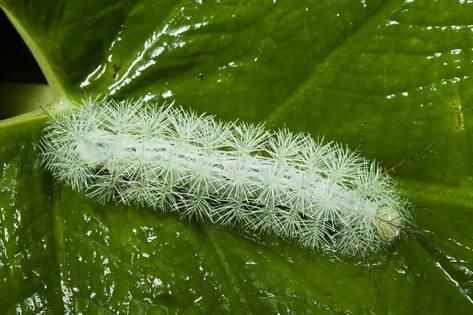
This creepy-looking caterpillar resides in South America and is responsible for several deaths each year. The giant silkworm caterpillar has tiny bristles that release a potent toxin that is poisonous when ingested. It has been called the “assassin caterpillar” or “killer caterpillar,” but it is just the larva of a giant silkworm moth (Lonomia obliqua). The venom from this insect can cause gangrene-like symptoms throughout the body, the leakage of blood into the brain, and even death.

Bullet Ant
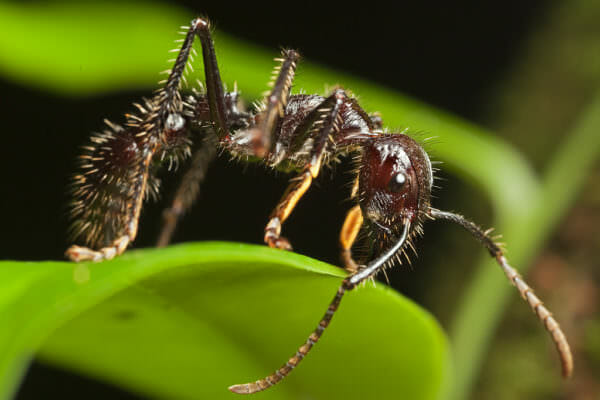
Bullet Ant

https://lostempireherbs.com

The world’s most painful insect sting belongs to the bullet ant. It is also the world’s largest ant and possesses a powerful, venomous sting. A worker ant can be over 2.5 centimeters (1 in) long and looks like a wingless wasp. Bullet ants are most likely to be found in Central and South America. The bullet ant gets its name from the shot of intense pain that it delivers. The venom-filled sting can produce agonizing effects in the recipient for up to 24 hours.

Amazonian Giant Centipede
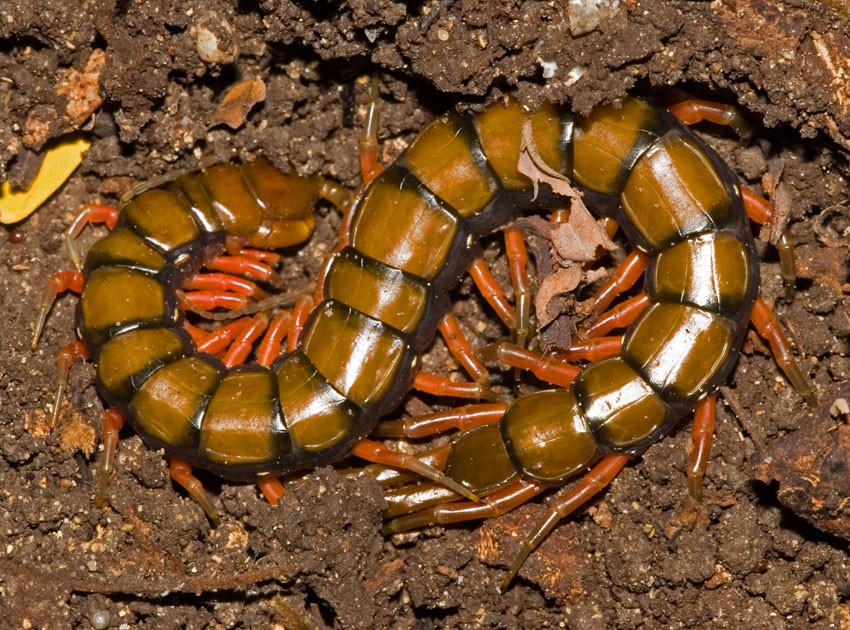
Amazonian Giant Centipede

https://haydensanimalfacts.com

Amazonian giant centipede is often considered the world’s largest centipede. It is widely found in South America and the Caribbean and is also known as the Peruvian giant yellow-leg centipede. The body of this creature consists of 21 to 23 well-marked sections, each containing legs. The venom that this critter carries is potent and fatal to many small animals. It is usually nonlethal to humans.

Tsetse Fly
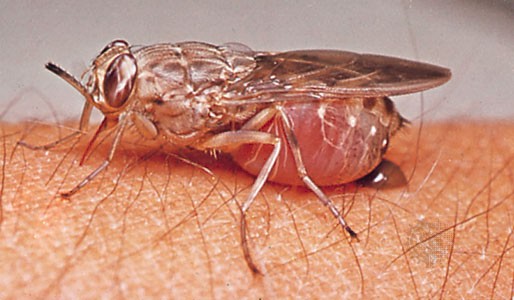
Tsetse Fly

https://www.britannica.com

Much like the mosquito, the tsetse fly sucks out your blood. The fly has tiny serrations on its mouth that saw into your skin. These insects also transmit diseases, and some can cause an illness known as “sleeping sickness.” If a person goes without treatment, the infection is usually fatal.

There are about two or three dozen species of the tsetse fly, and they are mostly found in Africa. This bloodsucking fly is usually 6–16 millimeters (0.2–0.6 in) long and is robust with a yellowish or brownish color.

They are mainly found in woodlands and are most active in the morning.

Human Botfly
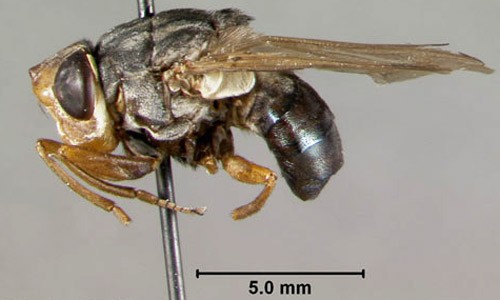
Human Botfly

http://entnemdept.ufl.edu

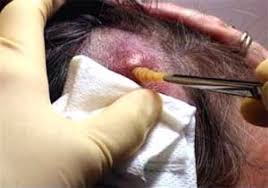
The human botfly looks like a bee, but it has more hair and fewer bristles. They usually only attack livestock, deer, and humans. The female fly attaches her eggs to mosquitoes, other flies, and insects, which carry the eggs to the host. Body warmth causes these eggs to hatch, and then the larvae begin to penetrate the skin.

The larvae are usually removed by a simple surgical procedure that includes local anesthesia. The larvae can also be popped out by applying pressure but only in certain cases. Antibiotics are given after the procedure, and the wound will normally heal in less than two weeks.

Killer Bees
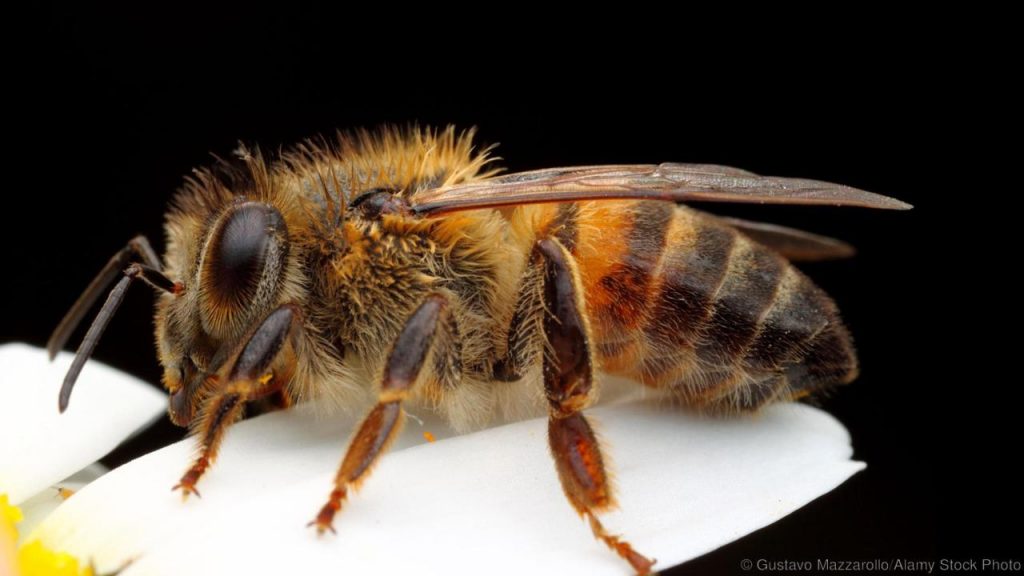
Killer Bees

http://www.bbc.com

The killer bee (aka Africanized bee) resembles a common honeybee so much that a laboratory has to measure the bee to even tell the difference. They have small colonies, so they can build unique nests in places like tires, crates, boxes, and empty cars. These scary bees have been known to chase people as far as 0.4 kilometers (0.25 mi) if they get excited and aggressive. Someone who is being chased by an Africanized bee should run in a zigzag pattern and seek shelter as quickly as possible. Never jump in the water to hide from them, though, because they will only wait around until you come back up for air.

Driver Ant
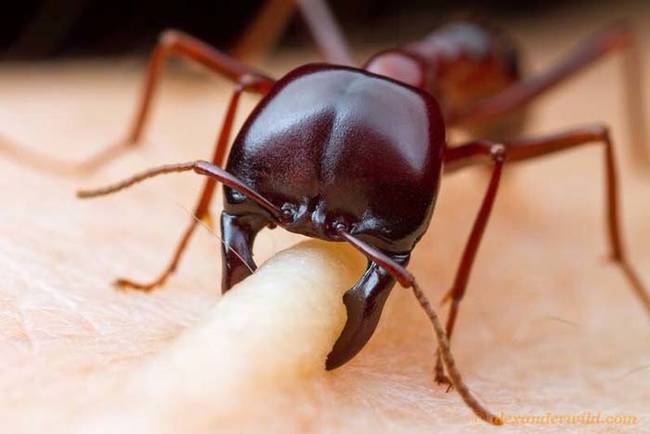
Driver Ant

http://www.viralnova.com

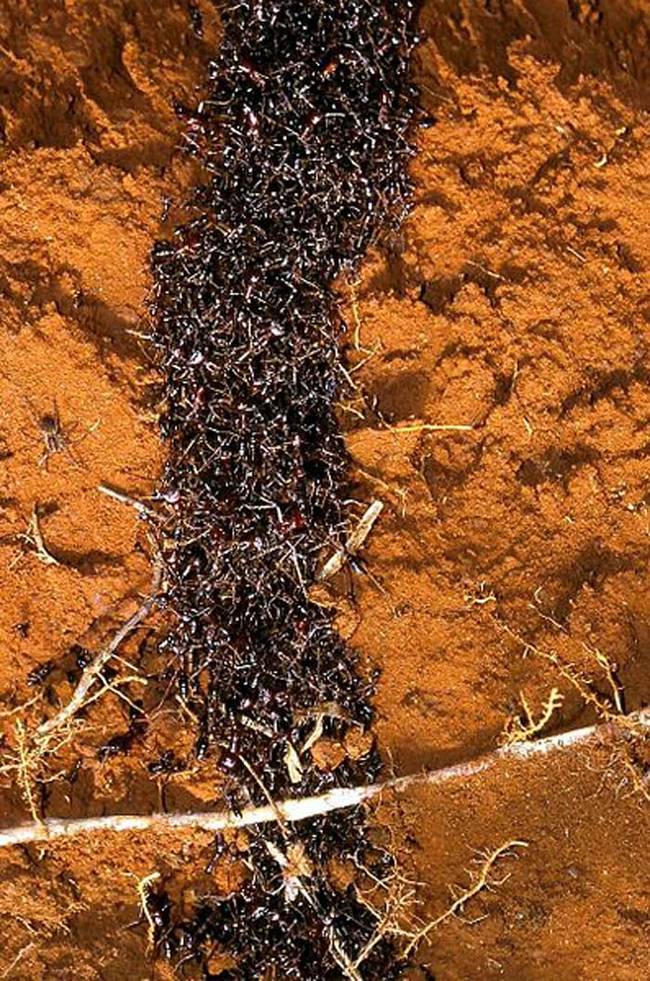
Colonies of driver ants can contain up to 22 million individuals. These creatures decimate any insect that gets in their way, which is why they can keep moving without ever starving. They are mostly found in Africa, and they prefer to live in forests. These insects don’t usually sting their prey. Instead, driver ants rip their victims apart with their mandibles.

Asian Giant Hornet
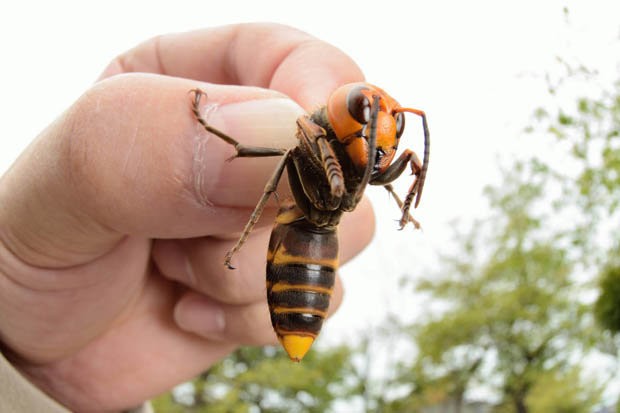
Asian Giant Hornet

https://www.dailystar.co.uk

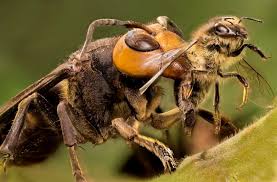
The largest species of hornets found in the world is the Asian giant hornet. They live throughout Eastern Asia but are most commonly found in the mountains of Japan. They are known to be extremely aggressive and fearless. Asian giant hornets feed honeybee larvae to their young and destroy entire beehives in the process. One hornet can tear 40 honeybees in half in under a minute! The Asian giant hornet has a 6-millimeter (0.2 in) stinger that injects venom powerful enough to dissolve human tissue.

Maricopa Harvester Ant
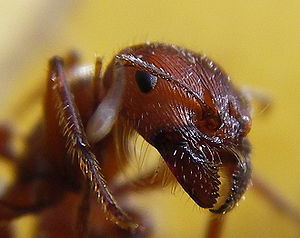
Maricopa Harvester Ant

http://blog.wildaboutants.com

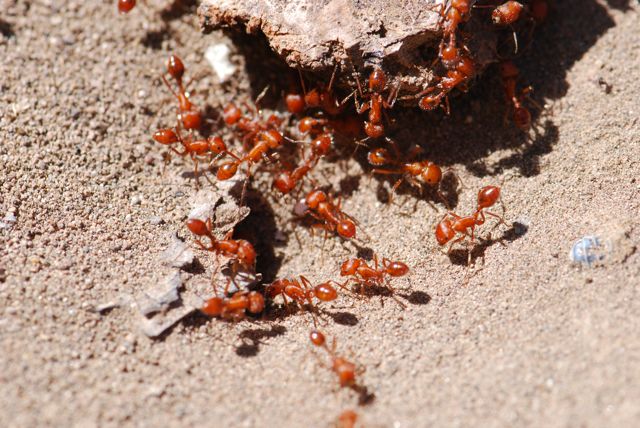
The most venomous insect in the world is the Maricopa harvester ant. They contain the most toxic venom, which is made up of amino acids, peptides, and proteins. The venom is 12 times more powerful than that of a honeybee. It would take around 350 stings to kill a human being. When a Maricopa harvester ant stings its victim, it releases pheromones that signal other ants in the colony to join the attack. They spend most of their lives in desert areas and are most commonly found in Arizona.

related content

The World’s Most Romantic Animals

0

Many people seem incapable of romance; it may be a surprise that some animals are capable of this human emotion. Here are few animal species which you might not expect to have a soppy and lovey dovey side.

Wolf Eels

Wolf Eels

https://www.aqua.org

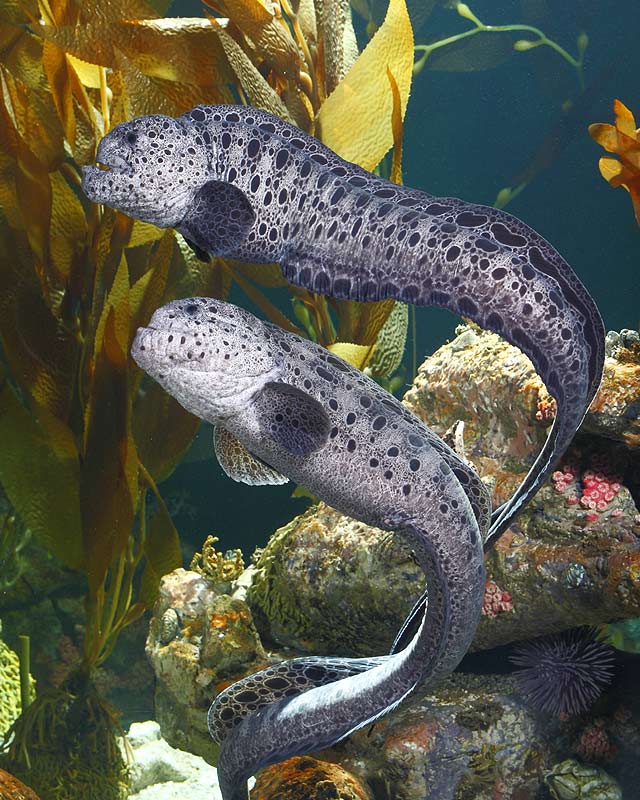
The romantic side of the wolf eel has been observed in aquariums. The mates set up home in a single crevice in rock. When the pair breeds, they produce hundreds of yellow eggs. Both male and female take their turns to guard their babies while the other goes out to feed. In aquariums, this partnership can last the length of the fishes’ lives, up to 28 years.

Albatrosses

Albatrosses

http://mentalfloss.com

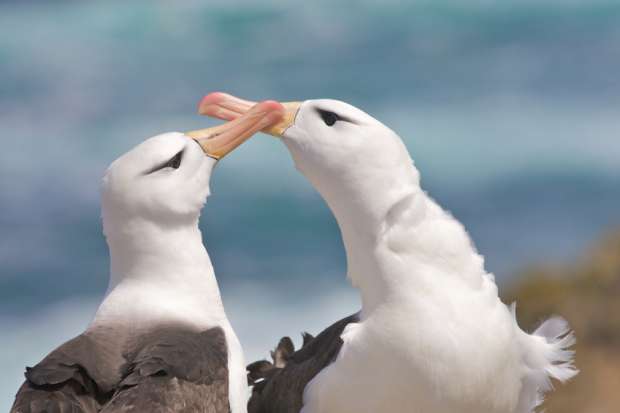
Albatrosses mate for life because there is so much riding on the success of their mating. They breed slowly and only lay a single egg at a time. By having a pair of adults dedicated to each chick, they increase the chances of their young surviving to adulthood. What makes the albatrosses’ dedication to their partners all the more remarkable is that their unions can last for decades despite the pair spending months apart each year while gliding over the waves of the ocean, only reconnecting on their island.

Bowerbirds

Bowerbirds

http://www.bbc.com

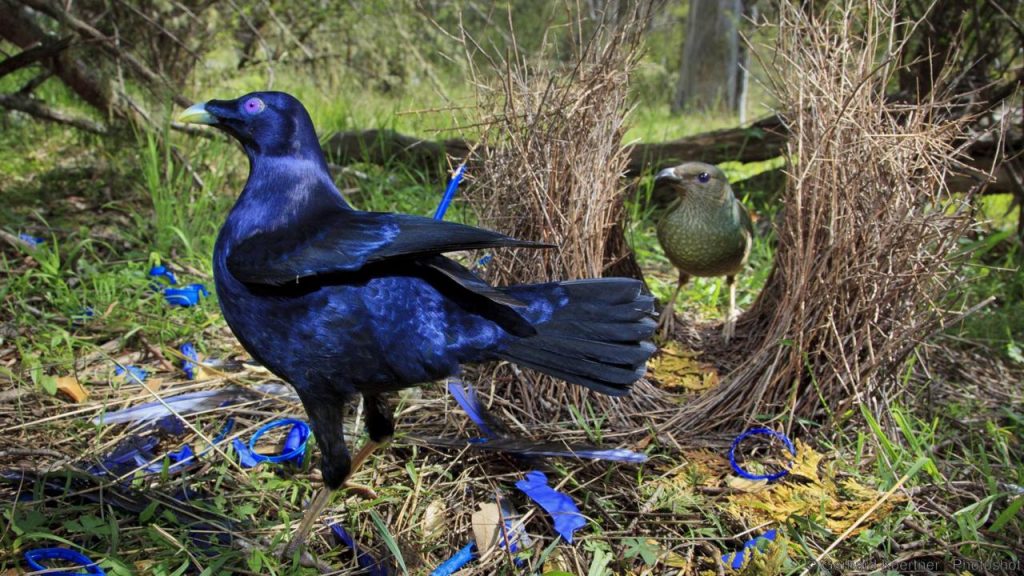
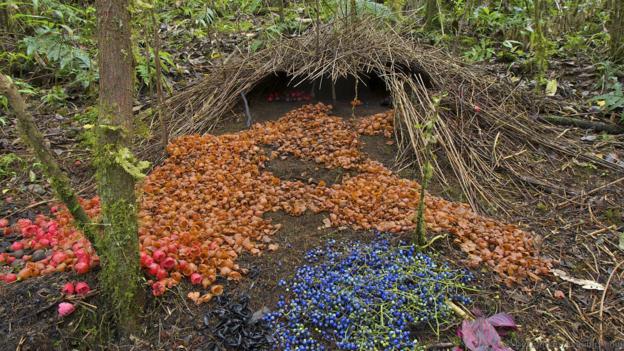
The bowerbirds get their name from the structures males build to impress females. These bowers are collections of twigs and leaves where a male can display himself to females. Around his structure, he places colorful objects. Berries, shells, and leaves are traditionally used as decoration. Female bowerbirds may visit several bowers before choosing the male that has done the best construction job and does the best mating dance. Once the mating is done, most female bowerbirds will build the nest and raise the chicks alone.

Mantis Shrimp

Mantis Shrimp

http://mantisshrimpresource.weebly.com

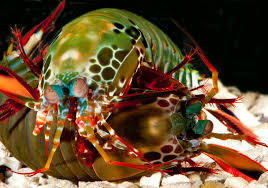
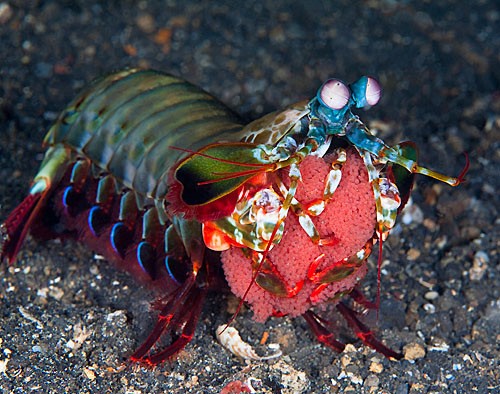
Unusually for invertebrates, the peacock mantis shrimp is generally monogamous. Once the female has chosen her mate based on his flashy carapace, she will accept the package of sperm that he passes to her. She then releases her eggs, and they are fertilized by the sperm. She then takes the eggs back to her burrow, where she will guard them, clean them, and make sure they receive oxygenated water. The father has limited involvement, and the mother will not eat until after the eggs have hatched. Despite this dereliction of duty, the pair will remain together.

Seahorses

Seahorses

https://news.nationalgeographic.com

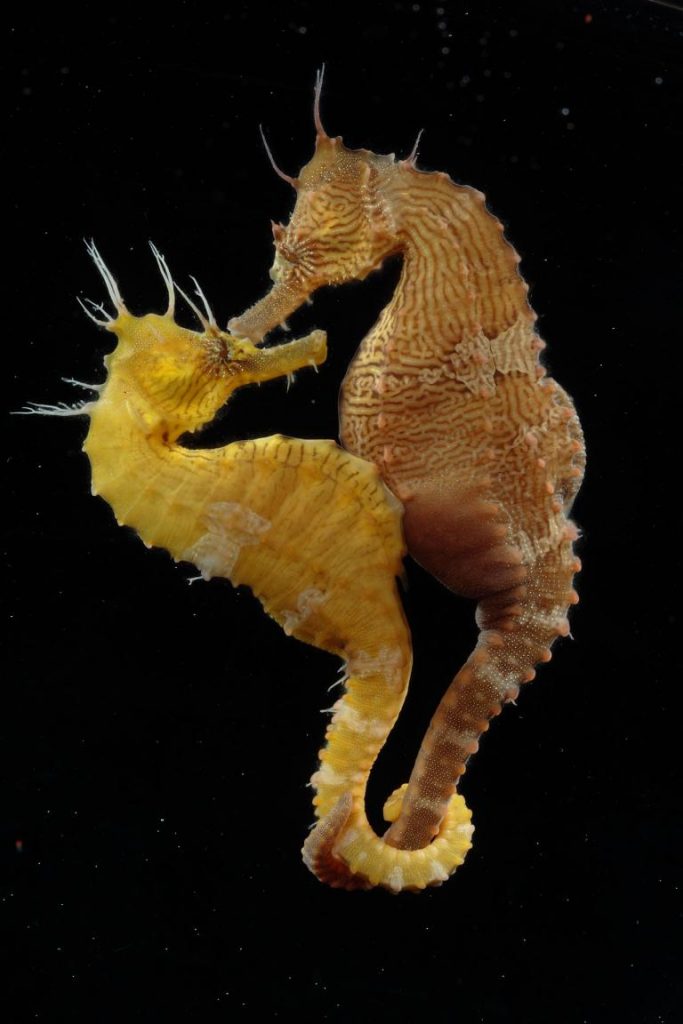
Before a male and female seahorse mate, they spend up to several days dancing around each other. This may be to assess each other’s fitness for breeding. Once a male and female do match up, though, their mating takes a strange turn. The seahorses line up, and the female uses an organ called an ovipositor to place her eggs inside a pouch on the male’s belly. In each mating, up to 1,500 eggs can be transferred. The male seahorse then incubates the eggs until they hatch. As soon as they leave their eggs, the tiny seahorses are self-sufficient. The male expels them from the pouch and immediately looks for another seahorse to dance and mate with.

Bonobos

Bonobos

https://www.pinterest.com

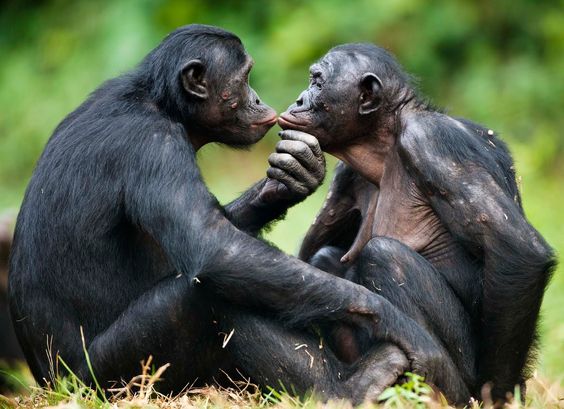
Bonobos are one of humanity’s closest living relatives—we share 98.6 percent of our DNA with them. Unlike prudish humans, the bonobos have brought sex out of the bedroom and make use of it in situations that would never occur to us. Female bonobos have a dominant place in their society, and they use sexual acts to ease social interactions. When bonobo females encounter a high-stress situation, they will engage in genital touching to reassure those around them of their place in the hierarchy. While two rival bands of chimps will often fight each other if they come into contact, bonobos will defuse the tension by performing an impressive array of sexual acts on each other.

Great Hornbills

Great Hornbills

http://listverse.com

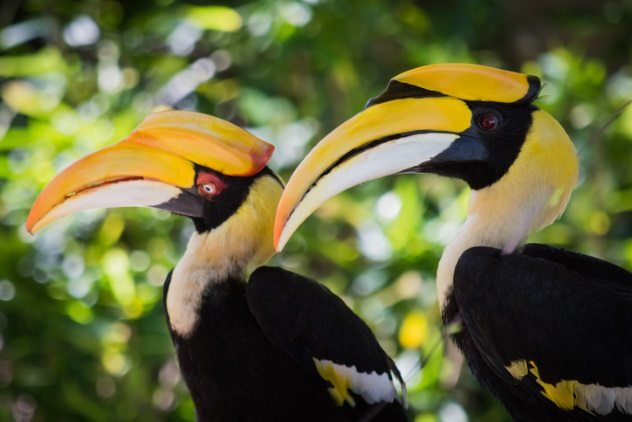
Before choosing a mate, female hornbills will watch males headbutt each other until one wins her approval. Once this display of male bravado is over, the pair of lovebirds set up a nest, usually looking for a hollow high in a tree. The two birds mate, and the female begins her unique form of interior decoration. Using her own feces, and those of her partner, she will erect a wall that seals her inside. Behind this poop wall, the female lays her eggs and incubates them. There is a small gap in the wall through which the male delivers food. For five weeks after the eggs hatch, the female remains walled up with her babies, dependent on her partner for food.

Pufferfish

Pufferfish

http://www.dailymail.co.uk

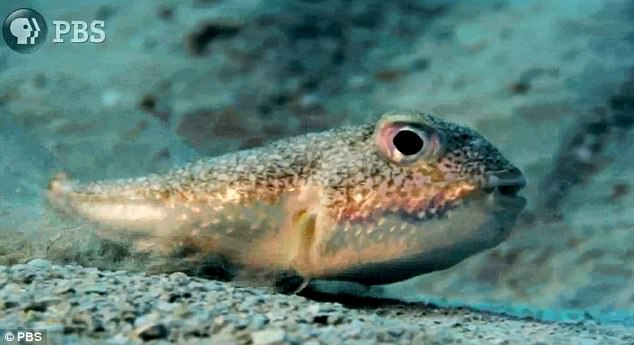
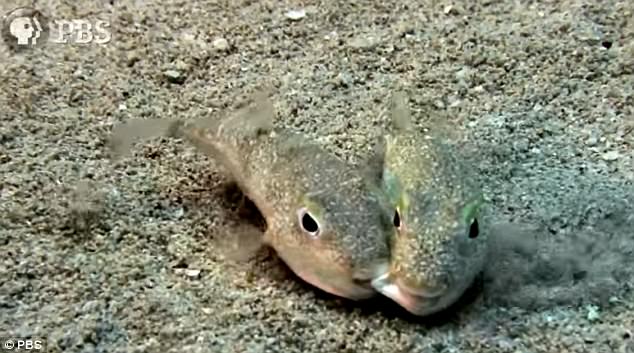
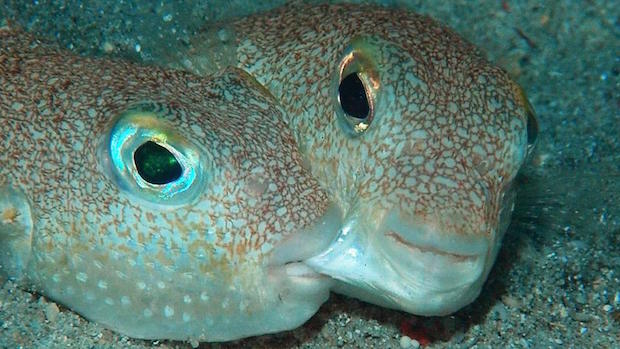
The male pufferfish is only around 13 centimeters (5 in) long, yet he will build a sand structure up to 2.1 meters (7 ft) across. And he does all this to attract a mate. Male pufferfish make the structures by flapping their tiny fins against the sand and nudging the floor with their noses. To further decorate the structure, the male will pick up shells and lay them on the ridges. Because the site is made of sand, the male pufferfish has to constantly repair it as the tide threatens to destroy it. All the effort pays off when he wins himself the attention of a mate.

Related Content

Horrifying Facts about Ducks

Hybrid Animals That Are Hard To Believe Actually Exist


Examples of Gift Giving In the Animal Kingdom

0

Everyone likes to receive a gift every now and again, especially if it’s from someone we love. With the exception of cats bringing dead prey that we probably aren’t going to eat, animals aren’t exactly known for their gift-giving skills. But as we will see here, it appears that many animals are fond of giving presents, whether it’s a ball of spit or a lethal poison. Here are just few of the examples of gift giving in the animal kingdom.

Spiders

Spiders

https://www.cutesypooh.com

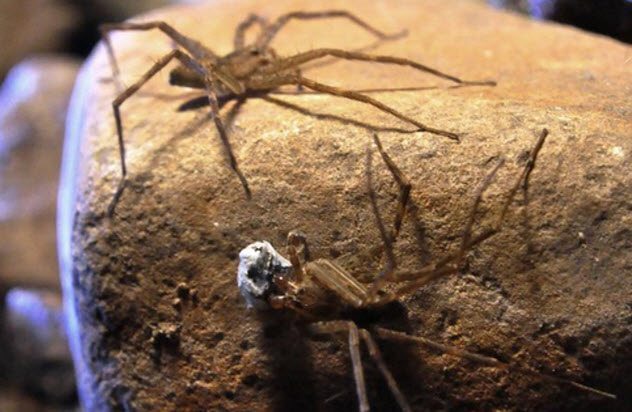
No animal understands the importance of presentation better than Paratrechalea ornata. Males of this South American spider species are known to use gifts to woo females, presenting them with a bundle of prey wrapped in silk. The bigger the present, the better his chances. Apart from the nutritional benefit, it is theorized that the presents help arouse the females due to their resemblance to egg sacs. However one study found that as many as 70 percent of the gifts given are fake.

Eurasian Jays

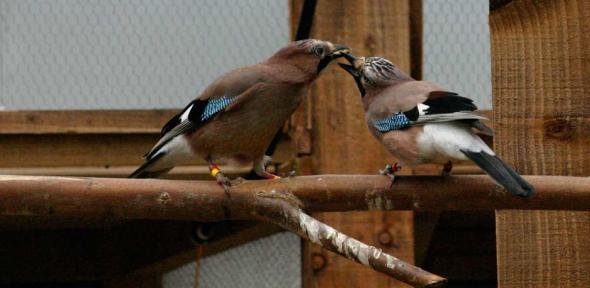
Eurasian Eurasian Jays Eurasian Jays

http://www.cam.ac.uk

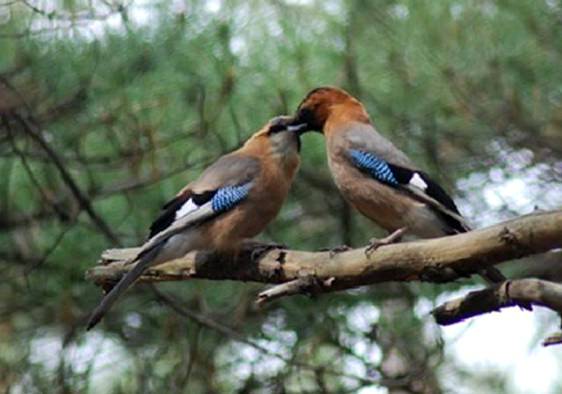
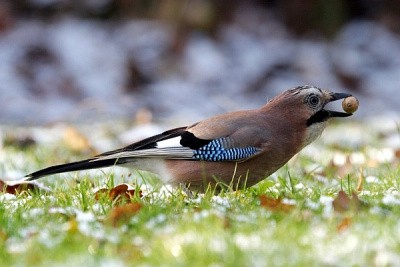
Eurasian jays like to give gifts to their mates simply because the females will enjoy the presents. In one experiment, males would be able to see their mates eating either moths or worms and would then have the opportunity to give them either one. If the female had been eating moths, she’d be given a worm. If she was eating worms, she’d get a moth. When the males could not see what she had eaten, there was no correlation. This shows that the males understand that the females would rather have something new than more of the same. She’ll accept both, but one is going to make her happier.

Moths

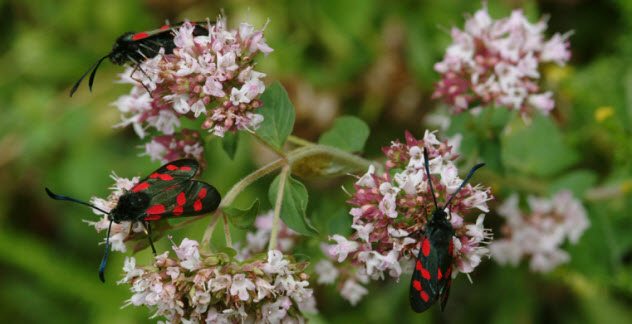
Moths

http://listverse.com

Six-spot burnet moths produce their own cyanide, which they use as a defense mechanism. But it also uses a lot of their energy and nutrient reserves. For this reason, males looking to mate will use their cyanide-producing chemicals to attract females. The females can detect how much of these chemicals a male has through his pheromones and opt to mate with those who have the highest levels. The chemicals are transferred through the sperm. When the eggs are laid, the mother will transfer some of these chemicals to her newborns, giving them a powerful defense and a much better chance at survival.

Bonobos 

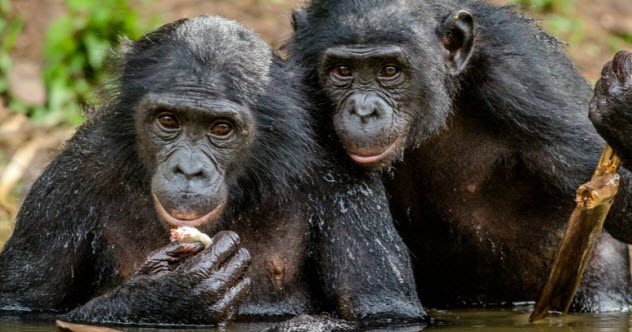
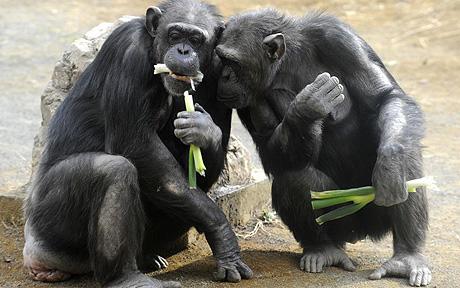
Bonobos Bonobos Bonobos

https://www.animalanswers.co.uk

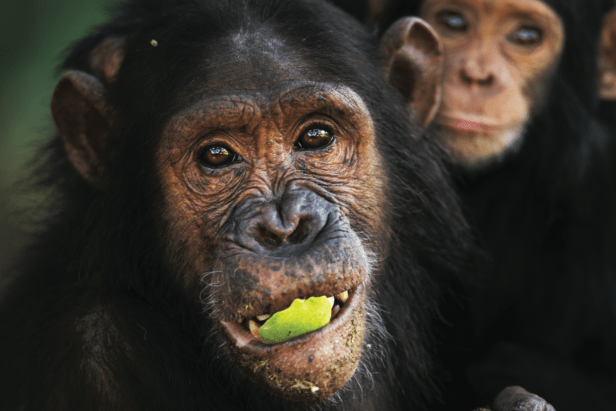
Despite their reputation as one of the most sex-obsessed species in the world, bonobos have developed the interesting habit of giving food to strangers. Bonobos are highly social and love making new friends. For this reason, they are happy to part with a bit of food if it means they get to interact with bonobos from other groups.

Penguins 

Penguins Penguins Penguins

https://www.animalanswers.co.uk

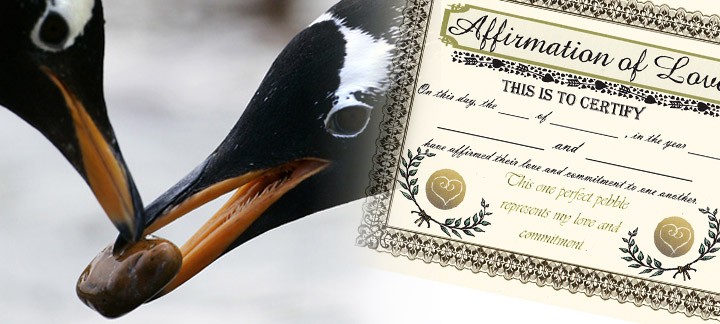
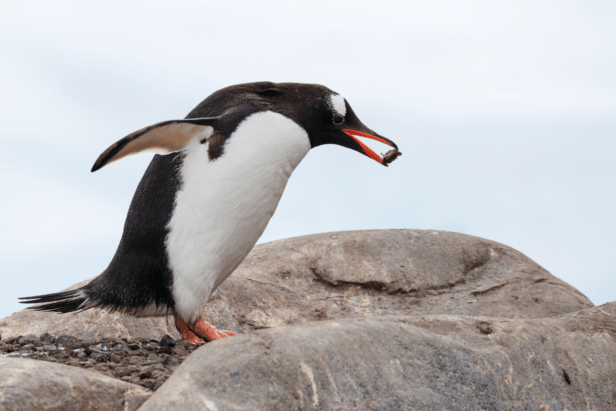
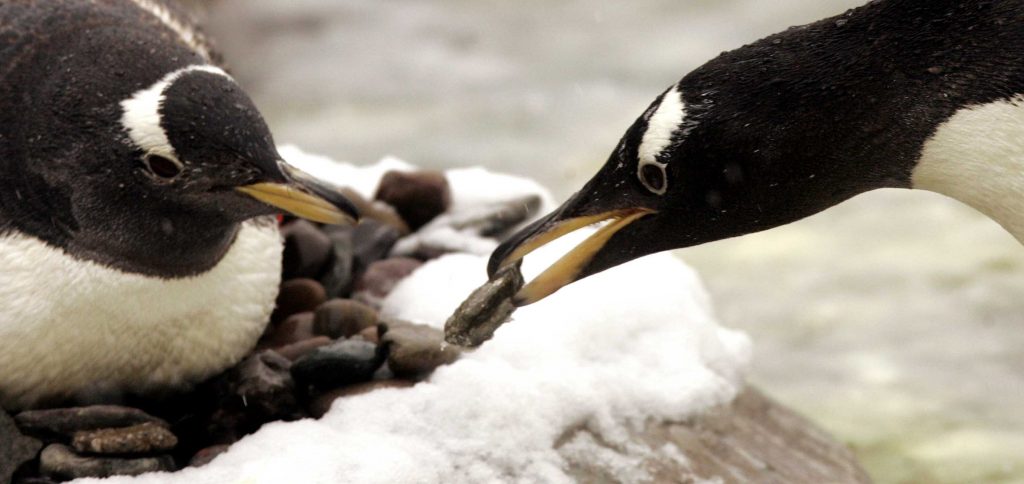
Penguins use pebbles to build nests. But since stones are hard to come by in Antarctica, they have to work hard to find them. When a male presents a female with a stone, she knows that he is asking her to build a nest together. So these stones are more than trinkets that the females think are pretty, the pebbles are essentially penguin proposals.

Dolphins

Dolphins Dolphins

http://www.dailymail.co.uk

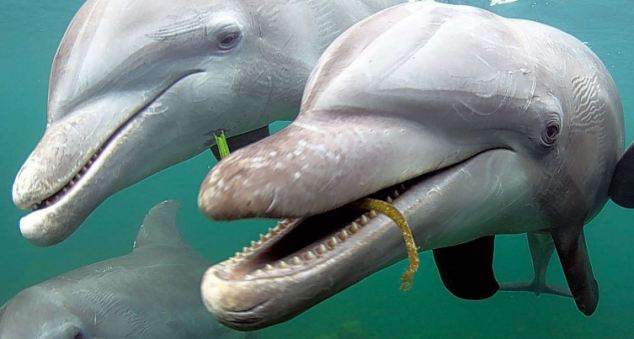
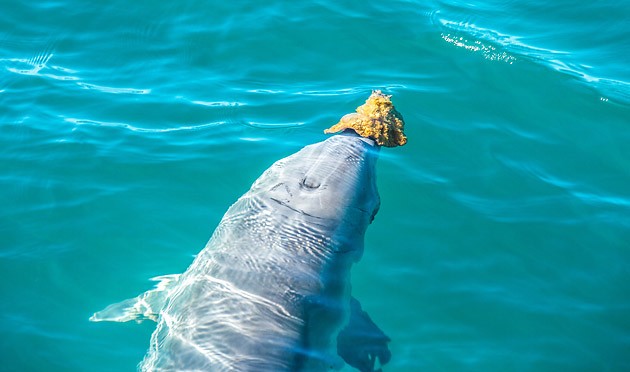
Playing a tune from his blowhole and striking what is known as a “banana pose,” a male dolphin will retrieve a sponge from the ocean floor, bring it to the surface. The males put on this strange display because the sponges are notoriously difficult to retrieve. As well as requiring a great deal of strength to pull free from the ocean floor. However, as macho as these dolphins may think they look, researchers have their doubts that the females are impressed at all.

Great Grey Shrike

Great Grey Shrike

https://wikivisually.com

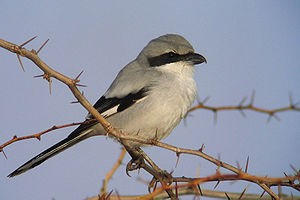
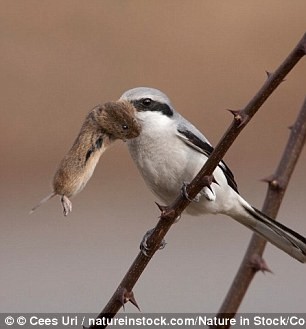
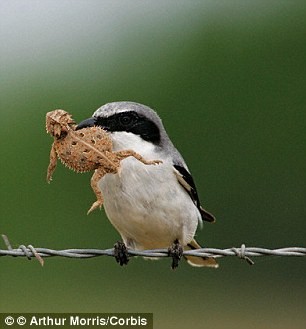
The great grey shrike is nicknamed as “the butcher bird.” great grey shrike prefers to eat small animals such as lizards, frogs, mice, or even other birds. Instead of simply eating its prey, the shrike will first crush its skull or spine before impaling it on something like a thorn or piece of barbed wire. These macabre kebabs are usually a method of keeping food for a few days. For this reason, it is called a “larder.”

During mating season, males will put these larders in clear view of females. The shrikes with the well-stocked larders will attract the most attention. Once a female has selected a mate, she is free to raid his larder as much as she wants.

Dance Fly

Dance Fly

https://bugguide.net

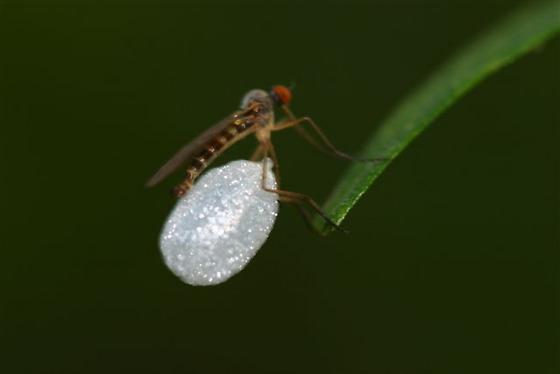
There are over 700 species of dance flies, most of which use saliva or silk to fashion a balloon made of hundreds of tiny bubbles. Then they present these balloons to potential mates during their mating dances. Males with the largest prey will make the smallest balloons, while those with less to offer will make huge balloons dotted with scraps of food. They simply make balloons and pass them to their mates. Although larger males make larger balloons, balloon size isn’t the most important thing. One study found that large males with medium-sized balloons had the best success.

Related Content
Weird and Wonderful Animal Monuments

The World’s Most Romantic Animals

Weird and Wonderful Animal Monuments

0

Some monuments put up to ensure that an animal or group of animals is remembered forever have been so large or frankly bizarre that they cannot escape our notice. Here are few of the notable sites of animal remembrance.

Monument to Laboratory Mice

Laboratory Mice

http://vsuete.com

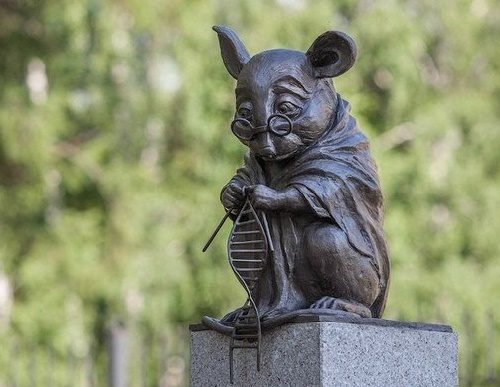
Lab mice and rats have allowed us to make huge strides in medicine, genetics, and a number of other fields. At one research center in Russia, it was decided that the role of these rodents in our advancement should be marked with a memorial.

At the Institute of Cytology and Genetics in Novosibirsk, you will find a small bronze statue of a mouse. The jolly-looking creature is knitting the double helix of DNA, which lab rodents have done so much to help us unravel.

Cheese Mite

Cheese Mite

https://www.atlasobscura.com

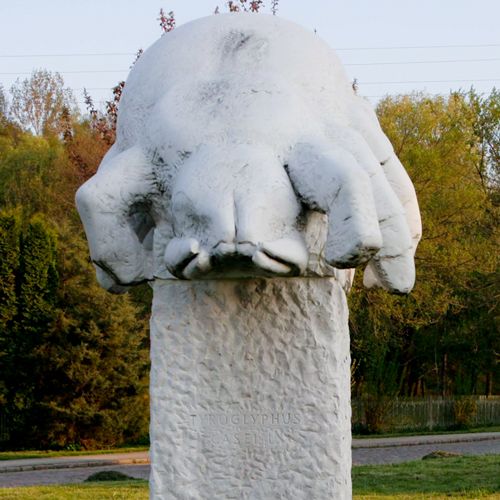
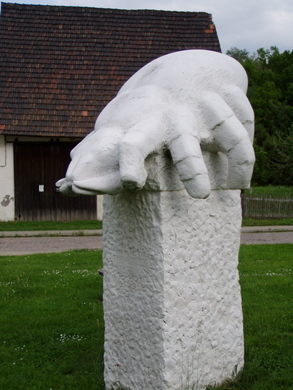
Cheese mites love to eat protein and fat, rich foods, whether that is dead human skin or a rich cheese. Some cheeses are thought to benefit from a mite infestation. One comes from Germany and is called Milbenkase (“Mite Cheese”). The cheese makers of Wurchwitz specifically add mites to their product to help age the cheese.

To celebrate the creatures’ role in this culinary delight, the cheese makers have erected a statue to the humble cheese mite.

Hi Jolly Camel Corps

https://www.roadsideamerica.com

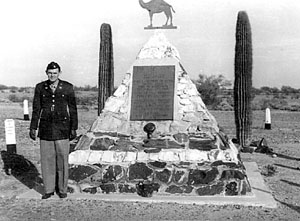
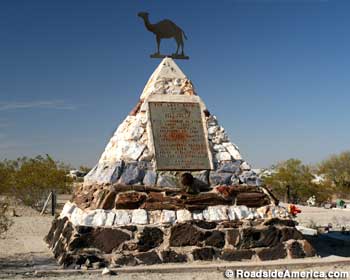
In Arizona, there is a monument to a man known as Hi Jolly who was hired by the US Army to introduce camels to the United States. It was thought that camels would be ideal beasts of burden in the desert states of the South. In 1856–57, 77 camels were imported to the US to test this theory. The experiment was a fiasco as other animals were terrified of the camels. However, the camels were successful in crossing the desert regions of the Southwest, able to eat the scrub vegetation available. With the outbreak of the Civil War, the camel corps was disbanded. Many of the camels were set free and became wild herds. None survive now. In fact, the only reminder of this strange camel experiment is a pyramid topped by a camel that marks the last camp of Hi Jolly.

The Sacrificed Donkey

Sacrificed Donkey Donkey

http://www.scmp.com

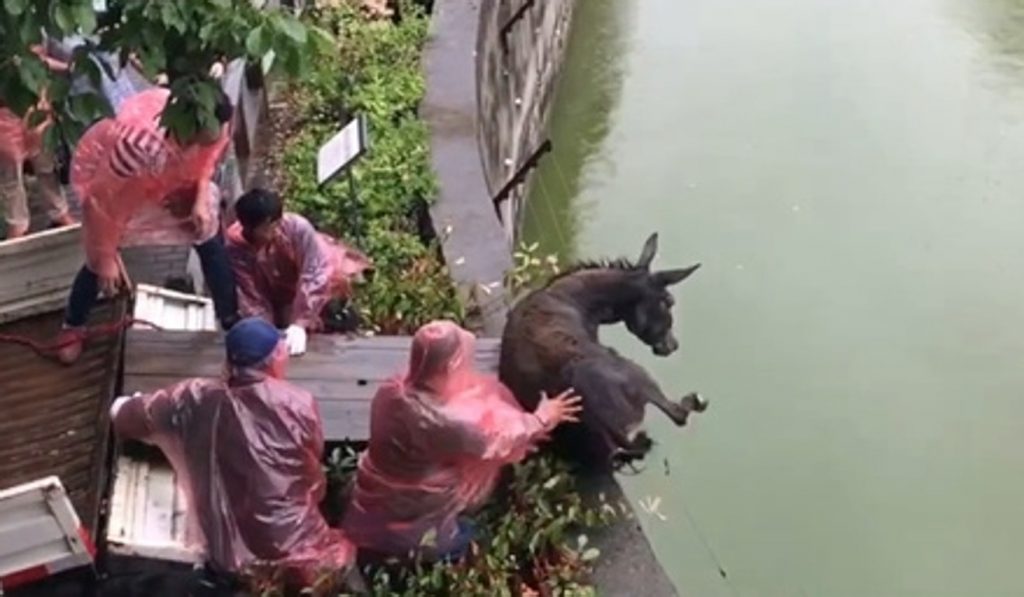
In 2017, shareholders of a Chinese zoo decided that they were not getting enough return on their investment. They entered the zoo determined to capture some of the animals and take them outside to sell to anyone who wanted them.

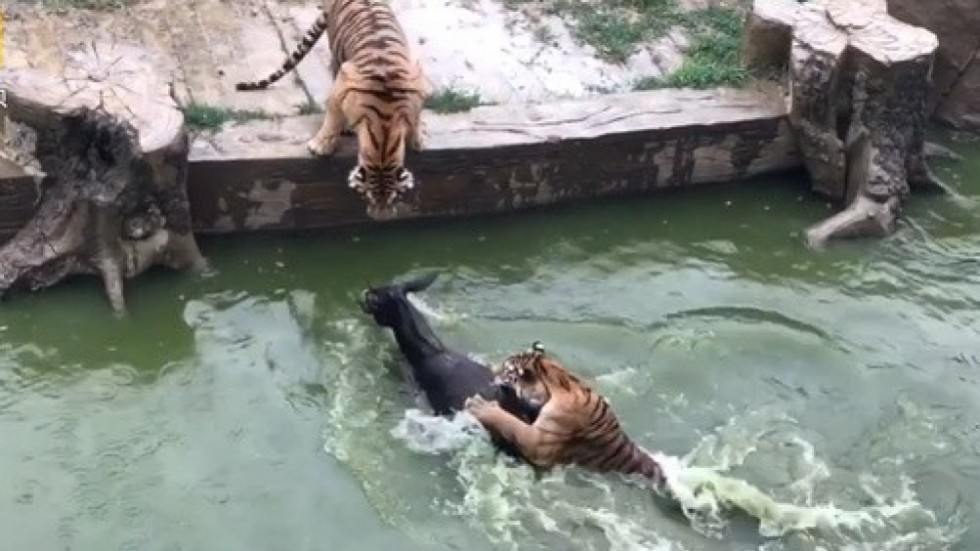
For some reason, they chose a donkey and a goat as the ideal animals with which to raise funds. When security tried to stop them, the shareholders pushed the donkey into an enclosure holding tigers.

A statue of the donkey was set up just one month later. An inscription on the side tells us about the donkey’s life. “I was born in the country on the farm. I should have grown up to have children and enjoy life on earth. This monument is calling for justice. I died in vain and should be remembered.”

Monkey Massacre Memorial

Monkey Monkey Massacre Memorial

https://www.atlasobscura.com

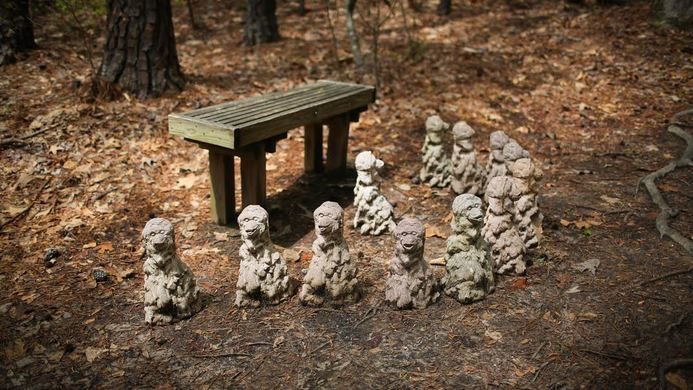
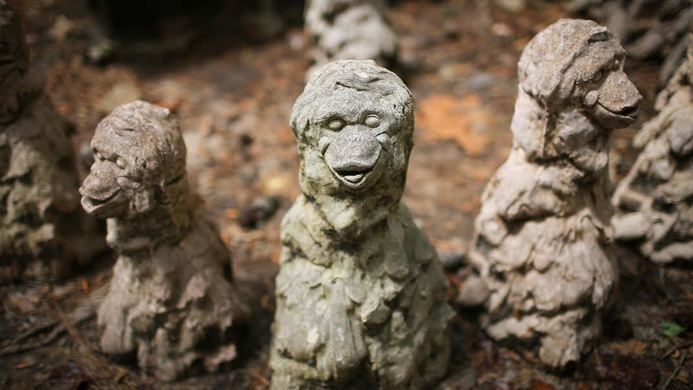
According to local legend, a train crash happened nearby in the early 20th century at Johns Creek in Georgia. This train was carrying the animals for a circus, and a troop of monkeys managed to escape and flee into the woods. The local farmers, unsure exactly what these creatures were, opened fire, and thus, the Monkey Massacre occurred.

In the 1990s, a local artist donated a group of stone monkeys to the city to mark the spot of this terrible slaughter. City officials hope the memorial will act as a reminder to visitors that shooting an unknown creature dead is not the only option.

Brooklyn Bridge Elephant Stampede Memorial

Brooklyn Bridge Elephant Brooklyn Bridge Elephant Stampede Memorial

https://viewing.nyc

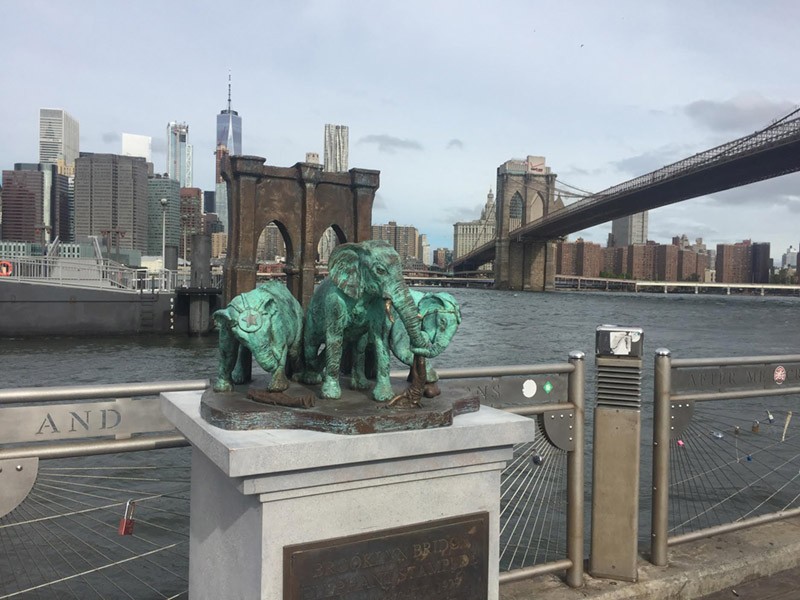
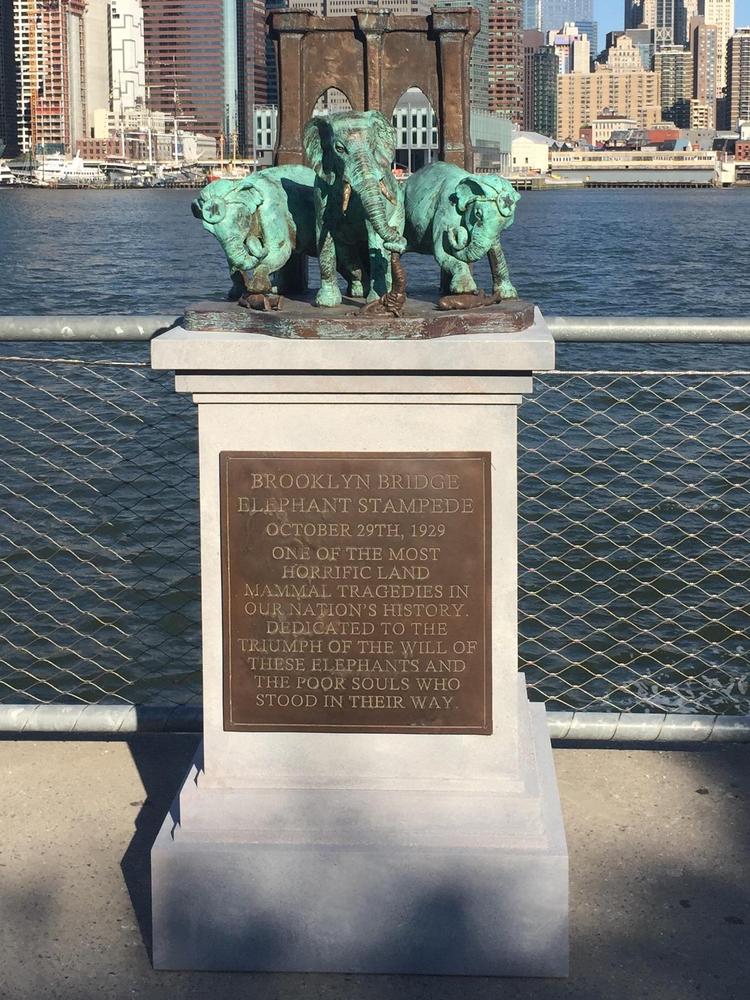
In 1929, crowds gathered to watch circus elephants, including the famous elephant Jumbo, march across the bridge. When the elephants panicked, they charged through and over the people lining the route and many people died. In reality, there was no elephant stampede.

The artist who created this statue has previous experience when it comes to memorializing fictional events. However, fake news can be hard to dismiss when it is cast in bronze.

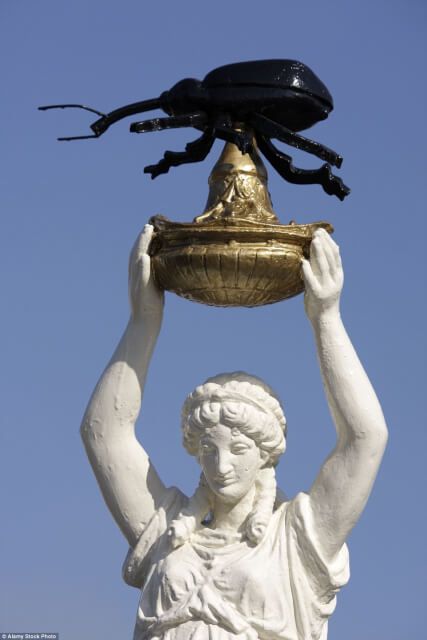
Boll Weevil Monument

Boll Weevil Monument Boll Weevil Monument Boll Weevil Monument

http://www.encyclopediaofalabama.org

Enterprise, Alabama, calls itself the “City of Progress.” Throughout its history, the city has faced several crises and none was more challenging than the arrival of the boll weevil. The boll weevil is an agricultural pest that feeds on the buds and flowers of cotton plants. The farmers of Enterprise were forced to diversify their crops, and peanuts turned out to be ideally suited to the land. Soon, Enterprise was flourishing as one of the great peanut-producing centers of the country.

Laika Monument

Laika Monument Laika Monument

https://www.tripadvisor.co.uk

Laika the dog was the first animal to be sent into orbit around Earth. This was quite the achievement for a stray dog found living on the streets of Moscow. Laika survived on Sputnik 2 for around five hours before succumbing to overheating. It was only in 2008, 51 years after her flight, that a memorial was put in place to celebrate Laika’s flight. Placed outside a military research station, the statue shows Laika perched on a rocket which transforms into a hand that cups the dog.

Related Content
Animals That Inherited a FortuneAnimals Who Became ArtistsExtraordinary Creatures of Antarctica

Oldest Animals That are still Alive

0

There are some really old animals around us. We mean creatures that have been alive for hundreds or even thousands of years. Although it is usually difficult to estimate the ages of wild animals, scientists have devised methods of calculating some of them. In fact, we are very sure of the ages of some critters that have lived around us, either in private ownership or in zoos.

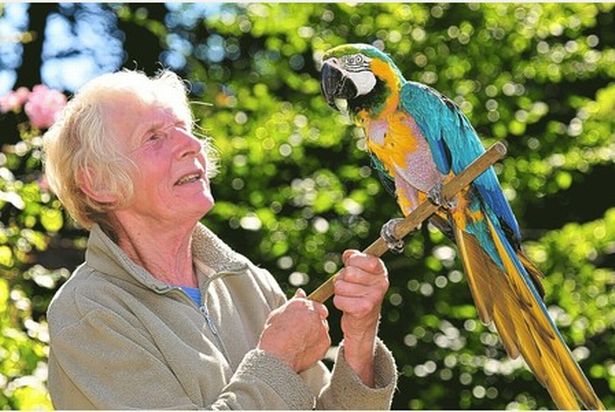
Charlie the Parrot 

Charlie the Parrot

https://www.getsurrey.co.uk

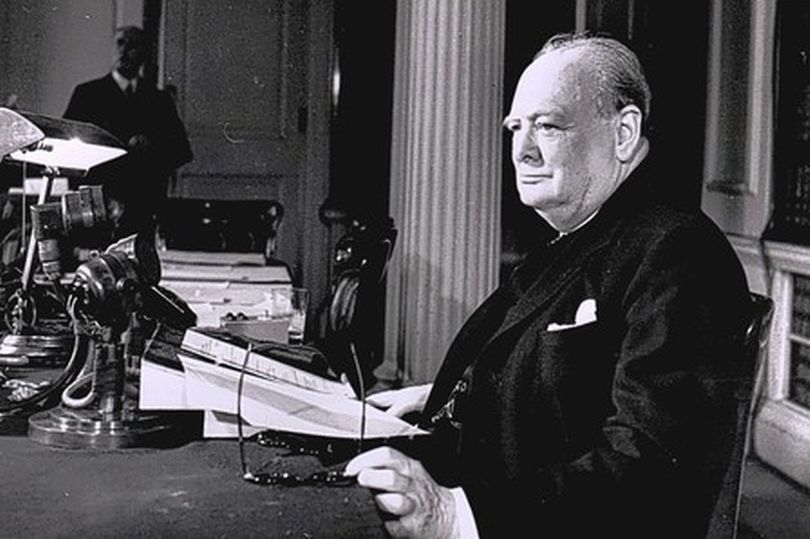
Charlie is a macaw parrot born in 1899, making him 119 years old as of 2018. He is owned by Peter Oram, who purchased the bird for his pet shop in 1965. Oram later took Charlie home because the bird was fond of swearing and chanting anti-Nazi slurs. Charlie is said to have learned the anti-Nazi slurs in the home of wartime British Prime Minister, Sir Winston Churchill, who reportedly bought him in 1937.

Churchill’s daughter denied her father’s ownership of the macaw.

She confirmed that her father had a parrot in the 1930s, but it was an African grey parrot and not a macaw. Family is only denying Winston Churchill’s ownership of Charlie because the bird’s behavior doesn’t promote them in a positive light.

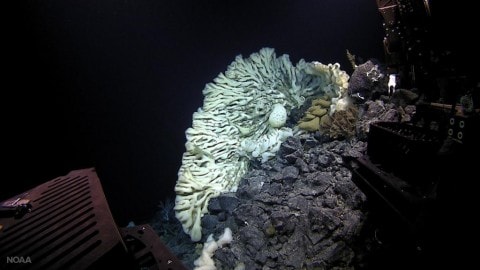
Minivan-Sized Sea Sponge

Sea Sponge

https://www.washingtonpost.com

At 3.7 meters (12 ft) wide and 2.1 meters (7 ft) long, a sea sponge the size of a minivan is the largest ever recorded. It was discovered 2,100 meters (7,000 ft) underwater between Hawaii and Midway Atoll. Researchers could not determine its exact age, but its extraordinary size means that it could be thousands of years old. Age is not the only mystery surrounding the minivan-sized sea sponge. Researchers couldn’t determine its genus, either.

George the Lobster

Lobster

https://wtop.com

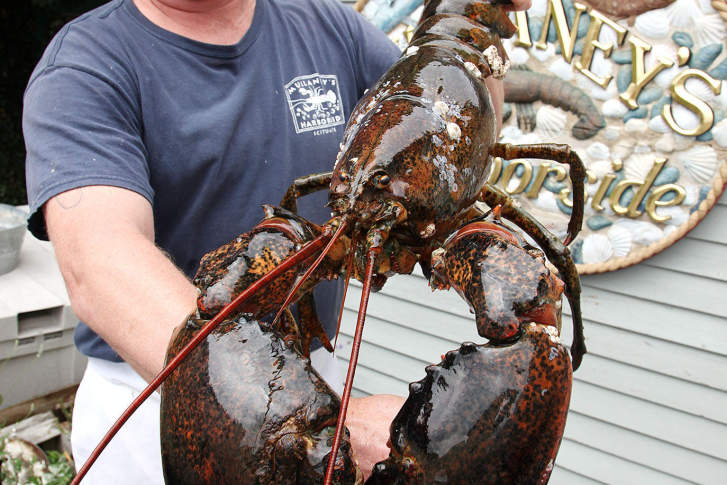
At 140 years old in 2009, George held the title of the oldest lobster ever found. He was caught off Newfoundland, Canada, and was sold to City Crab and Seafood restaurant in New York City. There, he sat in a tank like a mascot as kids had their pictures taken with him. Then George was spotted by two diners who called PETA.

PETA requested that George be returned to the sea. The restaurant agreed, and George was back in the Atlantic Ocean 10 days after he was caught. PETA and the restaurant estimated George’s age from his weight.

Someone even offered $1,000 to have him cooked for Father’s Day.

Unnamed Greenland Shark

Greenland Shark

http://divemagazine.co.uk

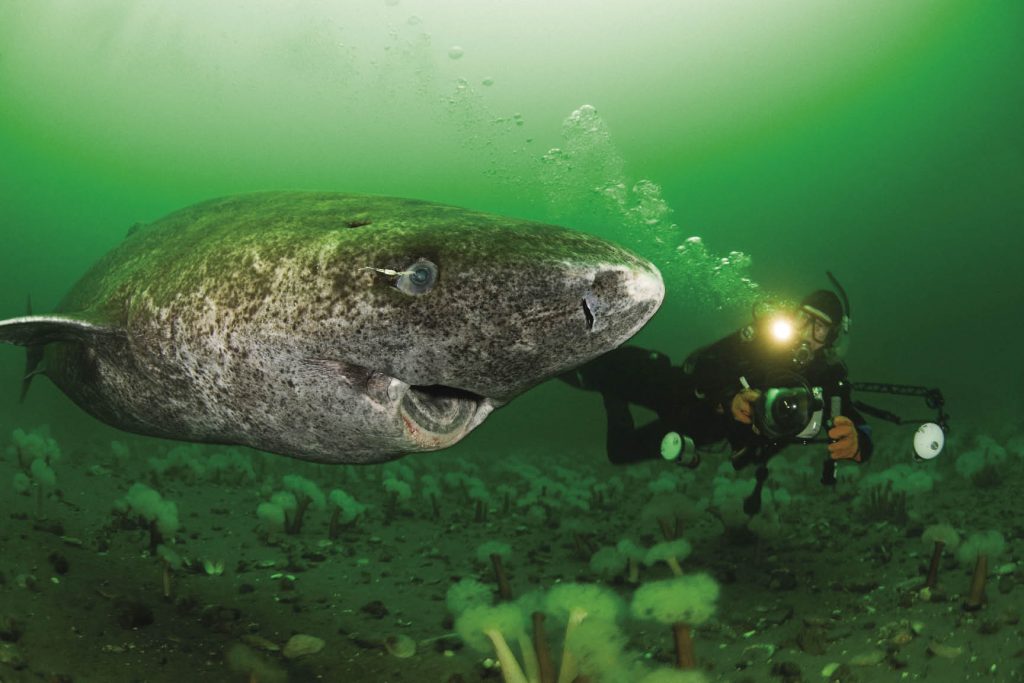
An unnamed female Greenland shark holds the title of the world’s oldest vertebrate. She is believed to have been born between 1501 and 1744, so she is probably between 274 and 517 years old as of 2018. Even her lowest possible age of 274 makes her the oldest-known living vertebrate. Before she was discovered, the title of the oldest vertebrate alive was held by a 211-year-old bowhead whale. Greenland sharks grow one centimeter (0.4 in) per year, reach sexual maturity at 150 years old, and could reach 5 meters (16 ft) when fully grown.

Muja the Alligator

Alligator

http://www.dailymail.co.uk

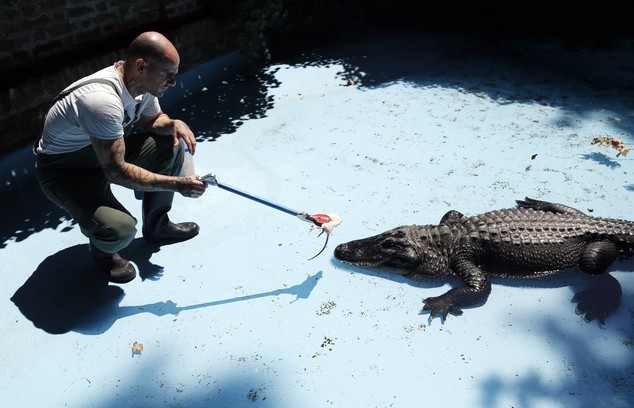
The oldest American alligator in captivity is in a Serbian zoo. His name is Muja, and he is believed to be at least 80 years old. He arrived at Belgrade Zoo from Germany as an adult in 1937, two years before World War II. Muja has been in good health for most of his life. However, in 2012, his right front foot was amputated after he developed gangrene. Before Muja, the world’s oldest alligator was Cabulitis, which died in Riga Zoo in Latvia in 2007 at age 75.

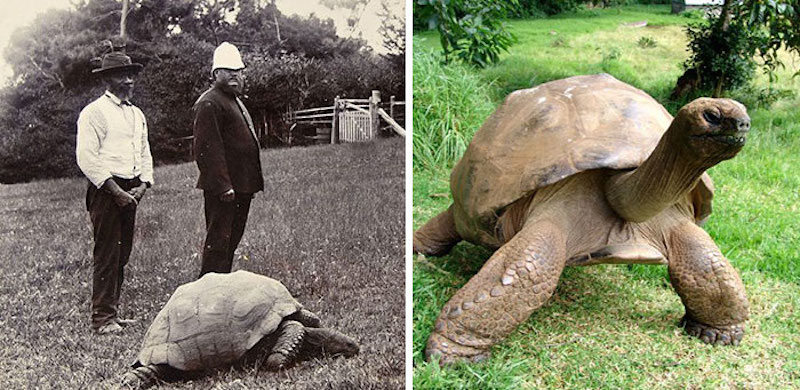
Jonathan the Tortoise

Tortoise Jonathan the Tortoise

http://www.earthporm.com/

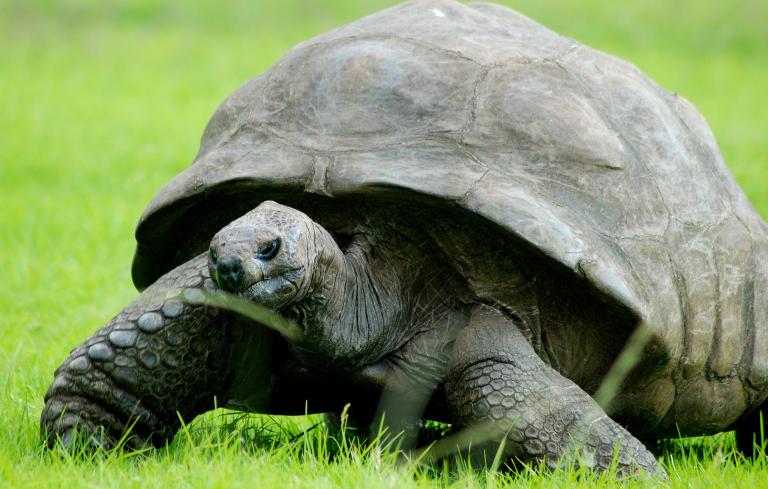
Jonathan is estimated to have been born in 1832. If this is so, then he’s 186 years old as of 2018. His vet, Joe Hollins, believes that Jonathan is no younger than 160 years old. The average life expectancy of a tortoise is 150 years.

Jonathan lives on the island of St. Helena, which is part of a British Overseas Territory in the South Atlantic Ocean. He was brought to the island in 1882, and there is even a picture of him taken in 1902.

He lives at Plantation House, the official residence of the governor of St. Helena, with five other tortoises.

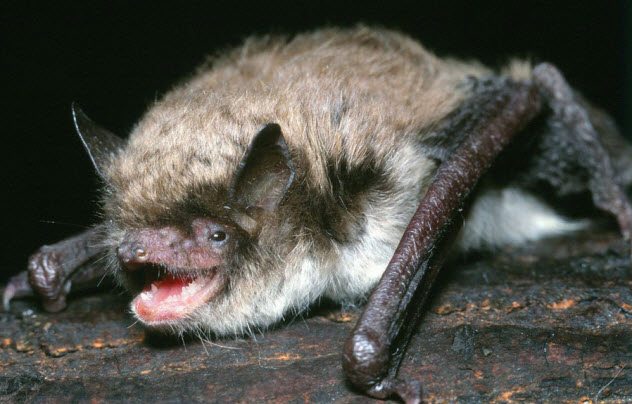
An Unnamed Brandt’s Myotis (Bat)

Brandt’s Myotis

http://listverse.com

An unnamed 41-year-old male Brandt’s myotis from Siberia holds the record of the oldest bat alive. It is also the smallest mammal alive. More interesting is the fact that the bat reached this age in the wild. The age of the unnamed bat became known after it was captured to be tagged in 2005. It was found wearing an earlier band that had been attached when the animal was first captured in 1964.Scientists believe that food supply and hibernation play a huge role in the higher-than-usual life expectancy of Brandt’s myotis.

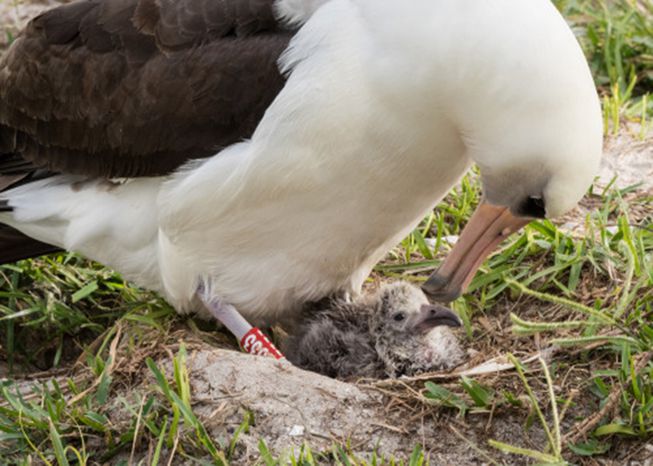
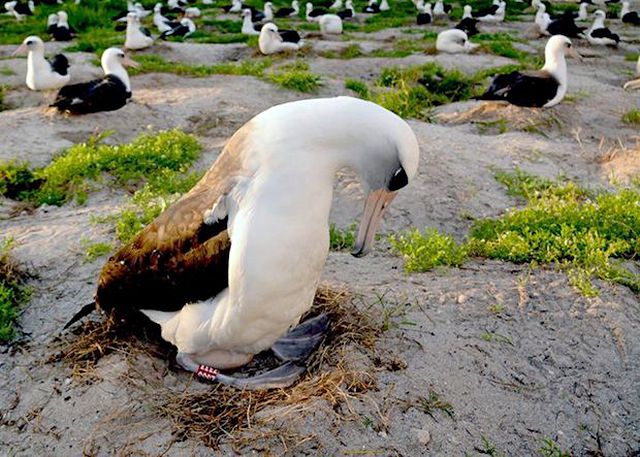
Wisdom the Albatross

Albatross

https://www.mnn.com

Sixty-seven-year-old Wisdom is the world’s oldest wild bird. She is a Laysan albatross, a type of bird which has an average life span of about 50 years. we only learned her age after she was captured to be tagged in 2002. She was found with an earlier tag from 1956.Wisdom was estimated to be six years old in 1956.More interesting is the fact that she lays an egg every year and has hatched 39 in her lifetime. Not all albatrosses lay eggs every year.

Related Content
Fascinating Facts about FerretsAnimals That Have Figured Out Their Own Life HacksCountries Where Your Pet Is Just Livestock

Animals That Inherited a Fortune

0

If you’re an animal lover, you might get along with your pets better than you do with people. But do you love your pets so much that you would include them in your will and cut your family members out? That’s exactly what many of the people on this list did. These are people who left their fortunes to their pets – often at the expense of those closest to them. These rich people who gave money to their pets also assigned trustees to take charge of the money and spend it on the animals. Many of these trustees got pretty sweet deals themselves; most of them got to live in the rich person’s mansion while taking care of the animals.

Oprah’s Dogs; Luke, Layla, Sadie, Sunny, and Lauren

Oprah’s Dogs

https://www.ranker.com

Oprah has five dogs: Luke, Layla, Sadie, Sunny, and Lauren. Whether they will outlive their owner nobody can tell, but if they do, they will be well taken care of. Oprah has set aside $30 million of her estate to care for her beloved canines.

Gunther III and Gunther IV

Gunther III and Gunther IV

https://iheartdogs.com

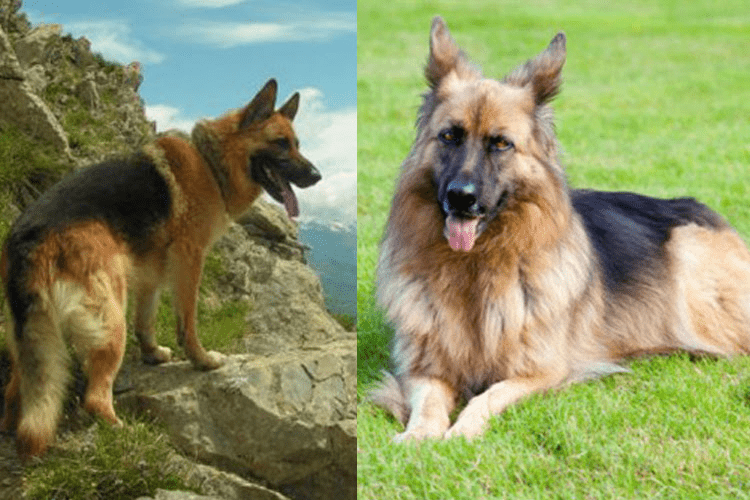
German Countess Karlotta Libenstein left her entire $80 million fortune to her German Shepherd, Gunther III. Trustees of the fortune have increased Gunther III’s estate to a value of $375 million through investments, making him the richest pet of all time. Gunther III reportedly purchased Madonna’s Miami Beach mansion in 2000. His fortune has now passed to his progeny, Gunther IV.

Betty White’s Dog; Pontiac  

Betty White’s Dog

https://www.ranker.com

Betty White is still alive and kicking at 94 years old. But when she dies, she wants to be sure her Golden Retriever, Pontiac, is well cared for. White, a widow with no children of her own, has set up a $5 million trust in her will to care for Pontiac and her other pets.

Trouble

Trouble

https://www.nytimes.com

Leona Helmsley was the wife of Harry B. Helmsley, a New York City real estate tycoon. Leona survived her husband, and when she died in 2007, she left $12 million to her Maltese, Trouble. Trouble received so many death threats that Helmsley’s trustees had to hire security personnel to protect the dog.

Two of Helmsley’s grandchildren were entirely left out of the will, and they filed a lawsuit. A judge decided to reduce Trouble’s portion of the will to $2 million and give the two snubbed grandchildren a total of $6 million. The majority of Helmsley’s estate went to charity to care for dogs.
Tommaso

Tommaso

https://radaronline.com

Maria Assunta was the widow of an Italian real estate investor. She had no children, so she took in a stray cat from the streets of Rome and named him Tommaso. When she died in 2011, she left her entire $13 million fortune to the cat and gave her nurse the responsibility of caring for him.
Conchita, Lucia, and April Maria

April Maria April Maria April Maria

http://www.paghat.com

Gail Posner belonged to one of Miami Beach’s richest families. When she died in 2010, she left a $3 million trust to her three dogs, Conchita, Lucia, and April Marie. Posner’s son only got $1 million, and he sued, alleging that the house waitstaff took advantage of his sick mother and pushed her to change her will. The waitstaff inherited $26 million and the right to live in Posner’s mansion and care for her dogs.

Samantha

Samantha

http://listverse.com

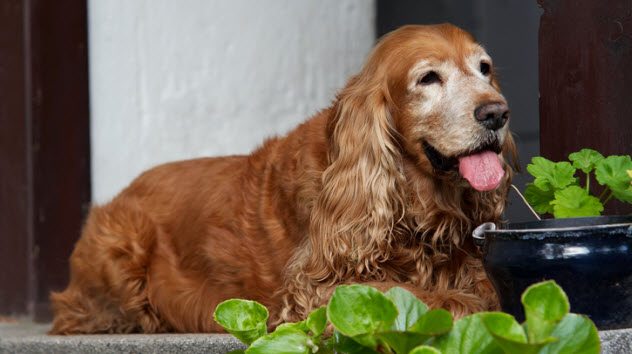
A businessman named Sidney Altman left the majority of his $6 million estate to his Cocker Spaniel, Samantha, and named his girlfriend, Marie Dana, the dog’s guardian. Dana was furious that she did not inherit any money from the will, and filed a lawsuit to get $2.7 million of the estate. Dana claimed she was Altman’s fiancé when he died. Altman’s will described Dana as his “good friend.”

Gigoo the chicken

chicken

http://www.wideopencountry.com

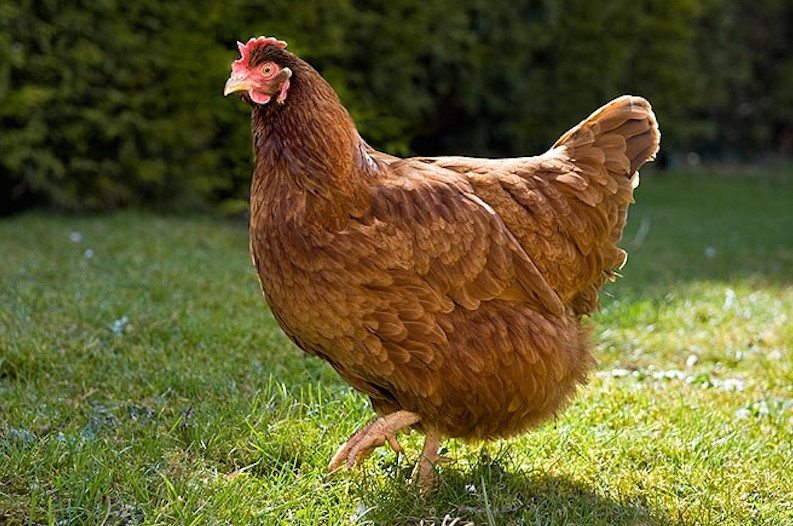
Miles Blackwell was a publishing magnate who, along with his wife, established the Tubney Charitable Trust to protect farm animals. Blackwell was going to leave his fortune to his wife, but she died before him in 2001. Blackwell had no children, so he left $15 million to his pet hen named Gigoo when he died just weeks after his wife.

Blackie

Blackie

https://www.ranker.com

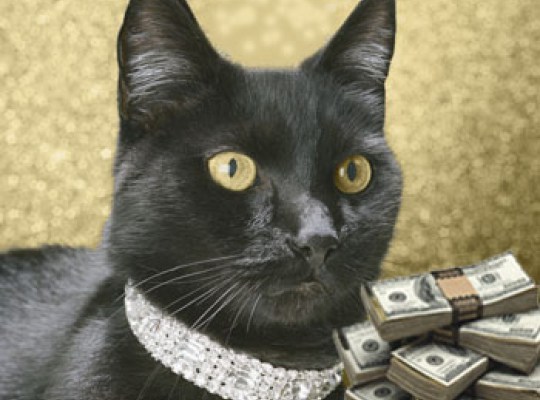
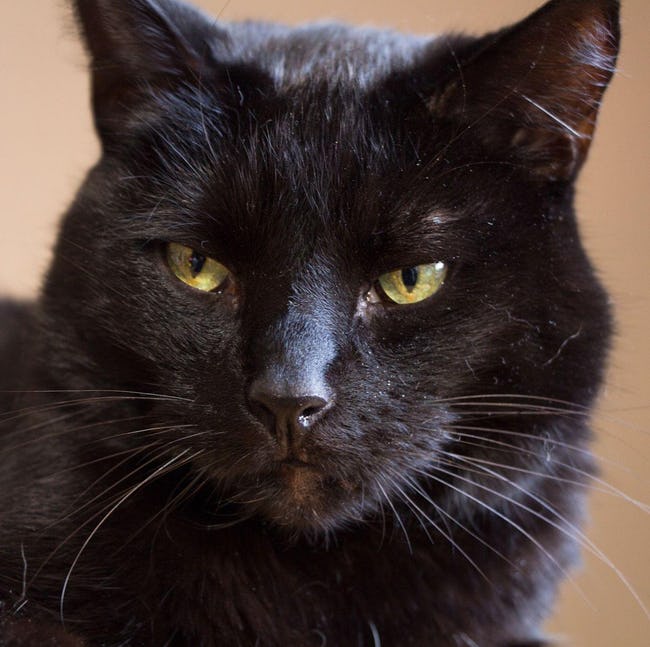
Ben Rea was a British antique dealer who was almost entirely unknown until his death in 1988. Even though he had surviving family members, he left almost his entire fortune to his cat, Blackie. Rea had 15 cats in his mansion, but Blackie was the last living at the time of his death. The remainder of Rea’s estate went to cat charities.

Related Content
Cheapest Pets for kids

Ways to Save Money on Vet Care

Animals Who Became Artists

0

You might be surprised how many animals have mastered artistic skills, from painting and photography to dance and collage. Given the opportunity, animals seem to enjoy expressing themselves through as many different mediums as we do. Here are some of the coolest examples.

Dagger DogVinci

Dagger DogVinci

https://www.telegraph.co.uk

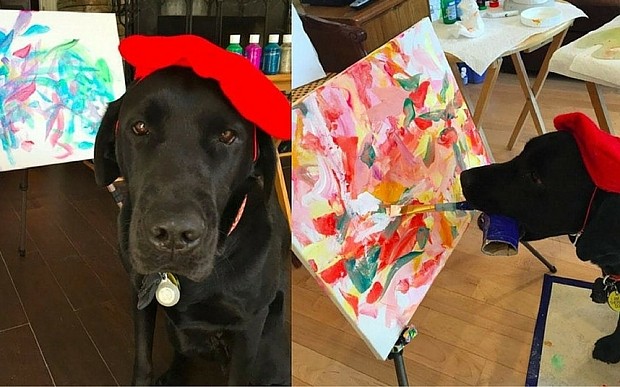
Dagger is a Black Labrador/Golden Retriever cross that was destined to become an assistance dog for Canine Companions for Independence (CCI).Because of his previous training, Dagger was used to learning how to observe and master human skills. One day, Yvonne gave him a paintbrush, and Dagger set to work creating his own art. He went on to sell more than 150 paintings and raise over $10,000 for charities. He is also trained to be a certified therapy dog for Therapy Dogs International.

Metro: The Painting Racehorse

Painting Racehorse

https://paintedbymetro.wordpress.com/

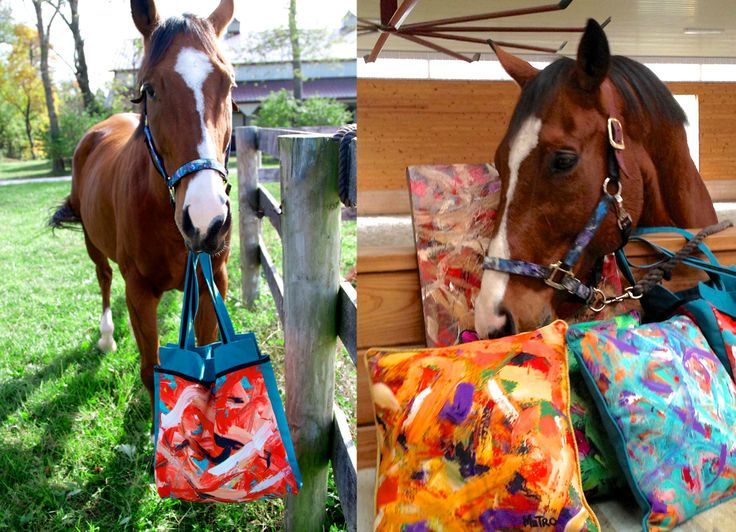
Top-class racehorse Metro Meteor was adopted by artist Ron Krajewski and his wife Wendy after he suffered serious knee injuries while on the racetrack. Metro was given a likely two years to live, so his owners wanted to make him as happy as possible. Ron noticed that Metro liked to bob his head up and down, and he had the idea that the horse might like to paint with a paintbrush in his mouth. Metro absolutely loved to paint.

He became the best-selling artist at Gallery 30 in Gettysburg, Pennsylvania, and made enough money to pay for a pioneering treatment for his knee condition. He has also given other horses like himself a chance to have a better retirement, donating over $45,000 from the proceeds of his work to a charity that helps racehorses find good homes.

The Painting Elephants Of Thailand

Painting Elephants

http://teakdoor.com

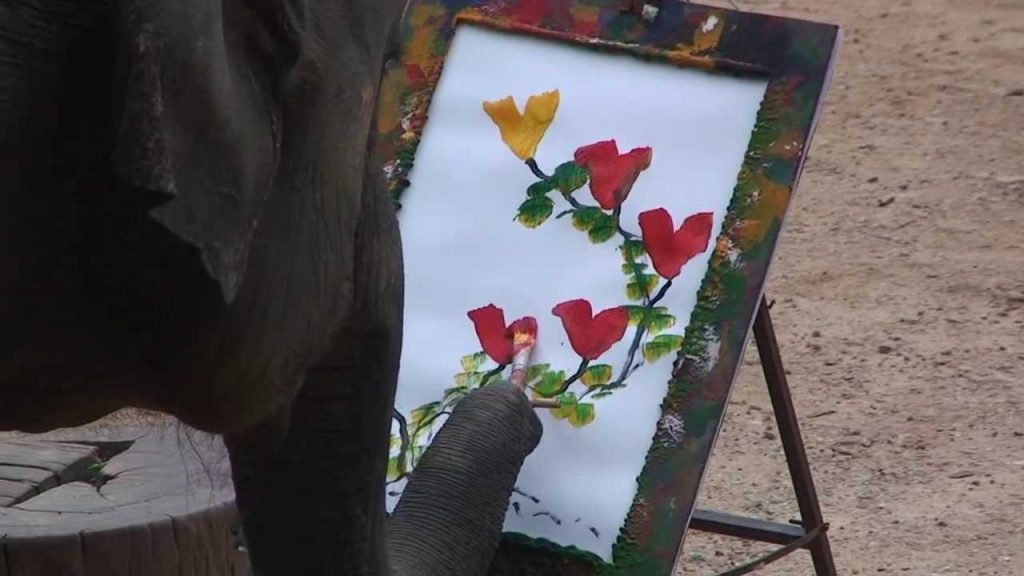
According to the caretakers at the National Elephant Institute, in Thailand, Thai elephants are natural born artists that will often pick up a stick, and start noodling in the sand. Trained properly these pachyderms can create original artworks that rival those done by some humans. Thanks to their incredibly mobile trunk (powered by 40,000 muscles) elephants can paint better than any other animals.

Mshindi: The Painting Rhino

Painting Rhino

http://time.com

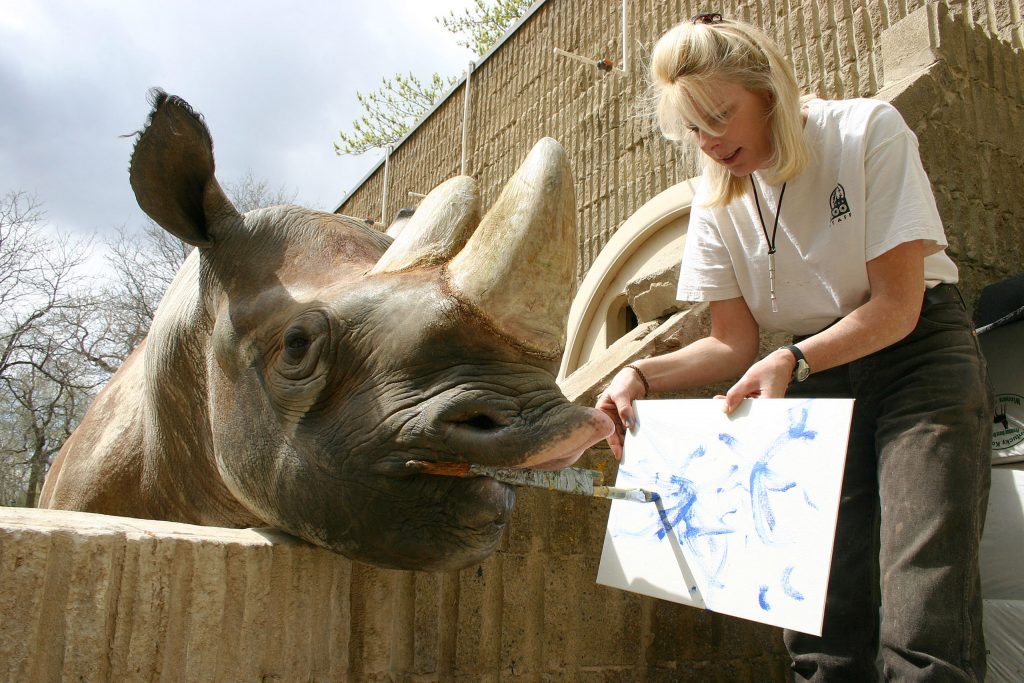
This talented black rhino is one of the main attractions at the Denver Zoo. Apart from being one of the gentlest most lovable animals there, Mishindi also likes to spend his spare time, painting. All he needs is a big paintbrush and someone to hold the canvas, and he just unleashes his artistic talent. In a fund-raising event, last year, Mishindi’s paintings have sold for $220, each.

Grizzler: The ‘Pho-Dog-Rapher’

Pho-Dog-Rapher

https://www.boredpanda.com

An experiment by Nikon allowed a lucky dog called Grizzler to become a photographer. The camera was strapped to Grizzler’s chest and had a sensor that monitored the dog’s heart rate. When Grizzler got excited by something he was seeing, his heart rate would inevitably rise. Whenever Grizzler’s heart rate was above 119 beats per minute, it would trigger the shutter release and take a photo.

Grizzler had an eclectic portfolio to show for his efforts, including pictures of cats, other dogs, plants, and even mushrooms.

Towan: The Orangutan Artist

Orangutan Artist Orangutan painting

http://damnfreshpics.blogspot.com

Towan, a 41-year-old orangutan, from Woodland Park Zoo, Seattle, was a big internet hit, back in 2008, when some of his original paintings were auctioned off, on eBay. Two of his artworks sold for close to $1,000, with the proceedings going towards organizing a zookeepers conference. All orangutans like to paint, but unlike all his other furry friends, Towan does it with a brush, instead of his tongue. He’s also much easier to deal with after he’s done painting, as he slides his tools, under his doorway, while other orangutans will desperately hold on to them.

Xiaoqiang: Painting Beluga Whales

Painting Beluga Whales

http://listverse.com

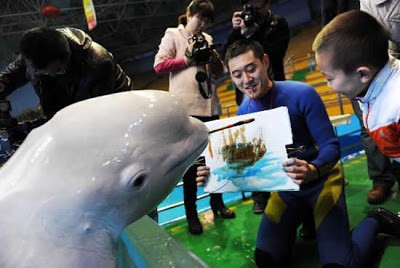
Xiaoqiang, a talented Beluga whale, at the Qingdao Aquarium, in China, learned to paint under the guidance of his instructor, and is now one of the aquarium’s top attractions. Incredibly enough, Xiaoqiang’s paintings aren’t abstract; they usually make sense, if you look close enough.

Sammy the Painting Dog

Painting Dog Dog paint

https://people.com

After his owner attached a paintbrush to his favorite rubber bone, Sammy took up painting, and never looked back. Inspired by his lush surroundings, in Eastern Shore, Maryland, Sammy creates the most amazing abstract paintings, using a variety of colors. You may think this puppy’s art is a joke, but his paintings have been showcased in various New York art galleries, and some have sold for up to $1,700. Now that’s no joke.

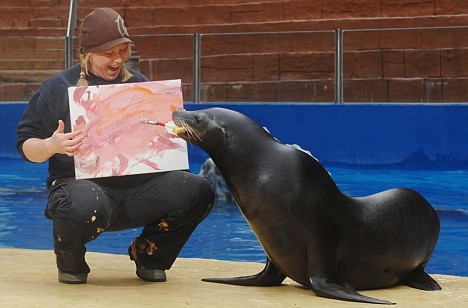
Lea the Sea Lion

Sea Lion painting Sea Lion

http://latimesblogs.latimes.com

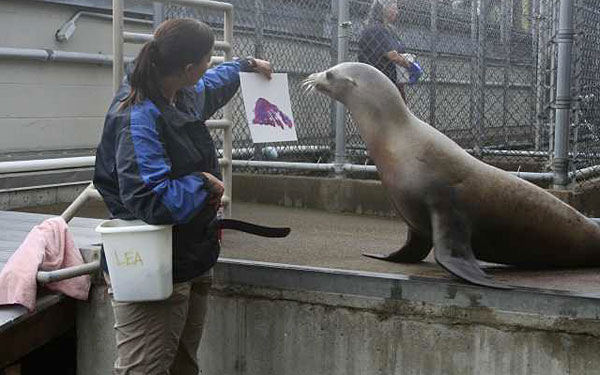
When Jen DeGroot, marine mammologist, at the Oregon Coast Aquarium, decided to teach Lea, the sea lion, to make flipper art, she had no idea it would eventually turn into a regular phenomenon. But when people heard there was a sea lion creating artistic imprints with her flippers, everyone wanted their very own custom artwork. The aquarium saw the potential of their slippery artist and decided to charge for her art, as a way of raising money for the animals. Since then Lea and her sea lion friend Max have taken it to another level and are now masters of the paintbrush, as well.

Related Content
What If Dogs Could Text? Hilarious texts from dogs

Hibernating Animals

Extraordinary Creatures of Antarctica

0

Whenever people think of Antarctica, the images of stunning icebergs, glaciers, and plenty of snow likely come to their minds. Additionally, whenever they imagine Antarctic life, it probably includes pictures of penguins, seals, skuas, and the krill that are found in the Southern Ocean.

However, many other fascinating discoveries have been made in Antarctica over the decades. Scientists are slowly unraveling one mystery at a time in a land that is full of extraordinary creatures.

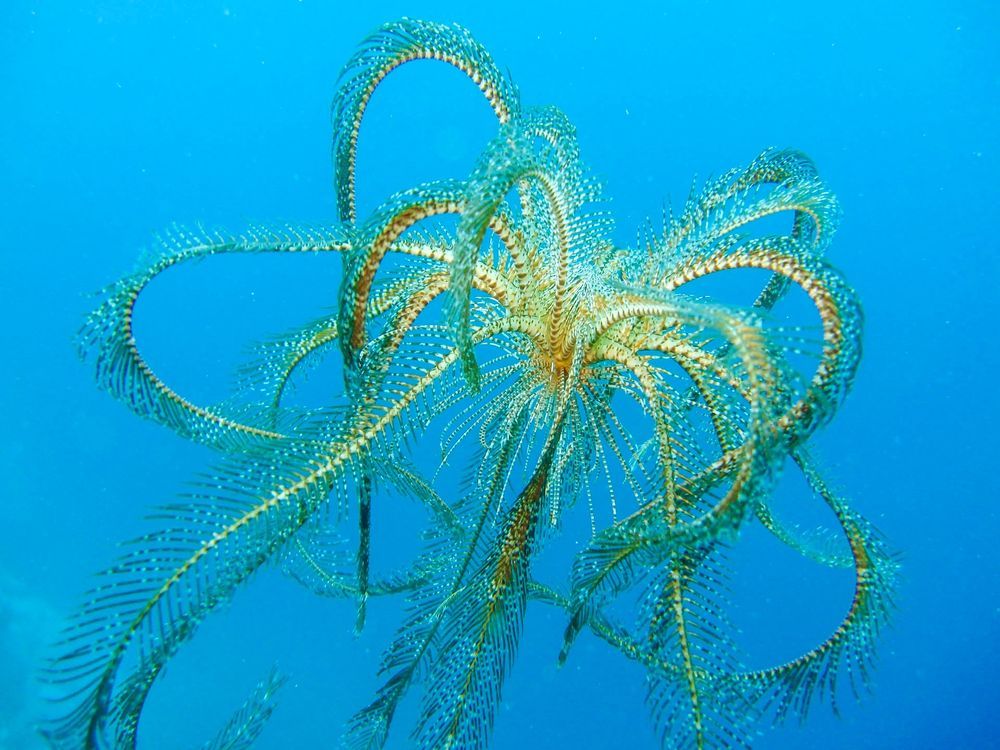
Antarctic Feather Star

Antarctic Feather Star

http://yourshot.nationalgeographic.com

This Antarctic feather star (aka Promachocrinus kerguelensis) is part of the Crinoid family. These animals live on the bottom of the Southern Ocean near the coast of the continent. Promachocrinus kerguelensis appears to be denser and more feathery than it really is. The creature’s 20 arms filter food from the water and help it to swim when it wants to settle in another area.

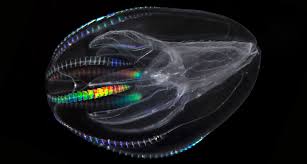
The Comb Jelly

Comb Jelly

https://www.sciencenews.org

Comb jellies (aka ctenophores) are soft, transparent animals that use eight plates or comb rows of cilia to paddle through the waters off the coast of Antarctica. They are the largest creature known to swim this way. Whenever light strikes their paddles, they emit different colors, which give them a unique appearance. They are also bioluminescent, which produces a blue-green light. Comb jellies live mostly on the ocean surface, where it is more acidic and warmer due to higher levels of carbon dioxide, and they thrive on that.

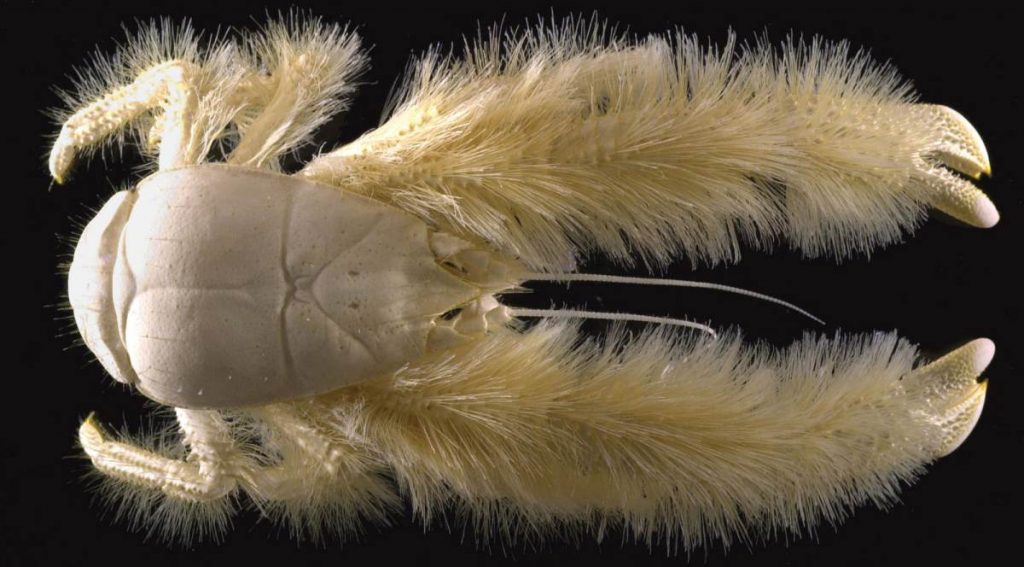
The Hoff Crab

Hoff Crab

https://www.toptene.com

The Hoff crab, a hairy creature that lives on the seafloor, gets its moniker from resembling David Hasselhoff’s hairy chest. Hasselhoff was quite honored that a creature was nicknamed after his hairy chest. Later, the crab was given the scientific name of Kiwa tyleri. The animal was found on East Scotia Ridge in the Southern Ocean, where the waters are about 0 degrees Celsius (32 °F).The Hoff crab has a hairy appearance because the animal is covered in bacteria. The crab uses its comb like mouthparts to scrape off the bacteria and eat them for dinner.

Wandering Albatross

Wandering Albatross

https://themysteriousworld.com/

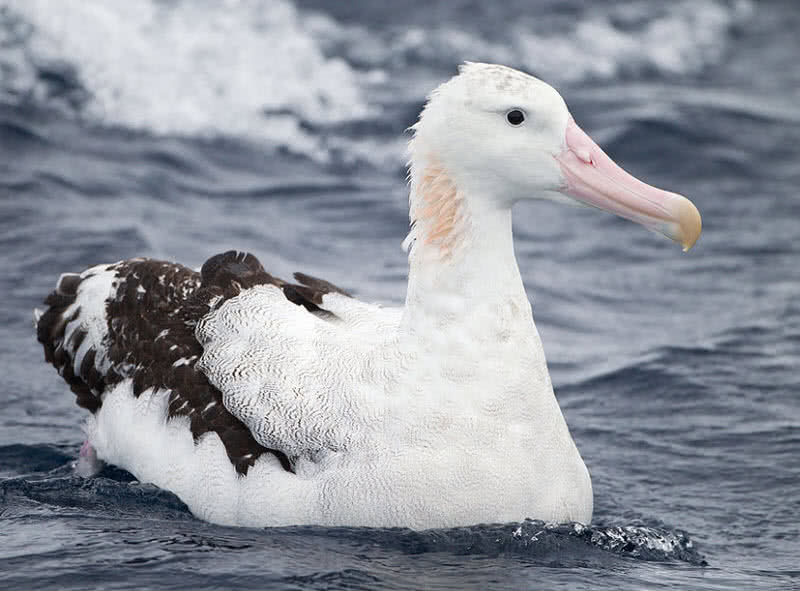
Wandering albatross have largest wingspan of any living bird in the world, ranges between 2.5 to 3.5 meters. They are native to Southern Ocean region, also sound within Islands of Antarctica. Wandering albatross spend most of their lives in flying, found rarely in land, only at breeding period and usually lay only one egg and give so much of care for it. They feed on small fishes and cephalopods, also like to drink ocean water.

Crabeater Seal

Crabeater Seal

https://themysteriousworld.com/

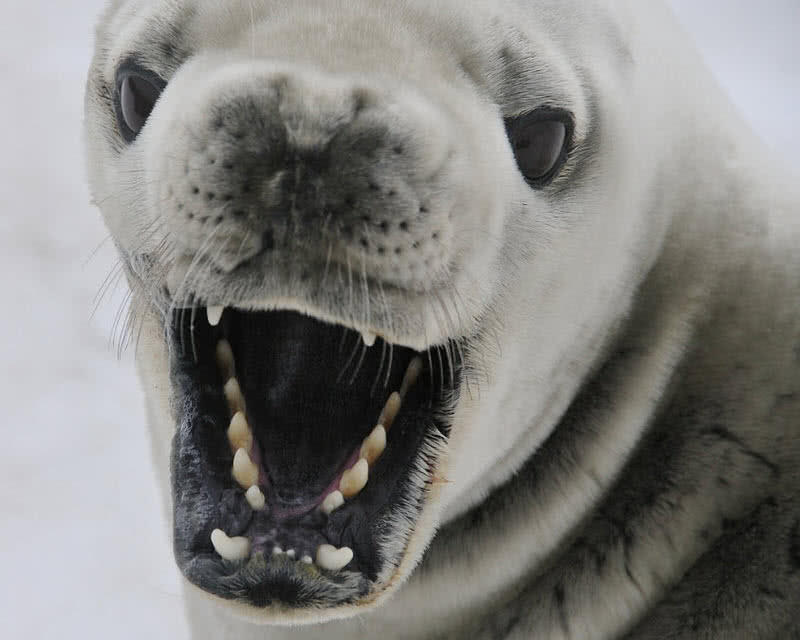
Crabeater seal spend their lifespan on ice-packed zone of Antarctica. They are abundant species of seal in Southern ocean, have population of 15 million. They also used to breed on ice, female seal looking after for pub for long time. They usually feed on krill and are capable of making dive to the depth of 250 meters.

Ice Fish 

Ice Fish

https://oceanbites.org

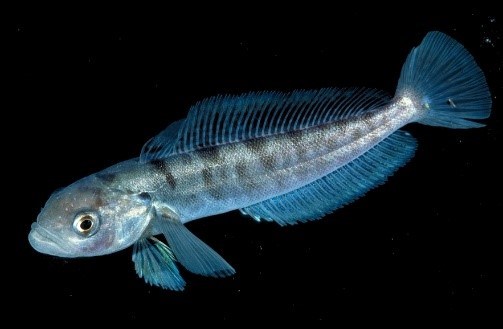
Ice fish are literally some of the coldest-blooded creatures you’ll find in the ocean. They’d have to be, if they wanted to survive in the Arctic. Ice fish have developed several special features that allow them to thrive in icy waters. Their body temperature is able to adapt to the temperature of the water, and remains very cold. In fact, if they were to encounter higher temperature waters, they would actually die. The blood of an ice fish is white in color, and that, combined with their transparent bodies, allows them to camouflage themselves.

The Sandhopper

Sandhopper

http://listverse.com

The sandhopper is an amphipod, which is a crustacean. They live in the frigid Antarctic waters but are land creatures, too. The sandhopper has earned that name because it jumps far if disturbed. This animal leaps by first tucking in its tail and then flipping it out.

Sea Pig

Sea Pig

http://mentalfloss.com

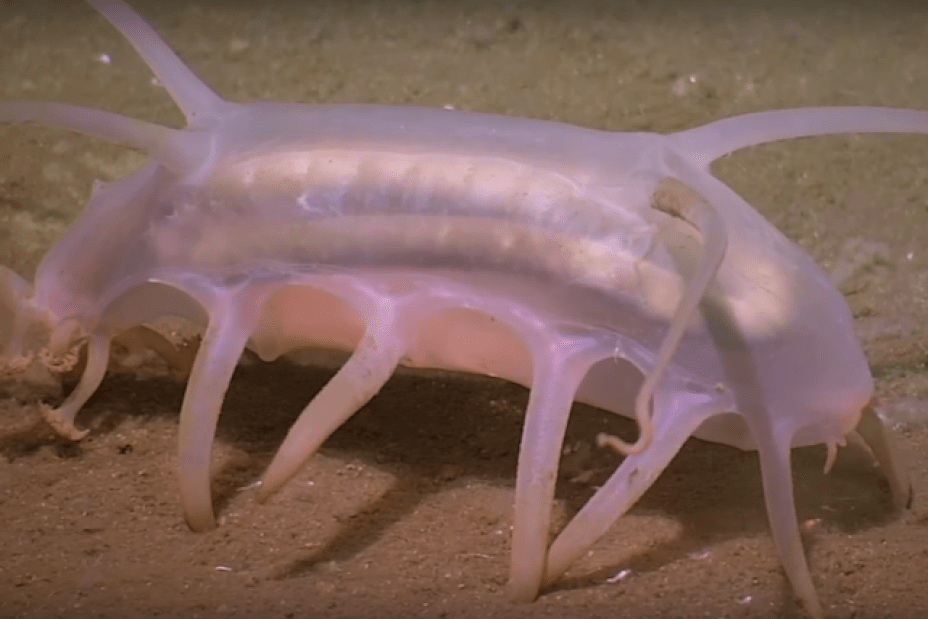
Sea pigs (aka sea cucumbers) are around 10–15 centimeters (4–6 in) long. They live in the deepest part of the Southern Ocean.

They serve an important purpose in the water. As with earthworms on land, sea pigs are needed to eat scum, mud, and decaying plant matter on the ocean floor. It is unknown how they mate, and their life span is also a mystery.

By the way, don’t be fooled by the fact that they are pigs in the sea. They taste nothing like bacon, but they are full of toxins.

Related Content
 

Fascinating Facts about Ferrets

Animals That Have Figured Out Their Own Life Hacks

Countries Where Your Pet Is Just Livestock


Fascinating Facts about Ferrets

0

Though domesticated for millennia, the quirky little ferret has only been popular as a pet for about 30 years. Although they resemble rodents, ferrets are actually members of the carnivorous mustelid family, alongside otters, weasels, minks, badgers, and wolverines. They are endlessly interesting creatures with a long history of hunting, manufacturing airplanes, and participating in one of the most bizarre blood sports in the world.

Ferret-Legging

Ferret-Legging

https://ohfact.com

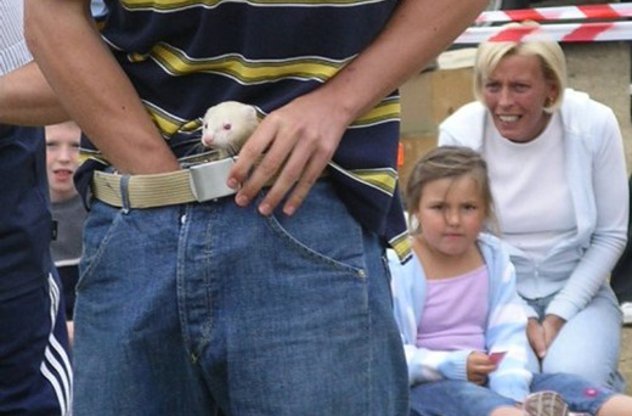
In various places throughout the world, an ancient, horrifying sport has made resurgence. Ferret-legging is an endurance event wherein participants drop two live ferrets into their pants, which are cinched off at the ankles and waist. The animal claw and bite fiercely in an attempt to get free. The winner is the man who can withstand this torment the longest.
Weasel War Dance 

Weasel War Dance

https://www.pinterest.co.uk

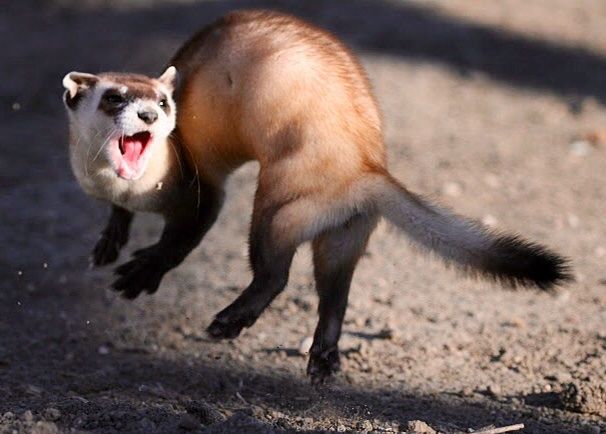
For those unfamiliar with ferrets, the so-called “weasel war dance” could be rather off-putting. With its back arched, the ferret will hop about in frenzy, its tail puffed out. It often makes strange hissing noises. This display might seem like the ultimate expression of ferocity, but it is really just an invitation to play, much like a dog will wiggle around when its leash or a favorite toy is produced.
Ferreting

Ferreting

https://www.youtube.com

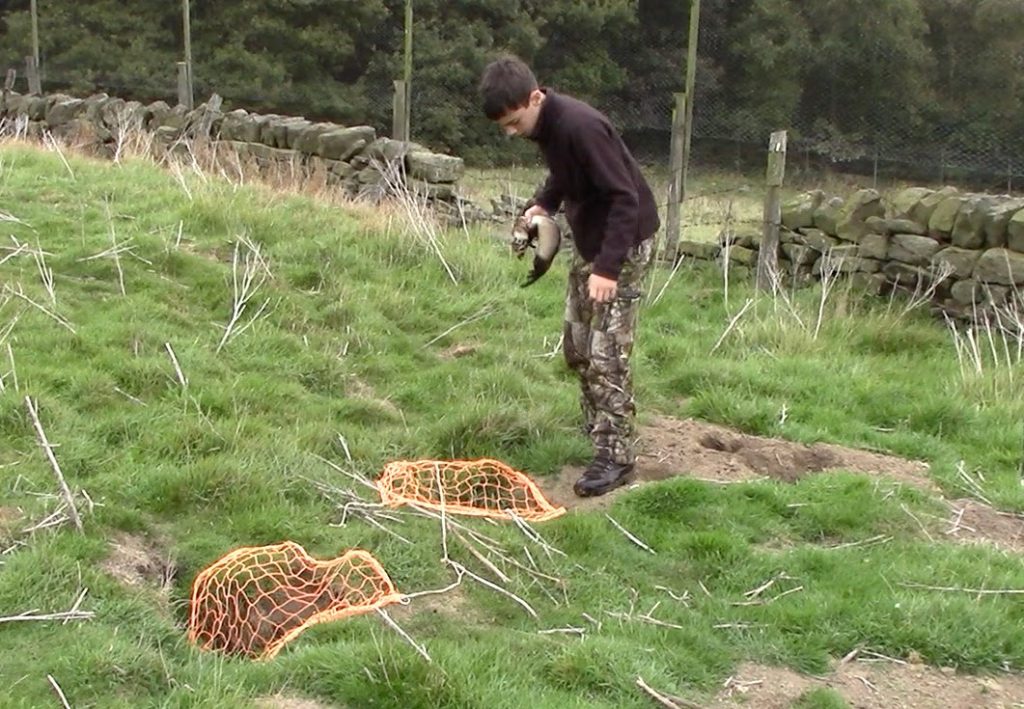
While they might be new to pet stores, ferrets have been domesticated for over 2000 years. A hunter would travel afield with his animals in a small cage or pouch, and upon sighting a rabbit warren, would let the ferret crawl inside. A few moments later, the rabbit would burst from another hole, the ferret in hot pursuit. From there, the hunter might shoot it or send fleet dogs like lurchers after it. For centuries, such practices were a vital lifeline for people trying to feed their families, but today it is largely done for sport or for controlling the rabbit population. The hunter will gut the rabbit and feed it to his ferrets, as they are a much better source of nutrition than commercially available foods.

As Pets 

pets

http://listverse.com

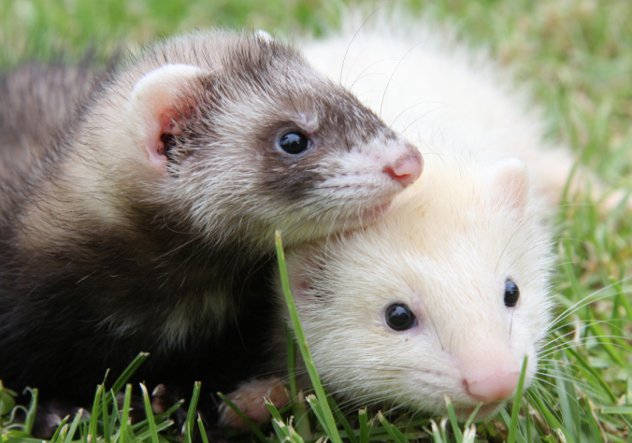
Despite their savage history, in general, ferrets make excellent pets. They are very intelligent, and can be trained to do all sorts of tricks. Like cats, they will use a litter box. They are happiest when there is at least one playmate in their cage. A group of ferrets is called a “business,” and they can be very entertaining to watch.

Running Wires

Running Wires

http://listverse.com

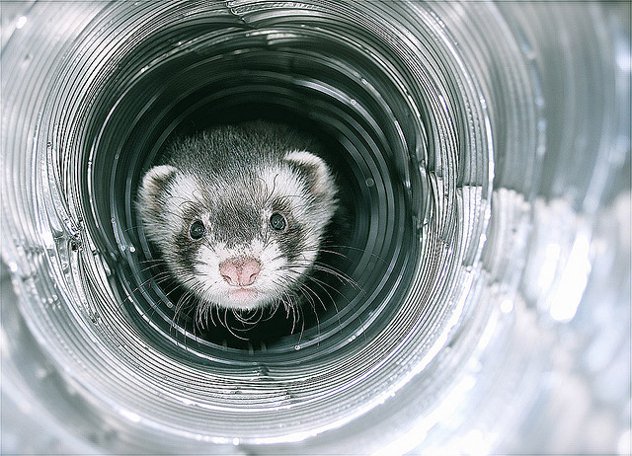
The majority of “working” ferrets are used to eradicate vermin, but they have other, less obvious purposes. Their ability to worm their way through confined spaces has led several institutions to use them for running wire. The photo above is of “Nibbler,” who helped with the wiring of the Large Hadron Collider.

Colors and Waardenburg Syndrome 

Waardenburg Syndrome Colors and Waardenburg Syndrome

https://www.weasyl.com

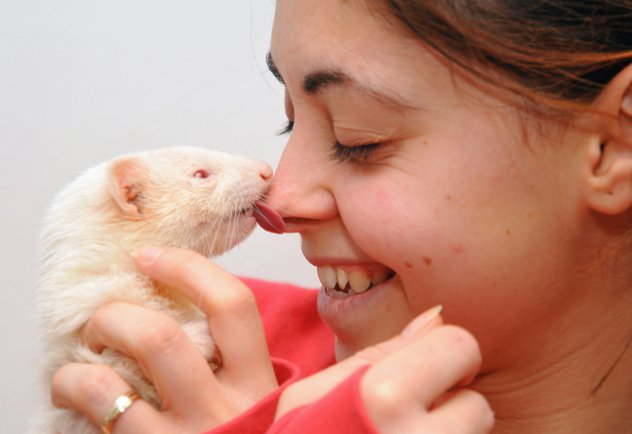
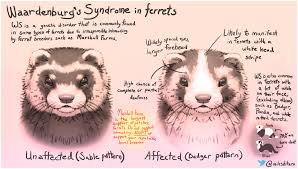
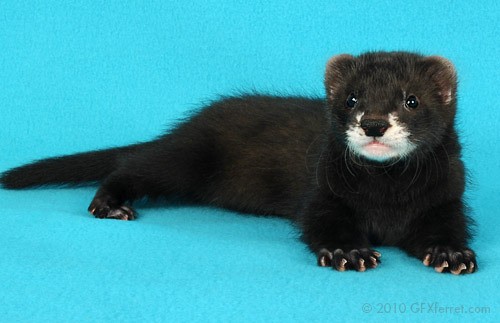
The vast majority of ferrets are either albino (white with pink eyes) or sable colored like their wild polecat ancestors. In recent years, ferret breeders have begun producing animals with designer color patterns, like “badger” and “panda”. Unfortunately, these patterns make the ferrets more susceptible to developing a congenital defect called Waardenburg syndrome, which causes the skull to broaden and causes deafness.

Ferret hybrid

Ferret hybrid

https://feralfront.com

As the gray wolf can interbreed with the domestic dog, ferrets and European polecats can readily produce offspring. There are some polecat-ferret hybrids living in the wild in the UK, and some hunters prefer to use them over pure ferrets, which have lost some of their predator edge through domestication.

Dead Sleep

Dead Sleep

https://ohfact.com

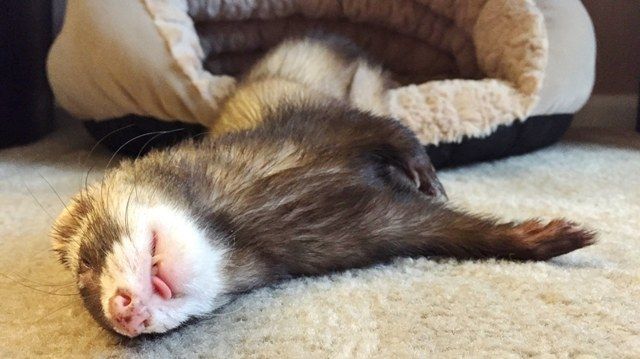
Ferrets love to sleep but did you know that ferrets can give an impression of being lifeless while sleeping. They cannot be wakened even when picked up or jolted and lasso they look kind of cute when doing this.

Related Content

Silly Halloween Costumes for Pets

Extraordinary Creatures of Antarctica

Incredible Cases of Animal Gigantism

Animals That Have Figured Out Their Own Life Hacks

0

Although we may not have flying cars or Mars colonies yet, we definitely have some wild technology to help us with everyday stuff. Like us, our animal buddies have figured out ways to make their lives just a little easier. From cleaning to sleeping, here are few animals who can do things just a little better than us.

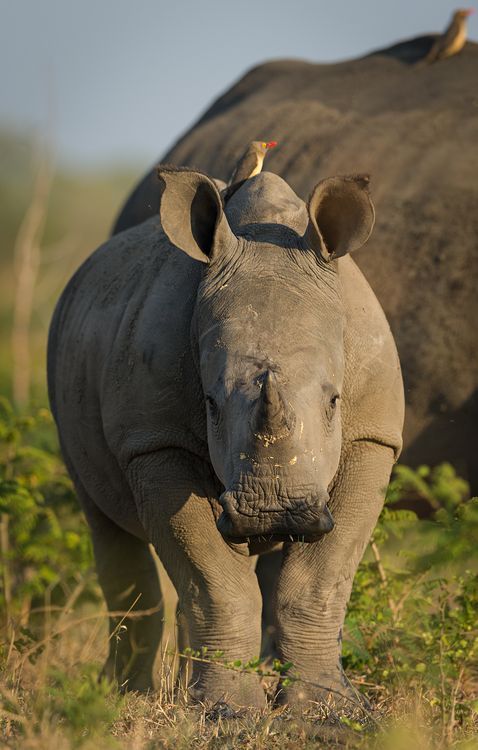
Rhinos cleaning hack 

Rhinos

https://www.pinterest.com

In the African savanna, rhinos become hosts for a lot of ticks, which cause problems with their sensitive skin. This is where the Oxpeckers come in. These birds will perch on the rhinos’ backs and eat all the ticks as part of the birds’ blood-based diet. Oxpeckers also act as useful safety tools or alarm systems. Rhinos are shortsighted and often cannot see when predators are drawing near. However, the birds have a good view from a rhino’s back and emit a distress call.

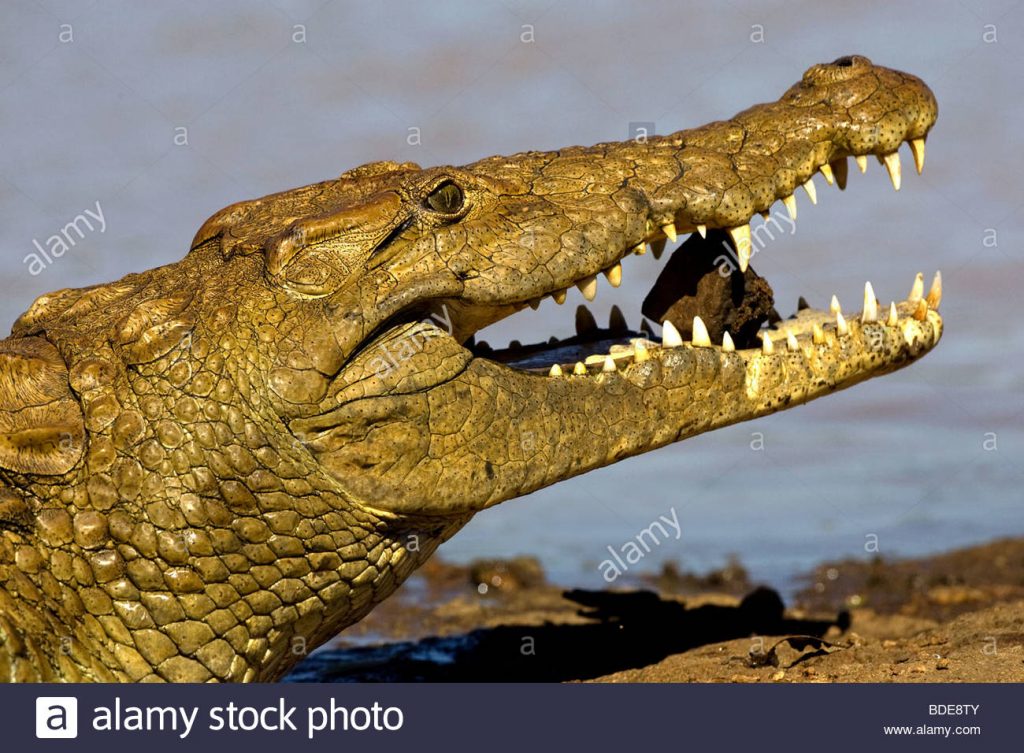
Crocodile diving hack 

Crocodile

http://animals.mom.me

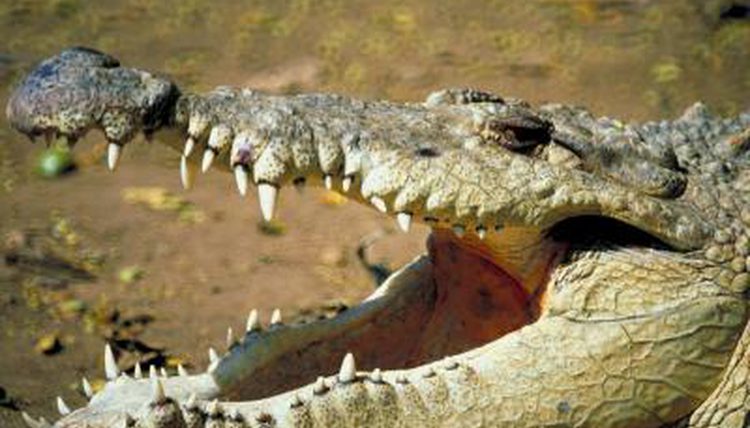
Humans rely on submarines or scuba gear to get us to the depths of the ocean, crocodiles have figured out a much simpler way to do it. When these bad boys need to get to the ocean floor to catch dinner, they simply eat a few stones. By swallowing big stones and rocks, they can increase their body weight and sink down to snag much bigger meals. This helps them with their deep-sea diving, their swimming abilities, and their digestion problems.

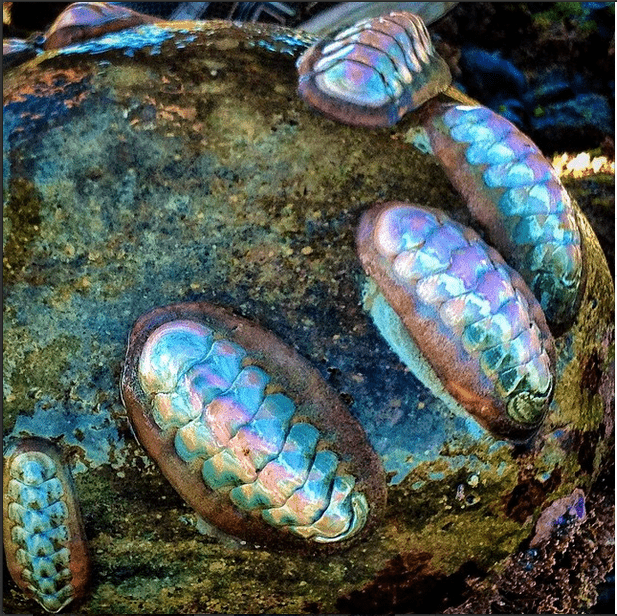
Chiton’s sharpest teeth 

Chiton Chiton teeth

https://www.newscientist.com

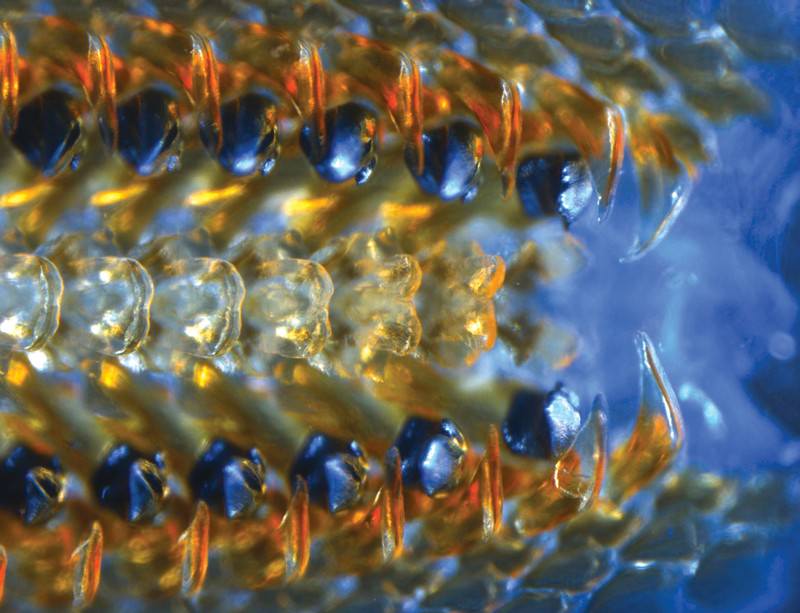
There is one animal in particular that beats our modern dental industry. The Chiton, a marine mollusk that lives in the Gulf of Mexico, has the ability to grow the hardest teeth in the world. These teeth are made out of magnetite, the hardest material produced by any organism. Scientists believe that humans will eventually be able to harness the power of the proteins that form the chitons’ teeth to “synthesize tough materials in labs.”

Stick Insect asexual reproduction 

Stick Insect

http://www.actwild.org.au

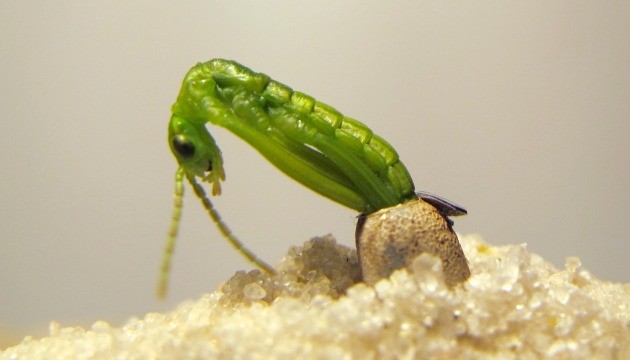
Female stick insects are able to give birth through parthenogenesis, a method of procreation that doesn’t involve a mate. It is sometimes referred to as a “virgin birth.” Some scientists have reproduced this phenomenon in their own labs in hopes of applying this knowledge to human reproduction.

Female stick insects are so opposed to getting in the sack that they have developed an anti-aphrodisiac chemical which they can spray at any randy male to diminish the temptation.

Salmon navigation skills 

Salmon

http://www.icr.org

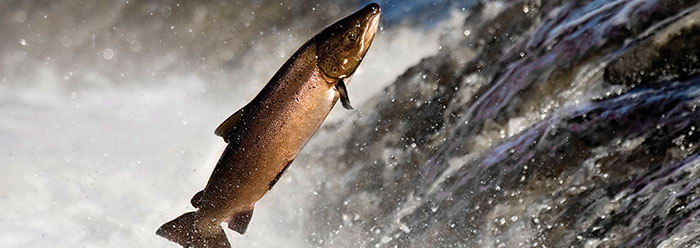
Salmon fish are born with the ability to sense variations in the Earth’s magnetic field. This skill allows them to navigate from fresh water to salt water so that they can eat and reproduce. Salmon are born in fresh water, travel to salt water, and then return to the stream where they were born to give birth. Other than their sense of magnetism, salmon use their sense of smell to navigate. The fish can recognize the smell of their birth stream, which helps them to find their way back home.

Plumed Basilisk lizard walking on water

Basilisk lizard lizard

https://www.youtube.com

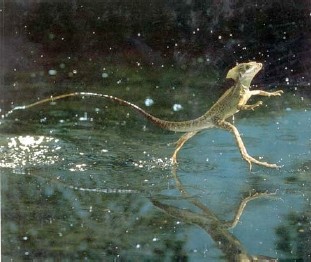
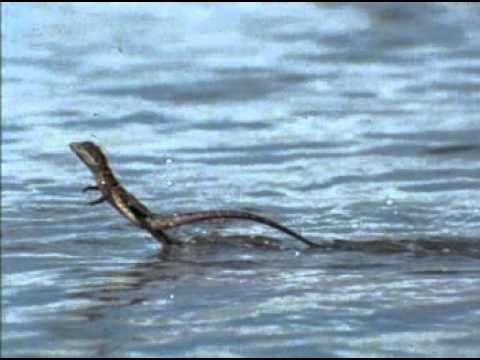
Plumed basilisk has mastered the art of “walk on water”. Nicknamed the Jesus Christ lizard, this critter can use its little toes to cross bodies of water. The toes on their rear feet have skin-like scales. These expand when hitting liquid to increase the surface area of each foot that contacts the water. By quickly moving their toes, the lizards can create air pockets on the surface of the water that keep them from sinking.

Dolphin sleeping with one eye open

Dolphin

https://perryponders.com

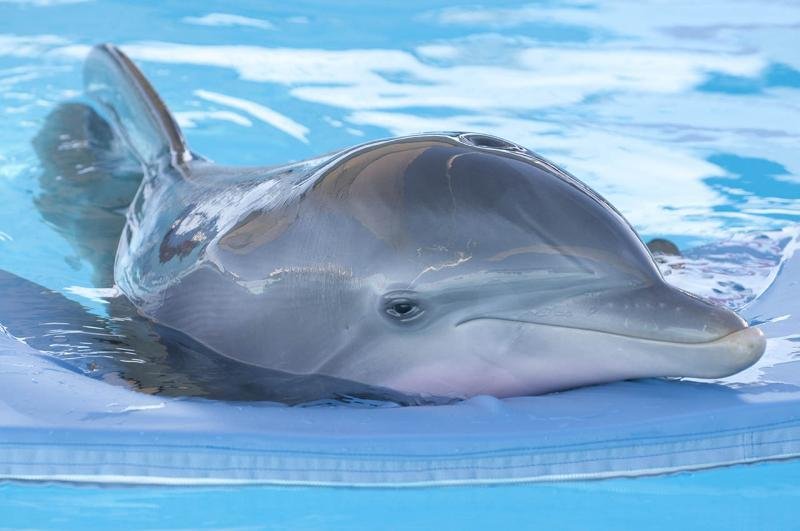
These marine mammals can stay awake for 15 days at a time by sleeping with half of their brain.

Known as unihemispheric sleep, this phenomenon allows the dolphins to rest while staying alert to the never-ending risk of shark attacks. This trick also keeps dolphins from drowning. A full brain sleep in the ocean would put them in danger of dying because their breathing is a conscious function.

By keeping half of its brain asleep, a dolphin can rest but still go to the surface for air when needed.

Related Content


https://luveurpet.com/practical-pet-products/

Bizarre Animal Symbiotic Relationships

Incredible Cases of Animal Gigantism

0

The phenomenon known as “animal gigantism” or “island gigantism” presents us with a clear and astonishing picture of evolution at work. And when they’re cut off from the rest of the population, say on a small island, animals can adapt over millions of years in some peculiar ways.

Flores Giant Rat:-

http://animaladay.blogspot.com

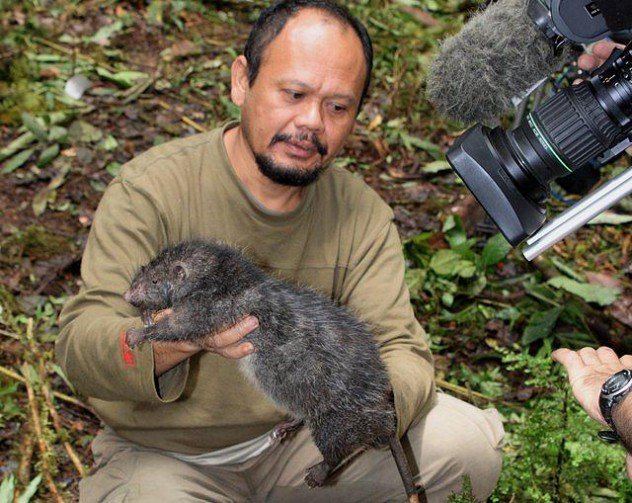
Flores, Indonesia, is home to the Flores Giant Rat. This isn’t the kind of rodent to be restrained by mouse traps as its body can reach 45 centimeters (18 in) in length, and that’s before you add its 75-centimeter (30 in) tail. Then the rat can exceed 1.2 meters (4 ft).Flores giant rats are believed to be vegetarians.

Chappell Island Tiger Snake:-

https://www.theadvocate.com.au

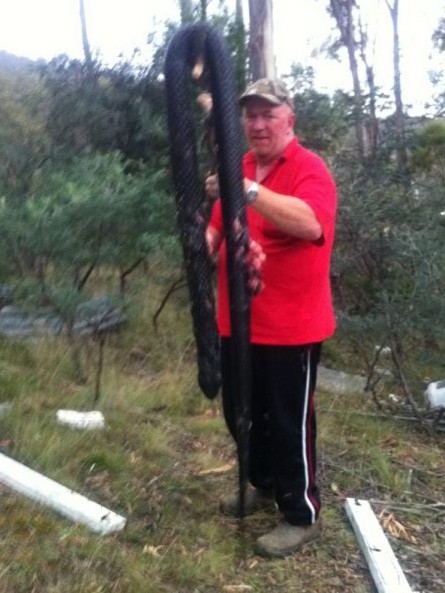
At 2.4 meters (8 ft) in length, the Chappell Island tiger snake is the largest of all tiger snakes. It has shared Mount Chappell Island, Australia, with a large number of local mutton birds and absolutely no serious predators. Like many Australian snakes, the Chappell Island tiger snake is highly venomous, and its bite can be lethal to any human foolish enough to interfere in the mutton bird business.

Madagascar Giant Pill-Millipede:-

https://blogs.scientificamerican.com

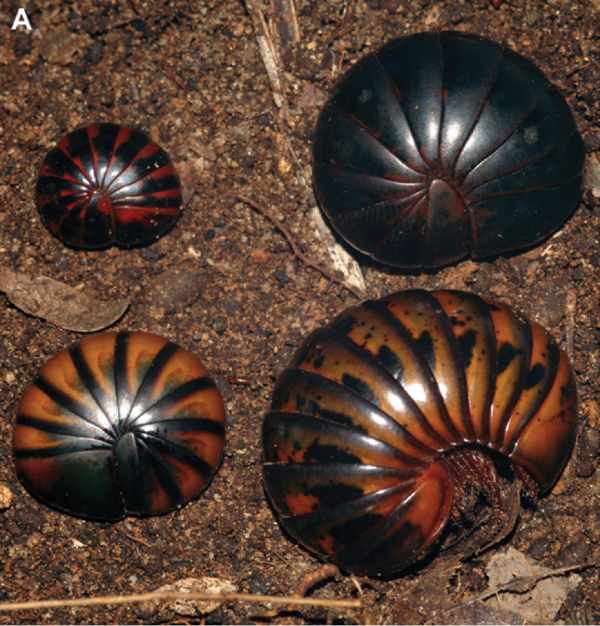
The giant pill-millipede of Madagascar is known by scientists as Sphaerotheriida, but locals have dubbed it more accurately as “star poo.” Though they look like normal millipedes in their relaxed state, they have the ability to roll themselves into an armored ball at the first sign of danger. Once they retreat into their armored plates, almost nothing can force them to unroll against their will. The largest pill-millipedes can reach the size of a baseball.

Galapagos Islands Giant Tortoise:-

https://www.santacruzgalapagoscruise.com

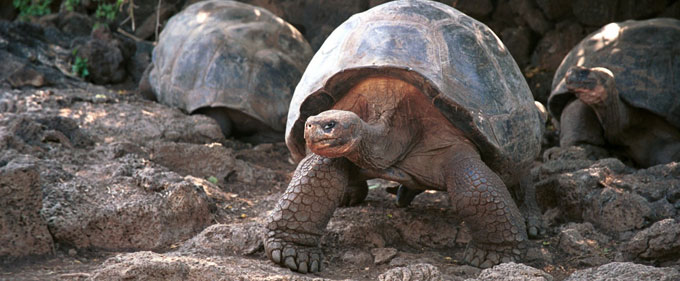
The giant tortoises of the Galapagos Islands off the coast of Ecuador have the potential to outlive any other vertebrate. They can routinely live for over 100 years, and one of them held on until the ripe age of 152. They’re also true giants of the tortoise world: Some subspecies can reach 250 kilograms (550 lbs) and over 1.5 meters (5 ft) in length. At the time of Charles Darwin’s famous visit, there were 14 different subspecies of giant tortoise in the Galapagos Islands.

Giant Fijian Long-Horned Beetle:-

https://naturefiji.org

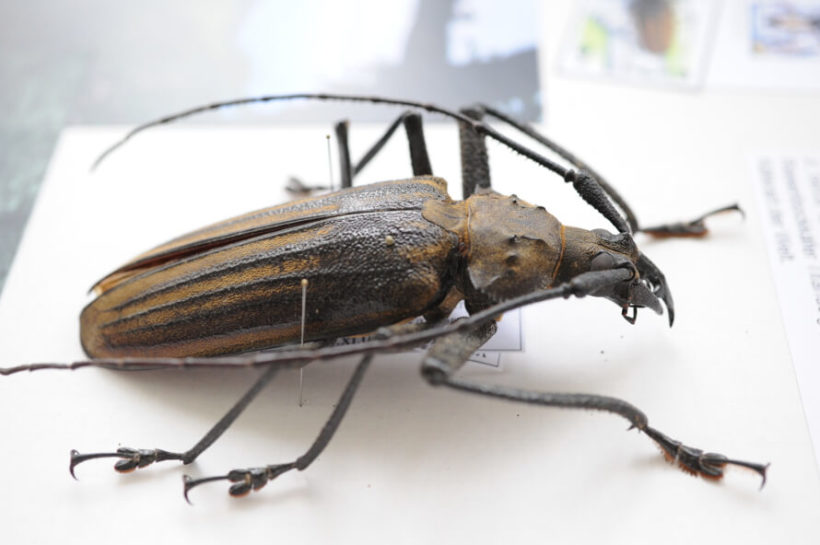
The giant Fijian long-horned beetle is the second-largest beetle in the world, reaching an extraordinary body length (by beetle standards) of 15 centimeters (7 in). The beetle lives a simple life in the trees of Fiji on a diet of plant matter. Its horns are often nearly as long as its gigantic body. Its larvae are sought out as a rare delicacy by Fijian villagers. Several tribes consider them to be sacred, and only the village high chief is permitted to eat them.

Elephant Bird:-

http://listverse.com

Elephant birds of Madagascar were around 3 meters (10 ft) tall and could weigh 400 kilograms (900 lbs). The species died off in the late 17th century. Elephant birds were probably the largest birds ever to have lived. Even their eggs were a full meter (3 ft) in circumference, and their fearsome appearance gave rise to the legendary “Roc” of Arabian folk tales.

Related Content

Oldest Animals That are still Alive

Examples of Gift Giving In the Animal Kingdom